
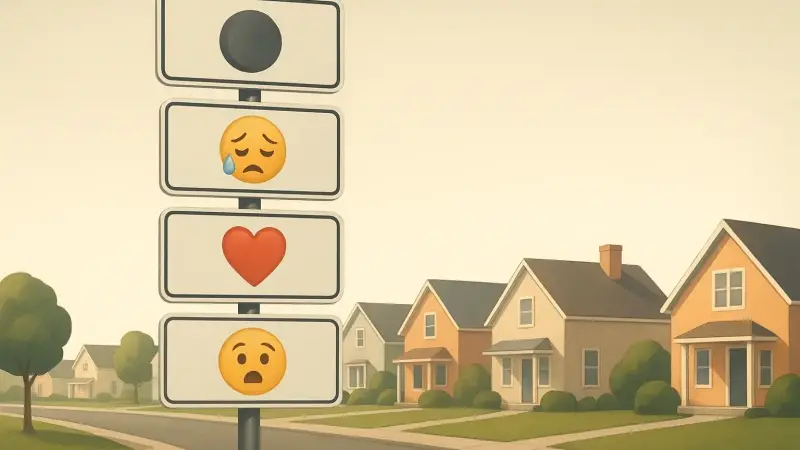
How a month of emoji streets usually starts
It’s an odd feeling to watch a delivery driver slow down because the map says “🍕➡️🏠” instead of “Maple Street.” There isn’t one single, famous neighborhood that did this everywhere; the idea has popped up in different places as short civic experiments, campus pranks, or festival tie-ins. People often compare it to the way some cities have done temporary renames for events, like “Prince Street” becoming “Ziggy Stardust Street” for a Bowie celebration, except emoji swaps are designed to be read instantly. The mechanism is simple: for a set period, residents and local groups put up temporary signs and use the emoji versions on flyers, social posts, and sometimes shared map pins.
The trick is that the streets don’t legally change. Mail still goes to the real address, and emergency services still dispatch on the real name. The emoji layer sits on top of daily life, and that gap is the whole point: it makes everyone notice how much navigation depends on shared conventions.
What has to change for it to feel “real”
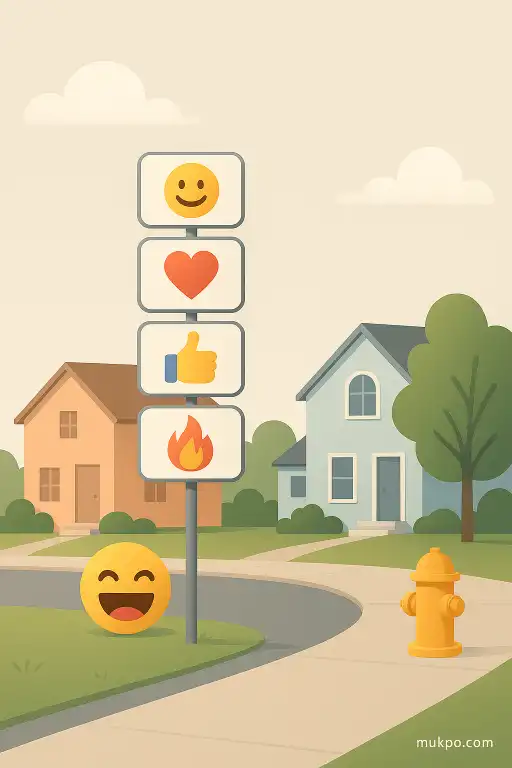
Temporary signs are the visible part, but the more important change is social. Neighbors have to agree on a stable emoji for each street, and they have to keep using it long enough that it stops feeling like a joke. When it works, you’ll see it on hand-written party invites, neighborhood newsletters, and porch pickup notes. People start giving directions like, “Turn left at the 🌳 sign,” even though the old sign is still right under it.
One detail people overlook is how hard it is to make an emoji unambiguous at street-sign distance. A “🌲” and a “🌳” look similar from across an intersection. Skin-tone modifiers, flags, and some newer symbols also render differently by platform, which matters if the neighborhood relies on digital maps, group chats, or QR codes. The physical design ends up more constrained than the emoji keyboard suggests.
Why people can still find anything
Most navigation isn’t pure reading. It’s pattern recognition mixed with habit. So even with emoji overlays, people still use corner landmarks, house numbers, and cross streets. House numbers quietly carry the whole experiment. They’re standardized, they’re already tied to dispatch systems, and they don’t care what the street “feels” like this month. If you watch someone hunt for an address during an emoji month, they glance at the emoji sign, then immediately drop their eyes to the numbers on doors and curbs.
Digital mapping usually becomes a parallel system. Unless a platform explicitly supports an alternate label, the emoji names live in screenshots, pinned notes, and shared lists. Some neighborhoods lean into that by printing a simple “legend” poster or leaving a taped sheet at a café: real name, emoji name, and the cross streets. It’s the closest thing to an official register, and it’s often maintained by one or two very committed people.
What breaks first: deliveries, accessibility, and outsiders
The first friction tends to show up with anyone who didn’t opt in. Delivery drivers, visiting nurses, contractors, rideshare pickups. They arrive with a route optimized for legal street names and numeric addresses. If the neighborhood has been using emoji casually in messages—“Leave it at 🐝 Street”—outsiders have to translate on the fly. That translation is easier if every emoji sign also keeps the original name fully visible. When the original name gets covered, even temporarily, confusion spikes fast.
Accessibility details matter more than people expect. A sign that looks cute can be unreadable for someone with low vision, or confusing for someone using a screen reader if the emoji name is shared digitally without context. “🍆” is a vegetable on the sign, but it’s not read neutrally by everyone, and some symbols carry meanings that vary by age, language, or internet culture. The neighborhoods that pull this off tend to pick boring, literal icons and avoid anything that depends on a wink.
How the month ends, and what tends to linger
Because the legal layer never changed, the ending is mostly about removing the extra signage and letting routines snap back. But small residues hang around. People keep a few inside jokes. A group chat might stay named after a particular street’s emoji. A local business might keep the temporary icon in a window decal because customers recognized it. Sometimes the emoji names even become a shorthand for blocks or micro-areas: not an address, just a way of saying “that stretch over there.”
The most interesting part is how quickly people discover the hidden infrastructure of naming. Street names aren’t just labels. They’re database keys shared by postal systems, property records, school bus routes, and emergency dispatch. For a month, the neighborhood gets to play with the top layer, and everyone gets a glimpse of the layers underneath when they try to tell someone where they are.
Related reads
- Why familiar places trigger sudden vivid memories
- How hammerhead sharks detect electric fields
- How three lighthouse keepers vanished from a Scottish isle in 1900
- The 17th-century Ottoman court that negotiated with a nonexistent envoy
- An apartment block where every mirror vanished overnight
- The bat tongue that scoops nectar with brushlike hairs