
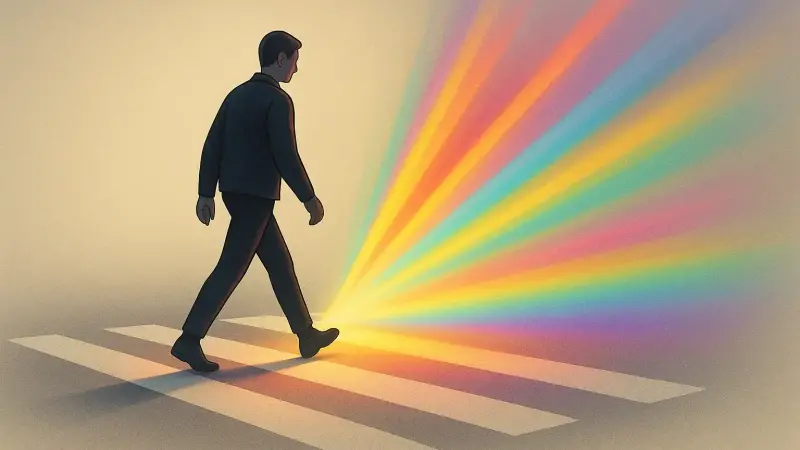
You’re walking home late and a perfectly normal zebra crossing suddenly starts pulsing with color, like someone hid a dance floor under the asphalt. This isn’t one single famous crossing, and the details vary by city. But the basic trick is consistent. After midnight, the crossing flips into a different mode: LEDs embedded in the pavement or in the beacon housing run a programmed light pattern. Sometimes it’s tied to a timer. Sometimes it’s triggered by low traffic conditions. You can see versions of this idea in places like London’s signal-heavy crossings, Tokyo’s highly standardized pedestrian signals, and U.S. cities that use LED-enhanced crosswalks for visibility. The “disco” part is usually a side effect of how the lights are controlled.
What people usually see
The shift tends to happen when the street gets quiet. The white crossing stripes look like they’re moving. Or colored dots ripple across the road surface. Sometimes the light spills onto nearby walls, which makes it feel even more dramatic than it is. If the system includes a push-button unit, the button light and the crossing lights can end up out of sync, which adds to the “why is this partying?” feeling.
A small overlooked detail is angle. LEDs in pavement studs and LED strips in bollards are intensely directional. If you’re approaching from one side, it can look like a full strobe show. From the other side, it can look almost normal. That’s why two people can describe the same crossing very differently.
The hardware that makes it possible
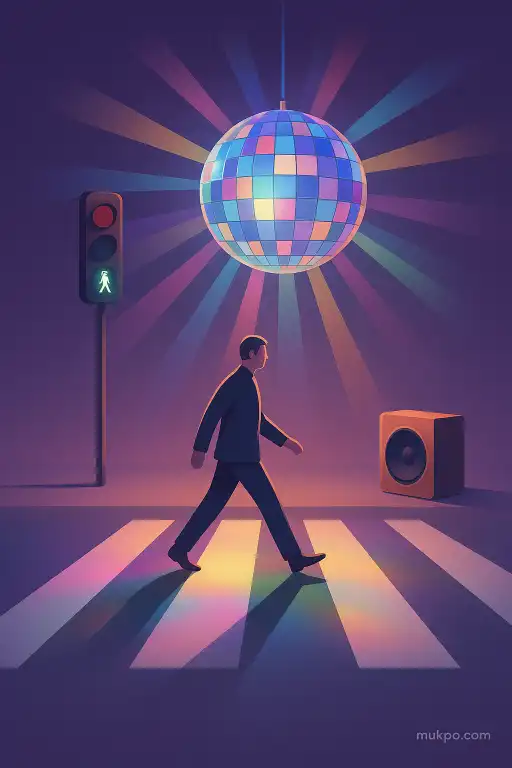
There are two common setups. One is “active road studs”: recessed LED markers embedded along the crossing edges or in the centerline. The other is “illuminated signage” where the poles, beacons, or belisha-style globes do the attention-grabbing, and the road markings just reflect. The disco effect is more likely when the light source is in the ground, because the pavement becomes the light fixture.
These systems typically use low-voltage power and a controller cabinet nearby, sometimes the same cabinet that handles signal timing. The LEDs are durable, but they aren’t magic. They’re segmented into channels. When the controller decides to animate, it’s often just turning those channels on and off in sequence, quickly enough that your eyes read it as motion.
Why it switches after midnight
At night, the goals change. Traffic volumes drop. Glare becomes a bigger problem. Nearby residents also notice noise and brightness more. So systems get put into an “overnight plan” that can shorten wait times, change how long the pedestrian phase lasts, or reduce the intensity of signals. If the crossing has extra LED lighting, that same overnight plan can also swap to a different pattern.
Sometimes the pattern is intentional. A pulsing or chasing light can catch a driver’s eye faster than a steady glow, especially on a wet road where reflections smear everything. Other times it’s a compromise: engineers want higher conspicuity without blasting full brightness nonstop, so they use brief pulses. After midnight, when the background is darker, those pulses look wilder than they do at dusk.
When it’s not meant to look like a disco
There are a few ways a normal safety pattern turns into something that feels improvised. One is a mismatched clock in the controller. If the cabinet’s time drifts, “midnight mode” can start early, late, or on the wrong day. Another is a sensor input that’s noisier at night. Inductive loops in the road, radar units, and camera-based detectors can all behave differently in rain, fog, or when insects gather around warm lamps.
Another overlooked detail is maintenance settings. Many LED crossing systems have diagnostic modes that cycle colors or sequences to help technicians confirm each segment works. If a system reboots after a power flicker, it can briefly run a test sequence before settling. To someone arriving at exactly that moment, it looks like the crossing “decided” to perform.
What sets the exact look: programming, power, and surroundings
The exact pattern depends on how the controller is written and what the supplier shipped. Some use simple PWM dimming, which can create visible flicker on phone cameras and a smoother look to the naked eye. Others switch whole segments on and off, which reads as crisp chasing lights. If the LEDs are RGB-capable, even if they’re usually set to white, a controller fault can land them in a default color cycle that feels very “club,” very fast.
Surroundings matter more than people think. Fresh asphalt absorbs light, so the LEDs look like sharp points. Old aggregate reflects it, so the whole crossing seems to glow. Wet conditions exaggerate everything by turning the road into a mirror. That’s when an ordinary safety pulse suddenly becomes a show, and it’s hard to tell if the system is being playful or just doing its job under different conditions.
Related reads
- When kings shaved silver from coins and markets exploded: medieval coin debasement
- How splitting attention makes ordinary tasks feel strangely harder
- How Victorian salons turned arsenic into beauty and scandal
- The museum plaque that rewrote itself every morning
- How a nine-day queen became a pawn in the Tudor succession crisis
- When a streetlight began syncing its blink to residents footsteps