
Seeing it for the first time
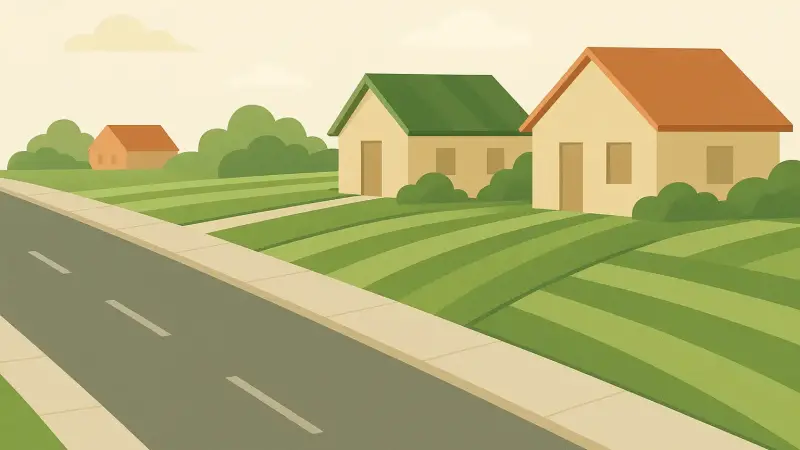
You walk past the same front lawns every day, so you notice when something is off. The stripes are still there, but they’ve shifted. A dark band that used to run near the sidewalk now sits closer to the porch. It can feel like the whole street coordinated overnight. This isn’t one famous “striped-lawn street.” It’s a repeatable effect that shows up wherever people mow in patterns—suburbs in the U.S. and Canada, estates in the U.K., and tidy neighborhoods in Australia. The basic mechanism is simple: grass blades get bent in different directions, and the light changes how those bent blades look. The surprise comes from how easily that look can change without anyone cutting more grass.
Why stripes exist even when nothing is dyed

Striping is mostly optics. When a mower has a roller or even just a heavy deck, it pushes grass blades to lean. Blades leaning toward you reflect more light, so they look lighter. Blades leaning away reflect less, so they look darker. The lawn can be the same height and the same color of plant tissue across the whole yard, but it won’t look that way from the sidewalk.
There’s a detail people often overlook: the “stripe” isn’t a line on the ground. It’s a field of tiny tilted surfaces. That means the pattern depends on viewpoint. Walk to the other side of the street and some stripes appear to swap light and dark without any change to the grass itself.
How the pattern can seem to rearrange overnight
The fast changes usually come from weather and plant recovery, not secret mowing. Overnight dew adds weight and surface tension, which can keep blades stuck in a leaned position longer than they would in dry afternoon air. A light rain can do the same thing, especially if it’s followed by a calm night. Then the next morning, the sun is lower in the sky, and the angle of light exaggerates any leaning that’s still there. The stripes can look sharper, wider, or shifted.
Wind is another quiet culprit. A steady breeze can push whole sections of taller grass to lay in one direction, especially along edges near the street where air moves freely. If the wind direction changes overnight, the “dark” side of a stripe can appear to move. It’s not moving like paint. It’s a new lean layered on top of an older one, and your eyes read it as a reorganized pattern.
Why a whole street can look synchronized
Neighborhoods often share the same mowing rhythm. People mow on weekends, or after the same stretch of rain, because the grass grows faster at the same time for everyone. They also tend to follow the same geometry. Most lawns are rectangles facing the street, so the easiest mowing passes are parallel to the road. That means a lot of lawns end up with stripes running in the same direction, even if nobody planned it.
There’s also the street-view effect. From the sidewalk, you’re looking at a row of lawns from roughly the same angle, with the sun hitting them similarly. If the morning light is coming from one side of the street, it can make one row of stripes pop while the opposite side looks flatter. Later in the day, that can flip, and it reads like the whole block “changed.”
The small things that make stripes drift
Grass doesn’t spring back at the same rate everywhere. A shaded strip near a maple tree can stay damp longer and hold its lean. A sunny patch over a buried rock or a shallow section of soil can dry out faster and stand up sooner. Those differences can create the illusion that the stripe borders slid sideways, when really the grass in one band recovered faster than the band next to it.
Mower overlap matters too, and it’s easy to miss. A person might overlap passes more near obstacles, or turn slightly as they approach a driveway. That leaves subtle “ghost” stripes that are invisible at noon. Then a cool, dewy morning makes them show up as if they appeared overnight, especially along the curb line where you’re most likely to notice the change.

Related reads
- How seawater ice traps air bubbles that record ancient storms
- A vending machine that always ejects a single antique spoon
- How your nose adapts so you can’t smell your own perfume
- The apartment where each mirror shows a different hallway
- Why you walk into a room and forget your purpose
- The elevator rule: why tiny strangers’ talk feels so awkward