
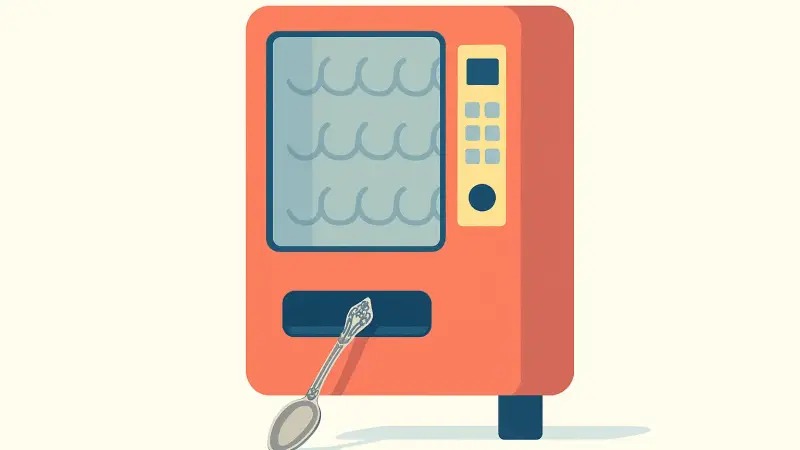
What people mean by “the spoon machine”
A vending machine is supposed to give you a choice. This one doesn’t. People describe a machine that takes money, whirs like it’s deciding, and then drops exactly one antique spoon. There isn’t one confirmed location for it. The story shows up as a roaming rumor, told about different places and different decades. You’ll hear versions set in a hospital hallway, a university basement, or a bus terminal. The mechanism is the same each time: any payment, any button, one spoon. The details that would anchor it—serial number, operator, service logs—are usually missing or unclear.
What tends to happen when someone tries it

The scene is always ordinary at first. Someone uses the machine as a joke or a dare. The payment varies by telling: a coin, a bill, sometimes “it takes anything.” The machine makes a normal vending sound, the spiral turns, and the drop is small and metallic. The spoon lands in the retrieval bin. It is rarely polished. More often it looks like it has lived a life—tiny scratches, a dulled bowl, a slightly bent neck.
One concrete detail people overlook is the bin itself. A lot of vending bins have a rubber flap and a shallow lip that catches objects so they don’t bounce back inside. A spoon is the kind of object that can slip past a weak flap or wedge at an angle. That matters because many “it only gives one item” stories depend on what can physically survive the fall and still be reachable. A candy bar tears. A spoon doesn’t.
Why an antique spoon, specifically
“Antique” is doing a lot of work here. People often mean “not modern stainless.” The spoons in these stories are described as tarnished silverplate, hotelware, souvenir teaspoons, or patterns that don’t match anything in the room. That’s a broad category. It can be old without being valuable. It can be mass-produced and still look out of time next to a glowing keypad and a card reader.
A spoon is also a safe object for a storyteller. It feels personal but not alarming. It doesn’t raise immediate legal or safety questions the way a pocketknife or medication would. It’s also easy to imagine coming from somewhere else: an estate sale box, a restaurant liquidation, a lost-and-found drawer. The word “antique” adds a charge without forcing anyone to prove an age, a hallmark, or a maker’s stamp.
How a normal machine could produce a single repeated outcome
Vending machines are less flexible than they look. Many are set up so every selection triggers the same motor in “free vend” mode during testing. If a machine is miswired, badly configured, or stuck in service settings, the keypad becomes theater. Pressing A1 or C7 can run the same spiral. If that spiral happens to hold one kind of object, you get the same result every time, even though it feels like you made a choice.
It’s also common for older machines to be repurposed. Operators use them as donation boxes, prop machines, art pieces, or cheap dispensers for odd items. A spoon fits into a spiral track surprisingly well if it’s packaged, banded, or stacked bowl-to-handle. If the machine’s drop sensor only checks that something fell—not what it was—then a spoon can satisfy the system. That single sensor, usually hidden behind the delivery chute, is a piece most people never think about while they’re watching the front glass.
Why the story persists even when the machine can’t be pinned down
The spoon version survives because it’s easy to retell with new scenery. Put it in a place where people are waiting and bored, and it makes sense that someone would try it. Put it somewhere with staff turnover, and it makes sense that nobody knows who owns it. The rumor doesn’t need a villain or a grand plot. It only needs one person to have held a spoon that “shouldn’t” have been there.
There’s also a social rhythm to it. Someone goes to the machine with a friend. They pay. They get the same strange object. The friend tries again, because repetition feels like proof. The moment turns into a little shared fact, even if nobody checked the inside of the cabinet or the configuration panel. After that, the spoon becomes less like an object and more like a ticket stub from a story people like to own.

Related reads
- How your nose adapts so you can’t smell your own perfume
- The apartment where each mirror shows a different hallway
- Why you walk into a room and forget your purpose
- The elevator rule: why tiny strangers’ talk feels so awkward
- When it literally rained frogs and fish
- The town where the postman still delivers every letter by canoe