
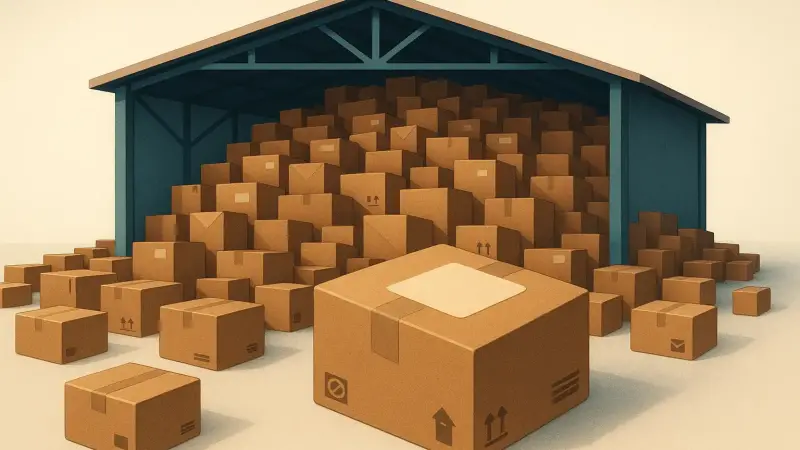
Most people assume a returned package simply goes back where it came from. But a huge share of returns never have a clean path “home.” It isn’t one single warehouse or one famous incident. It’s a pattern that shows up in lots of places where e-commerce is dense, like the United States, the UK, and Germany. The core mechanism is boring and brutal: a label gets damaged, a seller account disappears, the merchant address is a third-party logistics hub, or the “sender” was never a real sender in the first place. When nobody can be billed or contacted, the box becomes an orphan, and orphans accumulate fast.
How a package becomes “undeliverable” on the way back
Returns travel through a different maze than outbound shipping. A carrier can deliver a package with only a good destination label. A return needs a working return address, a valid account to charge, and instructions for what to do when something goes wrong. If the label is torn, the barcode won’t scan. If the return address points to a forwarding service, it might reject inbound parcels. If the seller used a prepaid label tied to an account that’s been closed, the carrier may have no one to ask.
A common overlooked detail is that “return address” and “original sender” are often not the same party. Many parcels show a warehouse, a freight consolidator, or a returns processor as the return location. When that middleman can’t match the box to a purchase record—because the order number is missing, the QR code won’t scan, or the retailer’s system no longer has the transaction—the parcel stops being a customer service issue and becomes a storage problem.
Where these boxes end up

Carriers and big retailers run “overgoods” or “undeliverable” streams. USPS uses the term Mail Recovery Center for certain categories of dead-end mail, and private carriers have their own versions. Retailers and returns processors also operate facilities that look like normal warehouses from the outside, except the inventory isn’t sellable stock. It’s a pile of items that arrived without the minimum information needed to route them back into the normal system.
What happens next depends on the contract. Some agreements require the carrier to attempt address correction or contact the shipper. Others allow rapid disposal when storage costs exceed the item’s value. And some returns processors are only paid for “matched” returns, so unmatched parcels get triaged into a separate corner that grows steadily during peak seasons.
Why nobody can claim them
“No sender” can mean a few different failures. The simplest is missing data: no invoice inside, no readable label, and no scannable code. Another is a dead merchant: the seller was a marketplace storefront that vanished, went bankrupt, or was removed. There are also gray-zone operations where the return address is a rented mailbox or a forwarding company that refuses unidentified freight. Even when a name exists, it may not be a legal entity a warehouse can invoice for handling and storage.
Fraud adds a separate stream. Some return scams involve sending back the wrong item, sending an empty box, or using a return label from a different order. When a facility can’t reconcile the contents with the expected return, it may be set aside for investigation. That “set aside” pile can quietly become permanent if the original transaction can’t be found or if the dispute window closes before anyone resolves it.
What the warehouse actually does with them
The first pass is usually identification. Workers look for any internal clue: a packing slip, a manufacturer serial number, a return merchandise authorization, even a sticker from a previous carrier sort. If they can match it to an order, it rejoins the normal returns flow. If they can’t, it gets categorized by risk and value. Lithium batteries, perishables, and chemicals can’t just sit. Items with personal data—phones, laptops, hard drives—often get isolated because wiping and chain-of-custody rules differ by company and jurisdiction.
After that comes disposition, and it varies. Some parcels are destroyed because the cost of safe handling exceeds any resale value. Some are liquidated in bulk to jobbers who buy pallets “as-is,” especially for low-margin goods like apparel and small electronics. Some are donated where policy and local law allow it. The part people miss is that even deciding takes labor, space, and paperwork. Storage isn’t free, and “figure it out later” becomes a decision when the building fills.
Why the pile keeps growing
Return volume spikes faster than the systems designed to reconcile it. E-commerce returns can be seasonal, but the infrastructure is year-round: barcode standards, label durability, data sharing between marketplaces and carriers, and customer support teams that can still access old orders. When any one of those breaks, the parcel becomes a manual problem, and manual problems don’t scale well.
There’s also a timing mismatch. A shopper expects a refund quickly, so companies optimize for processing the “clean” returns first. The messy ones—missing labels, mismatched contents, no seller response—linger. Over months, those leftovers form the warehouse-within-a-warehouse: shelves of sealed boxes that are perfectly deliverable to someone, in theory, except the chain that could name that someone has already snapped.

Related reads
- The pattern-hunting glitch that convinces us there’s meaning where there isn’t
- The necklace scandal that entangled Marie Antoinette and unraveled royal credibility in pre-Revolution Paris
- A mural that reveals hidden directions whenever it rains
- Why people cling to ‘lucky’ routines long after they stop working
- How forcing a smile can shift your mood in minutes
- The tiny mental skip that makes a face feel strangely familiar