
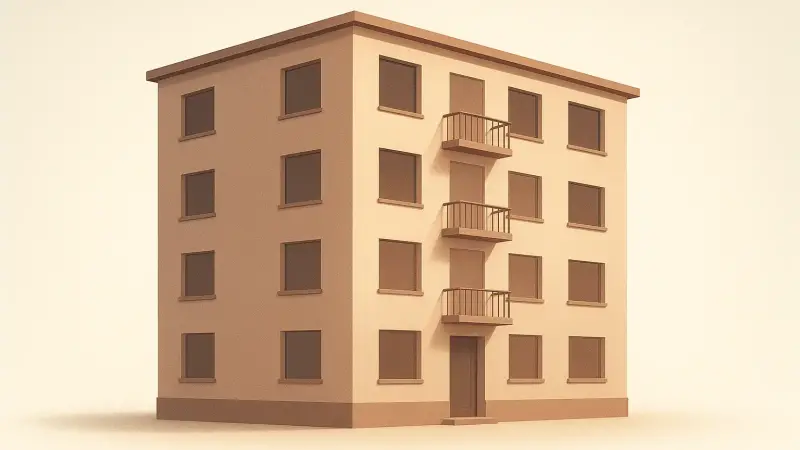
You don’t notice how many mirrors you live with until there aren’t any. Not “broken” and not “covered,” but gone. The story isn’t tied to one confirmed building or one verified year. It’s a type of apartment rumor that shows up in different places, from London council estates to New York walk-ups to big postwar blocks across Eastern Europe. The mechanism is always the same: a building wakes up to empty walls where bathroom mirrors and wardrobe doors used to be, and nobody agrees on how it could happen quietly. The odd part is that people often remember the same overlooked detail: the little metal clips and wall anchors are still there.
What people mean when they say the mirrors “vanished”
In most versions, it isn’t every reflective surface. Windows still reflect at night. Phones still work. It’s the household mirrors that are missing, especially the ones you can’t just slip under a coat: bathroom panels, mirrored sliding closet doors, full-length mirrors screwed into studs. That matters, because it narrows the possibilities. A roommate prank doesn’t scale. A quick smash-and-grab doesn’t fit the lack of noise, and it usually leaves shards, dust, or blood.
The reports also tend to include a specific kind of precision. Mirrors come off with the backing intact, no chips on corners, no torn drywall paper. People often say the frames are left behind, or the adhesive looks “cleaned” rather than ripped. It’s a small detail, but it changes the timeline. A careful removal takes time, and time usually creates witnesses.
How a whole building can lose them without a dramatic break-in

Apartment buildings are full of shared access points that don’t feel like access points. Service doors that should latch but don’t. Basement corridors that connect two stairwells. Tradespeople who look “right” to everyone because they’re carrying tools. If mirrors disappear across multiple units, the method that fits best is simple entry plus routine-looking movement: someone who can be in the hall for hours without being challenged.
Locks don’t have to be defeated the movie way. Older interior doors are easy to slip if the latch plate is loose. Some bathrooms have mirrored cabinets that lift straight up off a rail once you find the hidden set screw. And in buildings with frequent maintenance, a master key is not a magic object. It’s often a ring that passes through hands. People tend to overlook how many “legitimate” keys exist at any time.
Theft motives that make mirrors oddly attractive
Mirrors don’t sound like hot items, but certain types are. Large, clean sheets of glass are expensive to buy new and annoying to transport legally. The mirrors that vanish in these stories are often the thick, low-distortion ones used in older bathrooms, gyms, or built-ins. If someone is refurbishing another property, or flipping a unit, a stack of salvaged mirrors is valuable in a way that doesn’t show up in everyday shopping.
There’s also a quieter motive: getting rid of evidence of damage. A landlord or contractor can cause chips, hairline cracks, or desilvering during other work. Replacing one mirror is straightforward. Replacing many, while making it look like a “mystery,” can kick the problem into insurance, management confusion, or tenant-to-tenant suspicion. The practical clue here is consistency. If every missing mirror is the same model from the same era of fit-out, that points to inventory, not impulse.
Miscommunication that turns into a single overnight event
People often experience building changes as if they happened all at once, because everyone’s schedule is slightly out of sync. One tenant notices Monday morning. Another notices Tuesday after a late shift. By Wednesday, it’s “overnight.” That doesn’t mean anyone is lying. It’s how shared timelines form in hallways and group chats.
The most common real-world trigger for that kind of compression is routine access that nobody thinks to mention. A scheduled inspection. A fire safety visit. A contractor replacing medicine cabinets. In some buildings, notices are posted on a lobby board that half the residents never pass, because they use a side entrance or the garage. It’s the sort of overlooked detail that makes a coordinated removal seem impossible from inside one unit.
What tends to be left behind, and why that matters
When someone removes a mirror intentionally, they usually leave a signature without meaning to. The wall shows where the humidity line was. The silicone bead has a clean edge if it was cut, or a ragged edge if it tore. Mounting clips might be loosened and set back in place so the wall looks “normal” at a glance. That tiny effort suggests someone who expected time in the room, not someone rushing out.
And then there’s the sound question. Glass can be loud, but removal can be quiet if it’s done right. A mirror taped in a grid pattern doesn’t rattle. A suction-cup lifter keeps it from squealing on paint. A blanket turns a stairwell corner into a muffler. Residents often remember hearing nothing, but they also remember the building’s usual noise being absent that night: no elevator clunks, no hallway conversations, no delivery buzzers. That kind of quiet can make any small, unfamiliar sound blend into “normal.”

Related reads
- The bat tongue that scoops nectar with brushlike hairs
- How brief mirror practice changes the way you move
- The statue whose bronze weeps salty streaks after foggy nights
- How mussel byssal threads anchor entire intertidal communities
- The bakery that times its loaves to the passing freight trains
- The coffeehouse pitch in 1719 that fanned the South Sea Bubble