

Why a statue can “sweat” oil in hot weather
Walk past a stone figure on a hot afternoon and it can look strangely alive. Dark streaks appear on the surface. A glossy patch forms under the chin or along a fold of carved clothing. This isn’t one single famous event with one confirmed cause. It shows up in different places for different reasons. People have reported it on outdoor monuments in cities like Rome and Athens, and on older cemetery sculptures across the U.S. The core mechanism is simple: heat lowers viscosity and pushes trapped or applied oily materials toward the surface, where they collect dust and look like fresh seepage.
What materials inside older statues can migrate outward
Many statues are not “just stone.” Some are cast bronze with internal joints and seams. Some are marble or limestone with microcracks. Some are composite, patched, or pinned. Over decades, oils and waxes can end up in those pores and seams from earlier cleanings, protective coatings, or nearby sources. Heat expands the material slightly, and it also thins anything greasy that’s sitting in the surface network. Then gravity takes over. The residue tends to follow tool marks, hairline fractures, or old repair lines, which is why the trails often look oddly intentional.
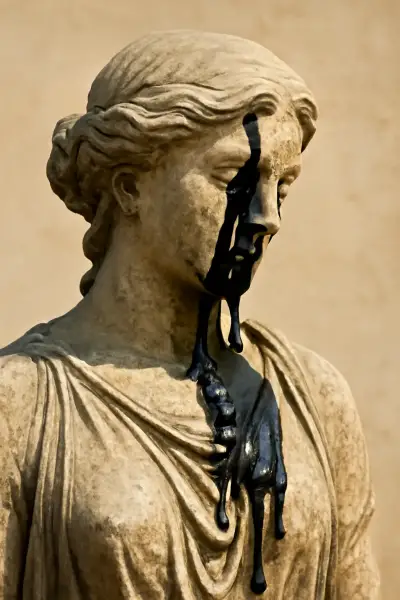
A specific detail people usually overlook is that the darkest “oil” is often not the original oily substance at all. It’s a mix. Thin wax or oily film comes out nearly clear, then immediately grabs airborne soot, traffic grime, pollen, and iron-rich dust. Within hours it can turn brown or black. That quick color shift makes it seem like the statue is producing something dramatic, when part of what you’re seeing is the city’s air sticking to a fresh tacky surface.
Heat, sun direction, and why the ooze shows up in specific spots
When people say it happened “in the heat,” they usually mean more than a warm day. Direct sun on one face of the sculpture can push temperatures far above the air temperature, especially on dark bronze or stone stained by pollution. The oozing often starts on the sun-facing side, then appears under ledges and in undercuts where the warmed material can pool. That’s why you might see a shine under the nose, along the lower lip, or at the bottom edge of a cloak. Those are natural drip points, and they’re also places that are hard to clean, so old coatings collect there.
There’s also a timing effect. A statue that looks fine at noon can look wet in late afternoon. Surfaces heat up, oils thin, and then as the sun shifts or wind cools one side, the flow slows and residue stays put. On porous stone, moisture movement can add to the illusion. Water vapor in the stone migrates toward the surface in heat, and that dampness can mobilize grime and old treatments, making the streaks look “oily” even when they’re a water-and-dirt mixture.
Old coatings: wax, silicone, and “helpful” cleanings that don’t stay put
Outdoor bronze is often waxed. Some stone is coated, too, sometimes with products that were standard decades ago and are now avoided. If a wax layer gets too thick, or if it’s applied unevenly, heat can make it soften and creep. Silicone-based water repellents and certain consolidants can also change how a surface behaves, especially if they’ve partially degraded. What looks like a fresh leak can be a very old layer finally moving again after years of sitting still.
This is where earlier repairs matter. A statue might contain modern fillers, adhesives, or sealants in cracks and joins, each with its own response to heat. Some adhesives can “bleed” plasticizers as they age. Even a small patched area can become a hot spot, because it absorbs heat differently than the surrounding stone. From a few feet away, that localized darkening reads as oil coming from inside the figure, when it may be coming from a repair line that’s acting like a wick.
When it’s not the statue at all: nearby sources and surface chemistry
Sometimes the source is external. Traffic aerosol can settle as an oily film, especially near busy roads. Cooking exhaust from nearby vents can do it, too, depending on the setting, though the details vary and are often unclear without testing. In cemeteries, lawn equipment and fertilizers can contribute residues that cling to vertical surfaces after mowing and trimming. Once a thin film is present, heat makes it more mobile, and it collects in carved details and at the base where it’s easiest to notice.
Surface chemistry can make the effect look stronger than it is. Stone with salts can develop damp patches as humidity shifts, and those damp patches trap dirt. Bronze with aged patina can show glossy runs where wax has thinned, while adjacent areas stay matte. The human eye reads “glossy + dark” as liquid. That’s why a small amount of softened wax or grime can look like an active ooze, especially when it appears suddenly on a day when the statue’s surface is simply much hotter than usual.
Related reads
- A note tucked inside a wall shows up during renovations
- The invisible itch: why imagining an itch makes your skin crawl
- How underground rivers trigger sudden sinkholes in flat landscapes
- The algae that turns shorelines bright pink and how its bloom works
- When people reportedly burst into flame with no visible fire
- Why mornings can leave you foggy for minutes after waking
If you liked this, you might also enjoy: