
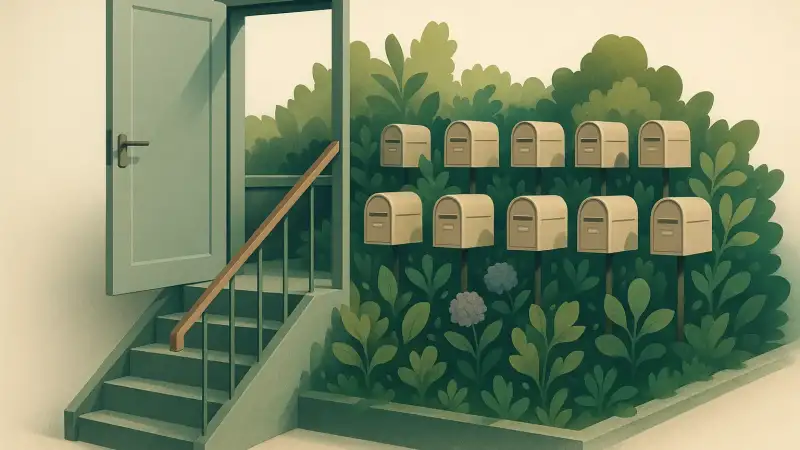
Most people know the stairwells in their building by sound. The echo changes when a door is propped open, or when someone drags a bike up the steps. But sometimes a stairwell is “unused” in a more literal way: it’s there on the plan, it’s technically accessible, and it still feels like it leads nowhere. This isn’t one single famous site. You can find versions of it in New York walk-ups, London mansion blocks, and dense apartment buildings in Tokyo. The core mechanism is simple. A service stair, fire stair, or old access route stays in place while the roof gets repurposed. The result can be a door that opens onto a small hidden garden lined with mailboxes.
How a “dead” stairwell stays in a living building
Unused stairwells are often leftovers from earlier rules and earlier layouts. A building may have had separate staff circulation, a coal delivery route, or an external fire escape that later got enclosed. Renovations can also shift traffic. A new elevator makes one stair obsolete. A lobby gets reconfigured and a door becomes “staff only,” then “keep shut,” then “nobody even notices.”
What keeps the stairwell in place is that it still solves problems the building quietly needs solved. It can be part of required egress, even if nobody chooses it day to day. It can also be the easiest vertical shaft for pipes, telecom lines, or venting. So it stays. It just loses social visibility. People stop treating it like a route and start treating it like a boundary.
Why rooftops turn into gardens without turning into public space
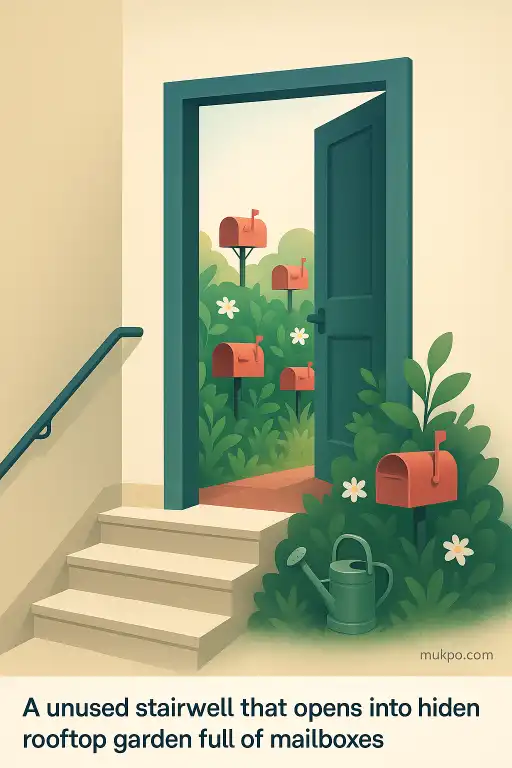
Rooftop gardens don’t always arrive as a big architectural gesture. Sometimes they’re a gradual fix. Someone adds planters to cool the roof surface. A co-op puts in a small green roof section to manage stormwater. A landlord creates an amenity space, but only for specific units. The roof becomes “used,” while access remains limited.
That mismatch is how a hidden garden happens. The roof is improved, maintained, even watered on a schedule. Yet the obvious access route is still discouraged. The main stairs might stop at the top floor. The elevator may require a key fob. The only continuous path is the stairwell nobody takes, with a door that looks like it should be locked, even when it isn’t.
Why mailboxes end up outside, and why it feels wrong
Mailboxes on a roof sound absurd until you remember that “mailbox” can mean more than postal delivery. Buildings use locked boxes for package overflow, internal routing, maintenance drop-offs, or outgoing mail that gets collected from a single secure point. A roof can be convenient if the building has a doorman station below and a managed access path above, or if a courier service already comes up for mechanical readings.
The overlooked detail is the labels. Roof-mounted boxes are often marked with unit numbers, but they may also carry vendor names, old apartment numbers that no longer match, or taped-over labels that hint at a previous system. The boxes don’t have to be “for the mail” to look exactly like mailboxes. That visual certainty is what makes the setting feel like a mistake, even when it’s simply an internal logistics choice that got dressed in familiar hardware.
What it looks like when you actually step through
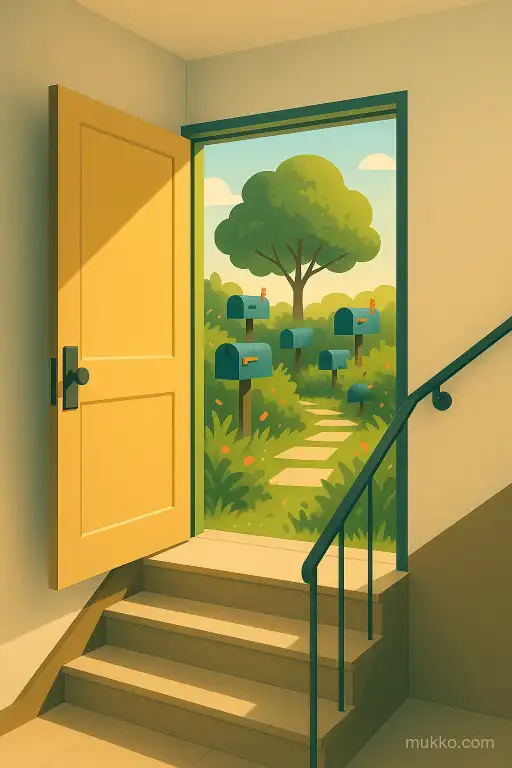
The transition is usually abrupt. A dim stairwell with scuffed paint and utility signage opens into bright space. The roof might have pavers, a narrow strip of soil, and planters set against a parapet. Sometimes there are string lights or a bench. Sometimes it’s just hardy shrubs and a hose bib. The sense of “hidden” comes from contrast, not from size.
Mailboxes tend to cluster where there’s already structure: near a bulkhead, beside a mechanical penthouse, or along a wall that gives some protection from wind. If the boxes are exposed, you may see small practical choices that explain the placement. A simple rain hood. A bead of silicone around the back. A line of drilled weep holes underneath. These are the quiet tells that someone planned for weather, not a prank.
Why these spaces stay semi-secret even when they’re not forbidden
Buildings teach behavior. A door that is always shut becomes a door people don’t touch. An unlit landing feels like a warning, even if it’s just a burned-out bulb. Add a sign like “ROOF ACCESS” paired with “ALARM WILL SOUND,” and the space becomes socially locked long before it’s physically locked.
Meanwhile, the roof garden and the mailboxes create a reason for a small number of people to keep using the route: a superintendent, a cleaner, a resident who waters plants, someone doing deliveries for a top-floor unit. That thin trickle of use is enough for the space to remain cared for without becoming familiar. The stairwell keeps its reputation as a dead end, and the roof keeps acting like a room that only exists when the right door opens.
Related reads
- What your blink rate reveals about attention and stress
- Why your taste changes with your mood
- Why we unconsciously copy another person’s posture
- The forged papal decree that handed power to emperors and fooled medieval Europe
- Why people keep tiny useless mementos for decades
- Why certain gestures instantly make us trust someone