
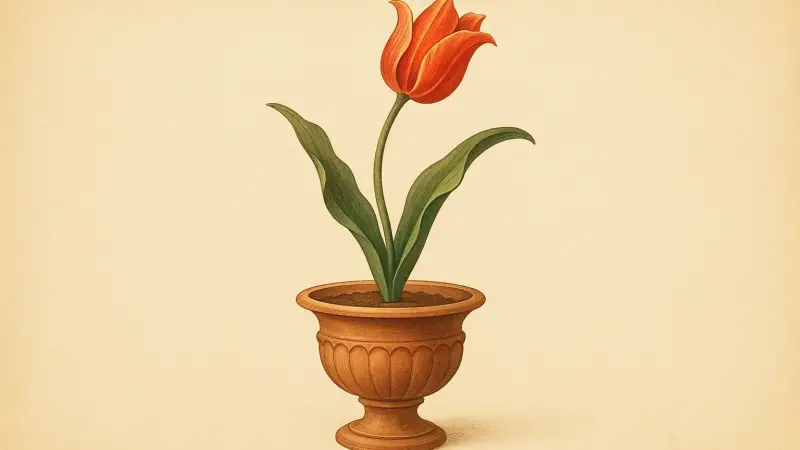
A flower seems like the opposite of finance. Yet in early 1700s Istanbul, certain tulip bulbs started behaving like assets. During the Tulip Era under Sultan Ahmed III, a gardener could plant beauty and, if luck held, sell a prized bulb for more than a year of ordinary wages. The mechanism was simple and strangely modern. Taste created status. Status created demand. And demand turned a slow, biological thing—one bulb dividing into a few offsets—into something people could trade, hoard, and brag about.
Why tulips fit Istanbul’s status economy
Tulips had already traveled for decades between the Ottoman court, diplomats, and European collectors. In Istanbul they landed in a world where public display mattered. Elite households staged nighttime garden parties with candles and carefully arranged flowerbeds. A rare bloom was not just decoration. It was proof that you had connections, patience, and money to burn in a way that looked refined.
That social setting mattered because it made demand visible. When a grandee’s garden featured an unusual tulip, other people saw it. They asked its name. They asked who grew it. The flower became legible as a marker of rank, which is exactly the kind of thing that can turn into a buying frenzy.
How a garden turns into a market

Tulips are easy to desire and hard to mass-produce quickly. A coveted variety can’t be scaled the way a workshop scales textiles. Bulbs multiply, but slowly, and not always reliably. That built-in scarcity is the first step toward speculation. The second step is that bulbs are portable. They can move from one garden to another, or from a gardener to a broker, without needing a whole estate attached.
Once people believe prices will keep rising, the garden stops being the point. Ownership becomes the point. Bulbs can be held back from planting. They can be traded as “next season’s” promise. A living thing that should be in the ground starts acting like inventory, and the calendar starts acting like a contract term.
What people were actually paying for
They weren’t just paying for color. They were paying for a name and a pedigree. Named varieties could circulate as talk as much as as objects, which is useful in a speculative market because conversation does half the advertising. People also paid for the right kind of irregularity: unusual flame-like streaks or distinctive forms that made a flower easy to recognize at a glance.
One detail people overlook is how fragile that “rarity” could be. Some prized patterns in tulips can be linked to plant viruses that change coloration. A virus can make a bloom look extraordinary, then weaken the plant over time. That means the very trait that boosts value can also undermine the supply that keeps the market going.
Speculation thrives on slow information
Prices rise fastest when nobody can quickly verify what a thing is worth. With tulips, verification took a full growing cycle. A bulb could be described one way in conversation and prove disappointing months later. Even honest sellers couldn’t guarantee how a bloom would present in a new garden, under different care, in a different microclimate.
That delay creates room for confident claims. It also creates room for secondary trading, where the seller might never intend to grow the tulip at all. The longer the gap between purchase and proof, the easier it is for a bulb to circulate as an idea—rare, fashionable, “the one everyone wants”—instead of as a plant that must survive and flower.
What broke the spell
The Tulip Era didn’t end because people stopped liking flowers. It ended amid political upheaval. In 1730, the Patrona Halil rebellion toppled Grand Vizier Nevşehirli Damat İbrahim Pasha and forced Sultan Ahmed III to abdicate. When a court-centered fashion depends on elite spending, a sudden change in power can chill the whole ecosystem of gifting, collecting, and showing off.
After that kind of rupture, a luxury bulb looks different. It still blooms. It can still be admired. But the social machinery that made it feel like a sure bet—patronage networks, courtly imitation, the expectation of ever-more lavish display—no longer runs at the same speed, and a market built on excitement has trouble staying liquid.
Related reads
- The hotel room shaped like an egg people book for its strange acoustics
- The bench that secretly grows a community garden inside its slats
- Why some river stones sing when water rushes over them
- The bakery that prints miniature maps on loaves pointing to secret recipes
- Why urban pigeons harbor unusual antibiotic resistant microbes
- How whale songs bend in deep ocean layers