
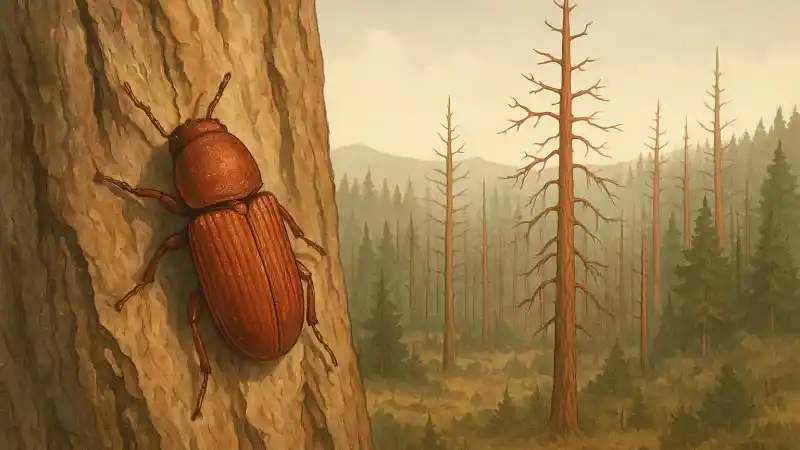
If you’ve driven through Colorado’s lodgepole pine country, you’ve probably seen it: whole hillsides of reddish-brown trees mixed into what looks like a normal green forest. That color shift often starts with something tiny. A bark beetle bores through the outer bark, lays eggs, and the larvae feed in the thin living layer that moves water and sugars. Enough galleries in the right place, and the tree can’t keep itself alive. There isn’t one single epidemic, or one single forest. The big 20th-century story played out in different ways in British Columbia’s interior, the U.S. Rockies, and parts of Alaska, depending on weather, forest structure, and what people were doing to those forests.
What “epidemic” means for bark beetles
Bark beetles are native insects, and they usually exist at low levels. An “epidemic” or “outbreak” phase happens when beetles reproduce faster than trees can resist. For several major species, the trick is numbers. A single beetle is easy to pitch out with resin. Thousands arriving over a short window can overwhelm a tree’s defenses. Many species also carry blue-stain fungi that clog water transport. The beetles don’t need the fungus to kill every tree, but the partnership can make attacks more effective.
The timing is narrow and easy to miss when people talk about “dead forests.” Adult beetles often fly and attack during a brief seasonal pulse. A tree can look green for months after it is effectively doomed. Needle color change tends to show up later, so by the time a landscape looks “red,” the killing happened earlier. That lag matters for how people interpreted outbreaks in the 20th century, because the visible damage always arrived after the causal moment.
Why 20th-century forests became easier to attack
Across much of western North America, 20th-century forest management shifted the playing field. Fire suppression reduced the frequency of lower-intensity fires that used to thin small trees and break up continuous stands. In many places, that led to denser forests with lots of trees competing for water and nutrients. Stressed trees make less resin, which is a key defense against beetles. Dense stands also let beetles move from host to host without having to cross big gaps.
Species composition and age structure mattered too. Large areas of even-aged pine—often the result of past logging patterns, past fires, or regeneration practices—created a buffet of similarly vulnerable trees. Outbreak potential is not identical everywhere, and the details vary by region and beetle species. But a recurring pattern in the 20th century was that human choices nudged forests toward uniformity, and uniformity made synchronized, landscape-scale beetle success more likely.
Climate swings turned outbreaks into landscape events
Weather determines whether beetles merely persist or explode. Cold snaps can kill overwintering beetles, and long, deep freezes historically helped keep populations in check in parts of Canada and the U.S. West. Warmer winters reduce that kill-off. Drought also plays a double role. It stresses trees, and it can speed beetle development in some conditions. Not every warm year produces an outbreak, and not every outbreak needs the same trigger, but 20th-century warming trends and drought episodes repeatedly lined up with vulnerable stand conditions.
One overlooked detail is that temperature affects beetle “scheduling.” Some species can shift from a multi-year to a one-year life cycle when summers are warm enough, which dramatically changes how fast populations can build. That kind of life-cycle compression is not a headline fact most people carry around, but it’s one of the ways a subtle climate nudge can turn a chronic background insect into a sudden, regional force.
What changed on the ground after trees died
When beetles kill a large share of mature trees, the forest stops behaving like it did. Light hits the ground differently. Snow accumulation and melt timing can change because needles are gone and canopies open up. Dead trees eventually fall, which changes how people and wildlife move through an area and how fuel sits on the forest floor. The fire story is complicated and depends on timing, weather, and what kind of forest it is. But the fuel profile does shift: first there are dry needles and fine fuels, later there are more large downed logs.
Ecology also resets in quieter ways. Some birds increase because there are more beetle larvae to eat and more dead wood for nesting cavities. Understory plants can surge with new light, including shrubs that were previously shaded out. Meanwhile, regeneration can tilt toward different species if the climate is changing or if seed sources are patchy. In some places, that meant forests coming back less pine-heavy than before, which can reduce future susceptibility to the same beetle species but also changes timber value and habitat structure.
How the epidemic reshaped forestry and public debate
Large outbreaks forced foresters and governments into hard choices. Salvage logging expanded in some regions to capture economic value before wood degraded, and to address safety concerns near roads and towns. That pushed logging into places that were previously marginal, and it changed mill supply and planning. In British Columbia, for example, the mountain pine beetle outbreak in the interior drove major shifts in harvest strategy and long-term timber projections, with ripple effects for communities tied to pine processing.
Public arguments changed too. People disagreed on whether beetle-killed forests were “ruined” or simply transitioning, and on how much intervention made sense in backcountry areas. At the same time, the outbreaks made it harder to talk about forests as stable backgrounds. A lot of 20th-century assumptions—about predictable timber supply, about what a “healthy” stand should look like, about how often fire should appear—started to feel less certain when a few warm winters and a dense, stressed forest could flip an entire mountainside from green to red in a single season.
Related reads
- What aurora colors reveal about collisions in Earth’s upper atmosphere
- The fish with transparent teeth that glow under red light
- The pause when two people start talking at once and who yields
- The town that held an election where a dog outpolled a human candidate
- The French adventurer who declared himself king of Araucania and Patagonia in the 1860s
- How prairie dogs shape rivers by digging