
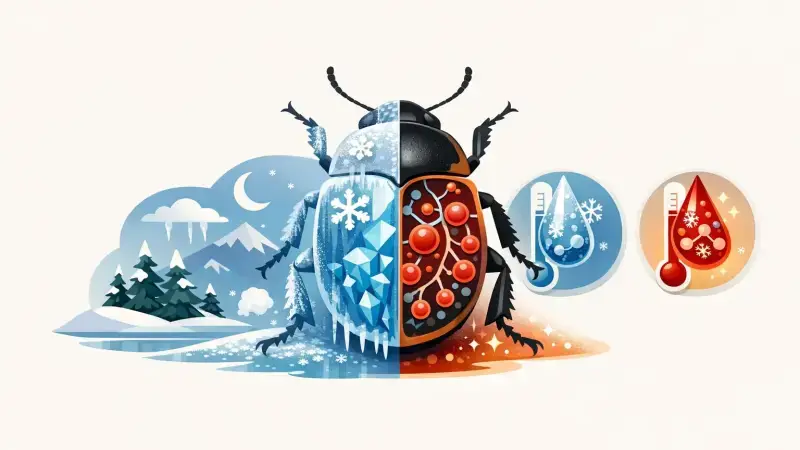
Seeing it happen in the cold
In interior Alaska and northern Canada, winter nights can drop far below freezing and stay there. You might assume any small insect outdoors is simply dead. But some beetles ride it out by changing their body chemistry before the worst cold arrives. They don’t “warm themselves up.” They make their internal fluids harder to freeze. The core trick is antifreeze-like molecules in their blood-like body fluid (hemolymph) and inside some tissues, plus deliberate dehydration. If conditions are right, ice forms where it’s safest, while the inside of cells is protected from turning into sharp crystals.
Two different strategies: avoid ice or manage it
Cold-hardy insects tend to fall into two broad camps. Freeze-avoidant species try not to form ice at all. Freeze-tolerant species allow some ice, but keep it controlled. Beetles include examples of both. What varies is how low the temperature goes, how long the cold lasts, and which life stage is doing the overwintering. Adults, larvae, and pupae can behave differently because their water content, fat reserves, and shelters in wood or soil are different.
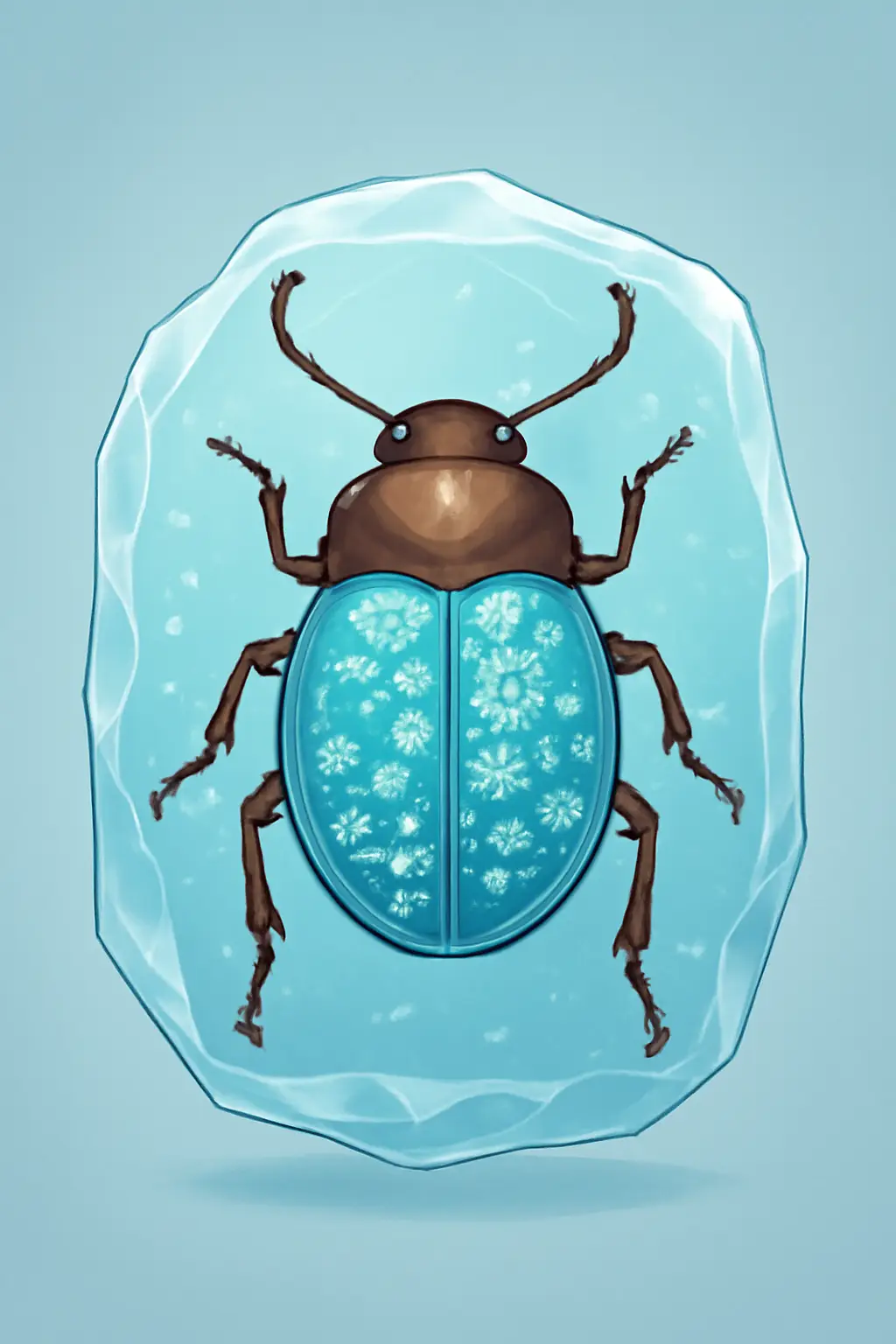
The part people often overlook is that “frozen” doesn’t have to mean “a solid block.” A freeze-tolerant beetle may have ice in the spaces between cells while the cells themselves stay unfrozen and functional. That difference matters. Ice inside cells is usually lethal because it punctures membranes and concentrates salts to toxic levels as water gets pulled out into crystals.
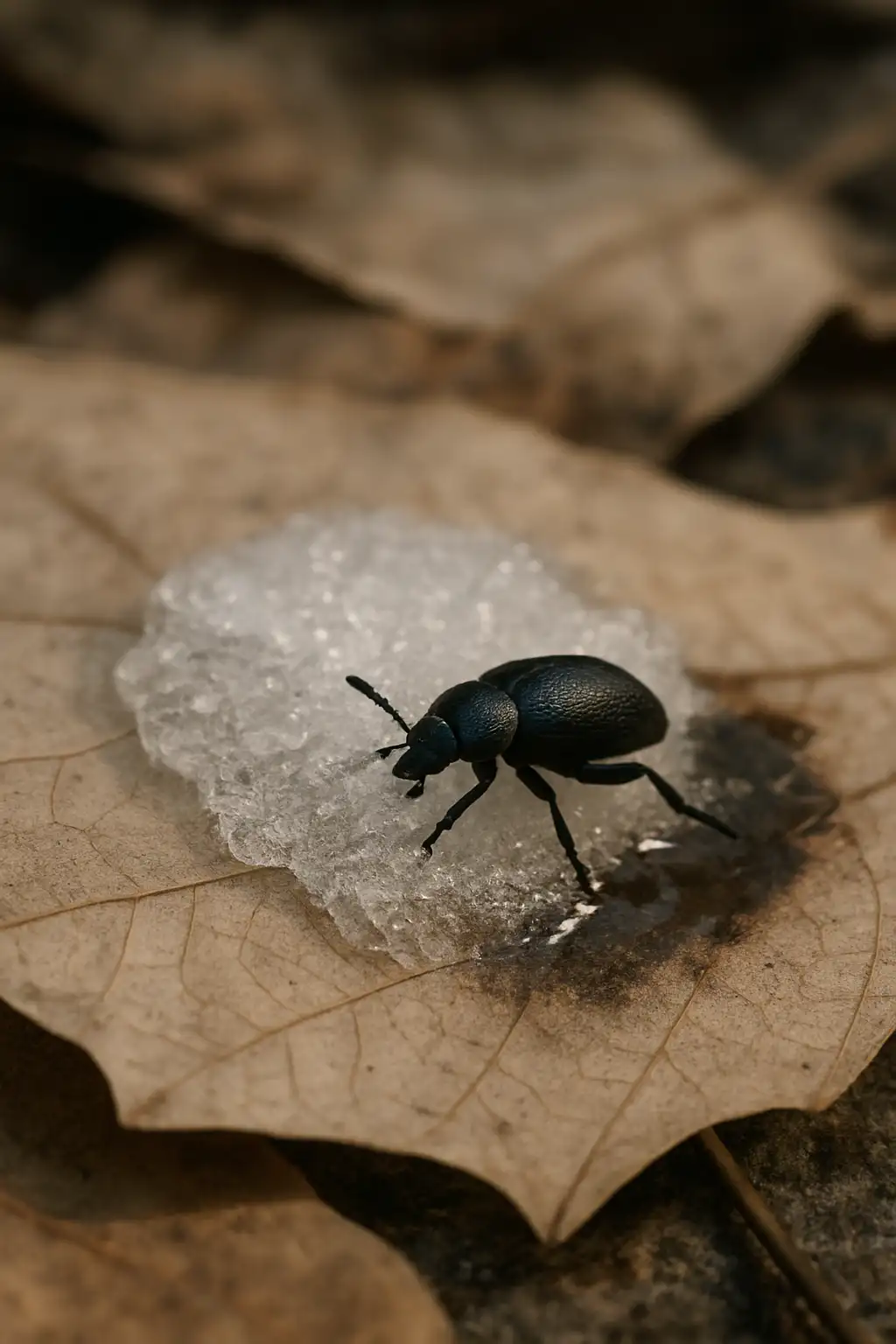
What the beetle actually puts in its hemolymph
The antifreeze isn’t one magic chemical. It’s often a cocktail. Many cold-hardy insects build up sugars and sugar alcohols such as glycerol, sorbitol, and sometimes trehalose. These raise the concentration of dissolved solutes, which lowers the freezing point and reduces how much ice can form at a given temperature. They also help stabilize proteins and membranes when water is being pulled out of cells.
Some species also make antifreeze proteins (or antifreeze glycoproteins). These don’t work the same way table salt does. They bind to tiny ice crystals and slow their growth, which can prevent small crystals from turning into larger, more damaging ones. Amounts, timing, and exact molecules can vary by species and habitat, and researchers don’t always agree on which component is doing most of the work in every case.
Preparing for cold starts before the freeze arrives
This shift usually starts in autumn, triggered by shortening day length and gradually dropping temperatures. The beetle’s metabolism changes gears. It converts stored energy into cryoprotectants and often enters diapause, a low-activity state that reduces damage from long-term stress. That timing is important because once hard freezing hits, it’s too late to rebuild chemistry or repair tissues at normal rates.
A situational example is a wood-boring larva overwintering under bark. The microclimate there can be colder than the surrounding air on clear nights because of radiative cooling, then warmer on sunny days. Those swings are risky. Repeated freeze–thaw cycles can be worse than one steady freeze because they encourage ice to reform and grow. The larvae that cope best tend to manage both the cold and the cycling.
Where ice is allowed to form, and why water matters
If a beetle is freeze-tolerant, the “safe” ice tends to be extracellular, in the body cavity or between tissues, not inside cells. That usually involves ice-nucleating agents that start freezing at relatively high subzero temperatures so the process is predictable. Without controlled nucleation, body fluids can supercool well below 0°C and then flash-freeze suddenly, which is more damaging.
Dehydration is a big part of the story. Many overwintering beetles reduce the amount of free water in their bodies on purpose. Less water means less ice can form, and it also concentrates the cryoprotectants they’ve produced. The overlooked detail is that this isn’t just “drying out.” Water moves out of cells as ice forms outside them, and the cells survive because membranes and proteins are chemically protected while the remaining internal fluid stays unfrozen.
Related reads
- A town that kept changing clocks so shops never opened the same hour
- What hummingbird tongues reveal about fluid dynamics at tiny scales
- An old statue began oozing oily residue in the heat
- A note tucked inside a wall shows up during renovations
- The invisible itch: why imagining an itch makes your skin crawl
- How underground rivers trigger sudden sinkholes in flat landscapes
If you liked this, you might also enjoy: