
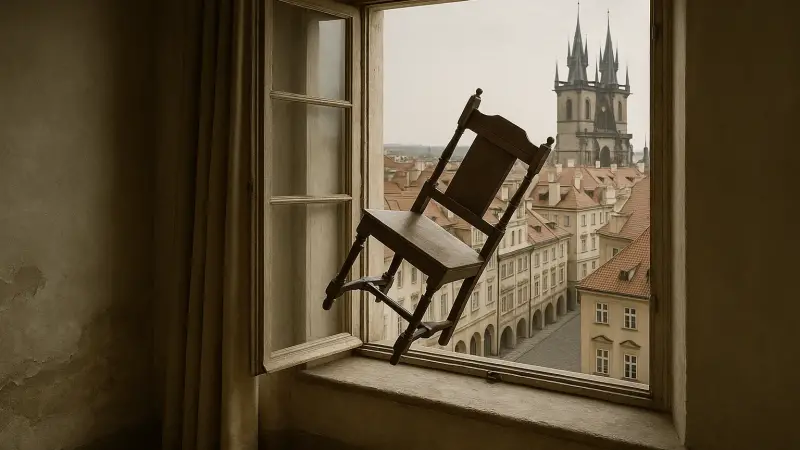
A thrown body as a political signal
People think of a riot as something that starts with shouting in a street. Prague’s 1618 uprising began in a quieter place: a room in Prague Castle where paperwork, oaths, and jurisdiction mattered. A group of Bohemian Protestant nobles confronted two imperial governors, Jaroslav Bořita of Martinice and Vilém Slavata of Chlum, along with their secretary, Philip Fabricius. Then they forced them to a window and threw them out. The fall was real, but the act was also a statement: the Habsburg king’s representatives could be removed by force, right there, on the castle hill.
It’s often called the Defenestration of Prague, but that label can hide the mechanism. This was a planned, public humiliation aimed at breaking a chain of authority. The window was just the tool that made it irreversible.
What the nobles thought they were defending
Bohemia wasn’t a free-for-all. It had a specific constitutional feel, with estates (organized political bodies of nobles and towns) that expected to negotiate with the monarch. A key reference point was the Letter of Majesty of 1609, issued under Rudolf II, which granted significant religious freedoms to the estates. By 1618, many Protestants believed those guarantees were being hollowed out in practice. Church buildings on contested land and the right to worship became flashpoints because they were easy to see and hard to ignore.
The overlooked detail is how procedural the argument was. The confrontation wasn’t only “religion versus religion.” It was also about who had the right to interpret earlier promises and local privileges. The Habsburg side saw enforcement and uniformity. The Bohemian estates saw a breach of a binding settlement, and they treated the imperial governors as the instruments of that breach.
The window at Prague Castle and why it mattered
The meeting took place in the Bohemian Chancellery at Prague Castle. Throwing Martinice, Slavata, and Fabricius out of a window wasn’t a random burst of fury. It followed an interrogation-style confrontation in which the nobles pressed them on responsibility for recent measures seen as anti-Protestant. The act performed a verdict without a courtroom. It said: you are not just wrong, you are illegitimate here.
The detail people tend to miss is that all three men survived. They fell into the castle ditch area below. Catholics later emphasized divine protection. Protestants pointed to the practical fact that the drop wasn’t infinite and the landing was not bare stone. Either way, survival didn’t soften the message. In some ways it sharpened it, because the victims could carry the story directly to Habsburg allies.
From defenestration to an uprising with institutions
After the window, the Bohemian estates moved quickly to act like a government, not a mob. They organized a provisional administration and raised forces. That mattered because it turned a shocking episode into a sustained challenge. The Habsburgs, for their part, could treat it as rebellion against the crown. That framing invited outside help and harder reprisals, because it shifted the dispute from local rights to imperial order.
There’s a practical reason the castle scene escalated so fast. Once the imperial governors were attacked, compromise became dangerous for everyone involved. The nobles who led it could expect punishment if they lost. The Habsburg court could expect other territories to test its authority if it looked weak. The incident narrowed the options down to winning or facing consequences.
How one fall rippled into a wider war
Bohemia’s rebellion didn’t stay local. It helped trigger the chain of alliances and interventions that became the Thirty Years’ War. What began as a conflict over religious rights and political autonomy inside the Kingdom of Bohemia drew in larger powers because it touched the balance inside the Holy Roman Empire and the Habsburgs’ ability to govern. The Bohemian estates eventually offered the crown to Frederick V of the Palatinate, a move that made the fight harder to contain.
In Prague, the original scene stayed vivid because it was so easy to picture. A delegation arrives. An argument about authority turns physical. People go out a window. After that, every proclamation and every troop movement is read through the same lens: whether the Habsburgs can enforce their rule, or whether the estates can still force the issue when paper promises stop feeling real.

Related reads
- How the solar wind sculpts comet tails into bright, streaming plumes
- The smell-triggered time machine: how odors unlock buried memories
- Why some rivers form tidal bores that rush upriver as walls of water
- How microbes dissolve concrete to access buried minerals
- Why volcanic ash plumes often produce spectacular lightning bolts
- How your brain filters out half of a crowded conversation