

A bucket sounds too small to matter
It’s hard to imagine a war starting with something as plain as a wooden bucket. Yet in 1325, the rival Italian communes of Modena and Bologna ended up in a cycle of raids and retaliation that later storytellers pinned on exactly that: a bucket taken from Bologna and carried off to Modena. The fight was real, and it was bloody. The bucket story is also real in a narrower sense, because Modena still displays a bucket tied to the episode. But the mechanism wasn’t about the object. It was about pride, borders, and the way medieval city-states kept score.
Why Bologna and Modena were already looking for a fight
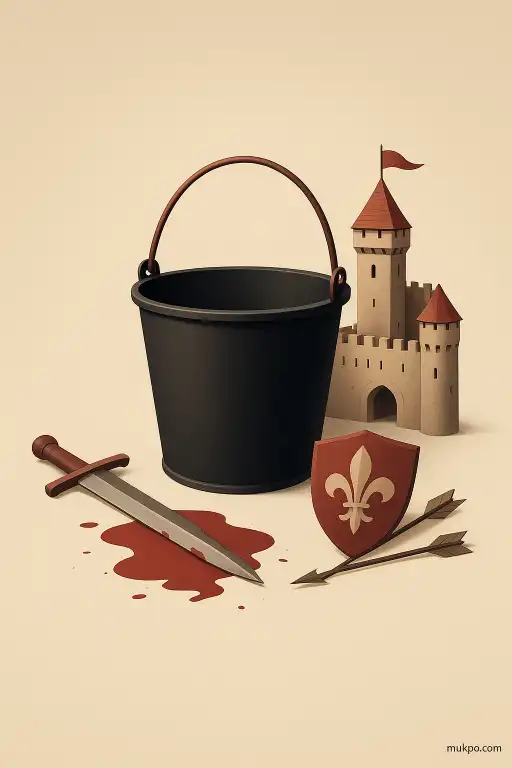
By the early 1300s, northern and central Italy was a patchwork of self-governing communes, lordships, and papal territory. Bologna and Modena sat close enough to rub against each other constantly, and they also sat on different sides of the era’s big political split. Bologna tended to align with the Guelf faction (generally pro-papal), while Modena leaned Ghibelline (generally pro-imperial). Those labels could blur in practice, but they mattered because they turned local feuds into coalition politics. An argument over a castle or a toll road could suddenly pull in allies, money, and grudges from outside the immediate area.
What people often overlook is how “state” these places already were. They had councils, taxes, written laws, militias, diplomats, and a habit of recording insults as if they were legal claims. A raid wasn’t only banditry. It could be treated like a statement. Once that logic sets in, returning a stolen item can look like admitting weakness, and refusing to return it can look like denying the other side’s legitimacy.
The raid, the bucket, and what it signaled
The familiar version says Modenese soldiers slipped into Bologna and stole a bucket from a well, then Bologna demanded it back and marched when Modena refused. Medieval sources don’t all tell it the same way, and later retellings lean hard into the comedy of the object. But the bucket functions best as a symbol of something that was happening anyway: armed probes, quick strikes, and deliberate humiliation. In a world where cities displayed captured banners and armor in public spaces, taking something ordinary from inside an opponent’s walls could be read as “we can reach you.”
There’s also a practical detail that disappears in the legend: wells and water access were not casual infrastructure. A bucket is a bucket, but a well is a piece of urban survival. Cities guarded wells, gates, and towers because they were where a siege could bite. So even if the specific bucket became famous later, the act of taking something from a well wasn’t just petty theft. It was a message aimed at security, not housekeeping.
How it turned into a year-long bloody feud
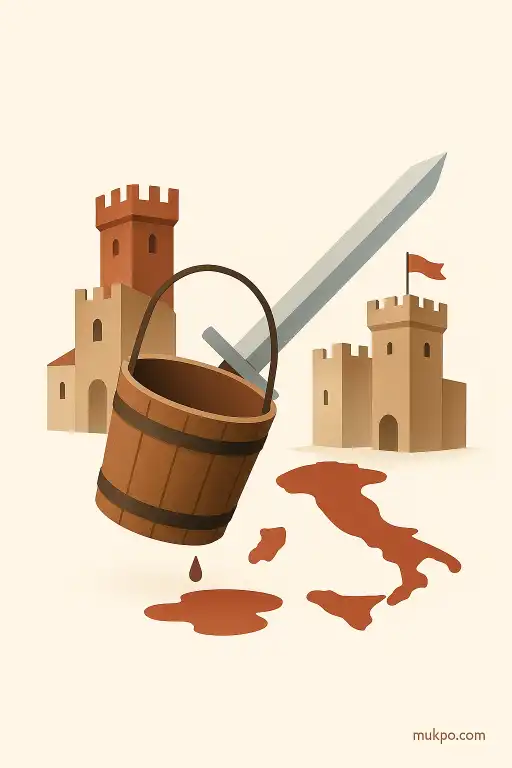
The conflict connected to the larger War of the Oaken Bucket (a name that shows how much the story stuck), with fighting that culminated in the Battle of Zappolino in 1325. That battle is usually described as a major Modenese victory, with Bologna suffering heavy losses and reputational damage. Numbers reported for medieval battles can be unreliable, and chroniclers had incentives to inflate them. What’s more consistent is the pattern: a sharp defeat didn’t neatly end the dispute. It reshaped it into demands for concessions, prisoner exchanges, and compensation that kept the feud alive.
This is where the “year-long” feel comes from. The bucket story gives a clean trigger, but the violence behaves like a negotiation conducted with raids. A city could punish villages aligned with the other side, burn crops, seize livestock, or take hostages, then offer talks from a position of strength. Even when leaders wanted to stop, the machinery of honor and vendetta made stopping look like losing, and losing could create domestic political trouble inside the city walls.
Why a small object became the part everyone remembers
The bucket survives because it compresses a complicated political landscape into a story anyone can repeat. The actual grievances involved territory, alliances, and authority, which are hard to picture without a map and a stack of names. A stolen bucket is instantly graspable. It also lets later generations laugh at their ancestors without challenging the serious parts of the past. It’s easier to mock a war “over a bucket” than to argue about Guelf and Ghibelline factionalism, or about how cities used violence as policy.
There’s a final twist that tends to be missed: the bucket becomes a trophy, not evidence. Displaying it in Modena is closer to hanging a captured flag than preserving a quirky antique. The point is that the other side wanted it back and didn’t get it. In medieval Italy, that kind of unresolved demand could sting for generations, even after treaties shifted borders and commanders died, because the object kept repeating the insult every time someone pointed at it.
Related reads
- Why your stomach knots before speaking and what that sensation signals
- How your brain recognizes a familiar face in under a blink
- A startup that bottles Himalayan mountain air and sells it by the can
- How a 16th-century Ottoman gardener sparked a palace scandal
- Why your hands go numb when you sleep on them
- Why your hands warm up when you remember a pleasant moment