
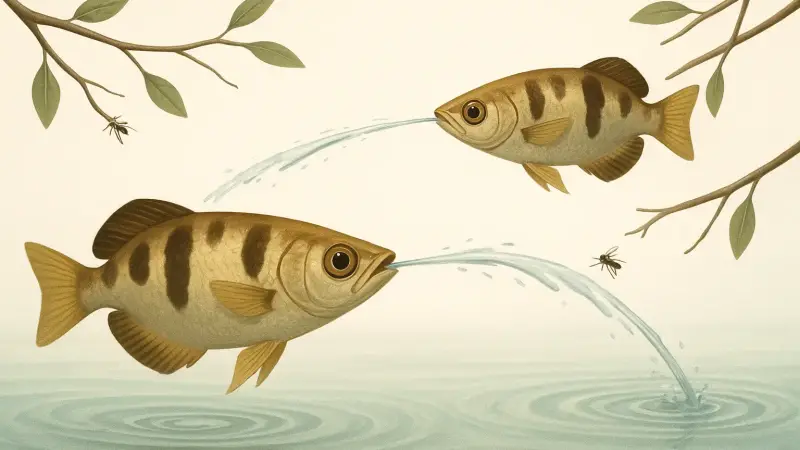
A fish that shoots, and hits, on purpose
People talk about animals using tools, but it’s still jarring to watch a fish knock an insect out of a tree with a stream of water. There isn’t one single place where it happens. Archerfish live in brackish mangroves and estuaries across Southeast Asia and northern Australia, including places like the Sundarbans and the mangrove creeks around Singapore. The basic trick is simple: the fish sits just under the surface, lines up with a bug on a branch, and fires a tight jet that hits hard enough to dislodge it. Then the fish surges forward to catch whatever falls, often before it even finishes bouncing off the leaves.
How the water jet is built in the mouth
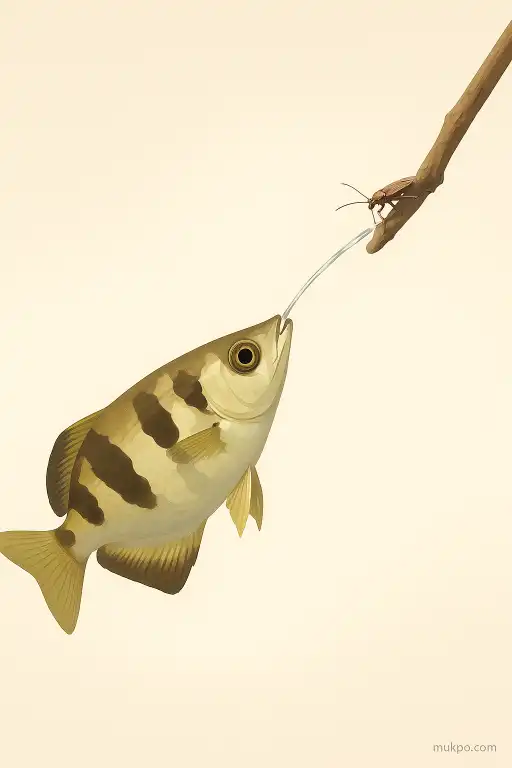
The “gun” isn’t a special organ. It’s a quick reshaping of the mouth. An archerfish raises its tongue against a groove in the roof of its mouth and snaps the gill covers shut. That squeeze forces water forward through a small opening formed by the lips. The fish can change that opening from moment to moment, which changes the jet’s speed and how tightly it stays together.
A detail people usually overlook is that the jet is not always the same kind of shot. At closer ranges it can be more like a short burst. At longer ranges it can be a pulse that “loads” more force toward the front of the stream, so the impact is stronger when it reaches the target. You can sometimes see it as a thickened front end, not a perfectly even струight stream.
How they aim through the surface without missing
Aiming from underwater is harder than it looks because the surface bends light. An insect above the water does not appear exactly where it is. It looks shifted because of refraction. Archerfish still hit accurately, which means they are not just firing at the apparent position and hoping. They adjust for the bending of light, and the adjustment changes with the angle they’re looking up at.
It also helps that they control their body position very carefully. The fish often stops, holds still under the surface, and rolls slightly so one eye has a clean view upward. Small ripples, glare, and floating debris can interfere, so they tend to shoot in brief windows when the surface is calm enough and the view is stable.
Timing matters because the insect won’t fall straight down
Knocking the insect loose is only half the job. The archerfish also has to be where the insect will land. In real mangroves, the drop is messy. Leaves deflect falling prey. Breezes push it sideways. Sometimes it ricochets off a branch and lands far from the point directly under the target.
So after the shot, the fish accelerates immediately, and not just toward the spot under the insect. It tends to launch toward where the insect is likely to end up, based on height and the angle of the branch. In groups, this becomes competitive. A fish that shoots well but reacts late can still lose the prize to a faster neighbor.
They get better with practice, and the targets change
Young archerfish are noticeably sloppier. They miss more, and their jets look less controlled. With experience, they tighten their grouping and choose shot types that match the distance. The environment pushes that learning. In some spots the prey is tiny and close to the waterline. In other places it sits higher and may be tougher to dislodge. The fish has to decide whether to take a long shot, creep closer, or wait for a better angle.
A concrete scene that researchers and aquarists see often is an archerfish hovering under an overhanging twig, tracking a fly that keeps shifting its feet. The fish pauses each time the insect moves, then fires the moment it settles. When it works, the insect drops, hits a leaf on the way down, skitters sideways, and the fish is already turning to intercept it.
Related reads
- Why fog clings to valley floors while nearby ridges stay clear
- Why some conversations make you forget time completely
- A café that brews espresso in cups stitched from old concert wristbands
- The beach where certain shells sing when the tide goes out
- The Cold War diplomat who ran an art forgery ring out of a consulate pouch
- Why an entire block unintentionally matched paint after a single storm