
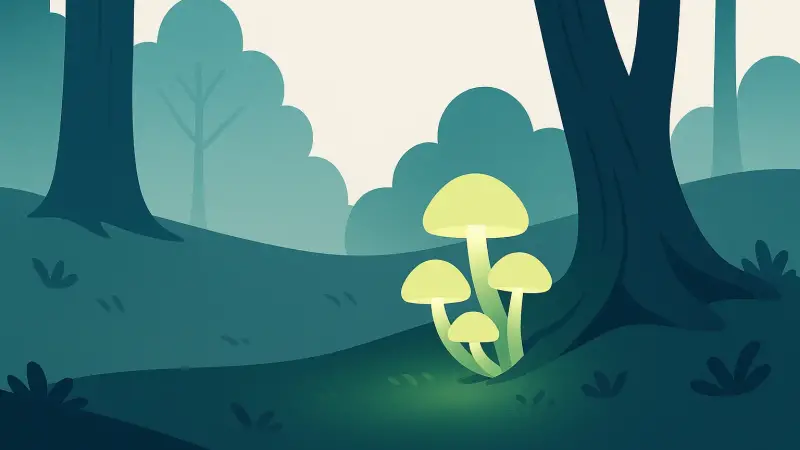
On some damp nights, the forest floor looks like it has a dim night-light hiding under the leaf litter. It is not one single place or one famous event. It shows up in scattered pockets, like Brazil’s Atlantic Forest, Japan’s Yakushima Island, and parts of the Appalachian region in the United States. The glow comes from living fungal tissue making light through a chemical reaction, not from sunlight stored up during the day. Inside the cells, a small molecule reacts with oxygen with help from an enzyme, and a bit of the energy leaves as visible greenish light instead of heat.
What is actually glowing down there
It helps to picture the parts of a fungus separately. The mushroom is the fruiting body, and it may or may not glow. The main organism is the mycelium, a web of fine threads in wood and soil, and that is often the brighter source. Some species glow in the gills or cap edges, some in the stem, and some mostly in the buried mycelium that you never see unless you peel back bark or leaves.
A common overlooked detail is that the glow is easy to “miss” because eyes need time to adapt. If someone checks with a phone screen or a bright flashlight and then looks away, the light can seem to vanish. The fungi did not stop. The observer’s night vision just reset, and the glow sits right near the threshold of what human vision can pick up.
The chemistry that makes the light
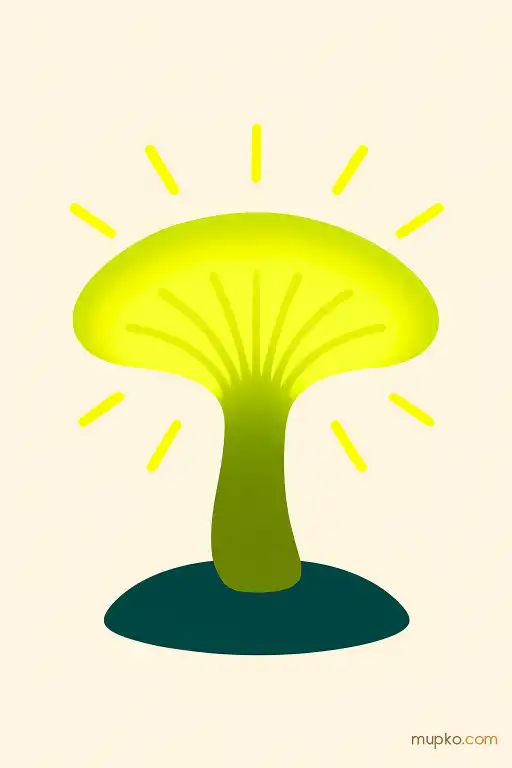
Bioluminescence in fungi is a chemical pathway. The core pieces are a light-emitting molecule (a luciferin), an enzyme (a luciferase), and oxygen. The enzyme helps oxidize the luciferin, and the reaction creates an excited product that drops back down in energy by releasing a photon. The color tends to land in green wavelengths, which travel decently through humid air and also line up with what dark-adapted human eyes detect best.
This is not the same system used by fireflies, and it is not a glowing bacteria coating the surface. In fungi, the machinery is built into the fungal cells. The intensity varies a lot by species, temperature, and the fungus’s stage of growth. It can also vary across the same log because the mycelium is not uniform and nutrient levels are patchy.
Where the energy comes from
The light is not “free.” The energy ultimately comes from the fungus breaking down organic material and running normal cell metabolism. The reaction does not usually make the fungus warm. It is called “cold light” because so much of the energy ends up as photons rather than heat.
That dependence on metabolism is why the glow is often linked to moisture and oxygen. A soaked log can support fast growth, but if the pores are waterlogged, oxygen can become limited. A slightly damp, airy piece of rotting wood can be a better setup. That mix of wetness and airflow is one reason these fungi so often show up in decaying logs, bark seams, and the underside of fallen branches rather than on exposed, drying surfaces.
Why glow at all
The “why” is still not nailed down for every species. One idea is that glowing fruiting bodies could attract insects and other small animals that move spores around. There is some experimental support for insect attraction in certain setups, but it is not a universal answer. Plenty of fungi spread spores just fine without glowing, and some luminous species glow most strongly in the mycelium, where spore dispersal is not the obvious point.
Another idea is that the chemistry is tied to handling reactive oxygen compounds produced during wood decay. Fungi that digest lignin and other tough plant materials deal with oxidative chemistry all the time. A light-producing pathway could be a side effect of that broader chemistry, or it could help manage it. Which explanation fits best seems to vary by species, and for many species it is still unclear what role, if any, the light itself plays.
What it looks like in real forests
In places like Brazil’s Atlantic Forest, observers sometimes report glowing patches that trace the shape of buried roots or the grain of rotting wood. That shape matters because it tells you what is actually luminous: a network feeding through a substrate, not a single “lamp” sitting on the ground. In other regions, small mushrooms can appear as faint points with brighter lines where gills are packed tightly together.
The glow can also be rhythmic in a simple way. It often looks steadier than firefly flashes, but it is not always constant hour to hour. As the fungus shifts between growth, repair, and fruiting, the chemistry can change, and the visible light changes with it. That is why two logs a few meters apart can look completely different on the same night, even if both are colonized by fungi.
Related reads
- Where microplastics go when dust lifts off the ocean
- Why some sands fluoresce under UV light
- The Renaissance codex that baffled royal libraries — the Voynich Manuscript’s mysterious path
- The night massive brewery vats burst and flooded a Victorian London neighborhood with beer
- An elevator that stops on unmarked floors and leaves sticky notes
- The mental habit behind checking the stove twice