
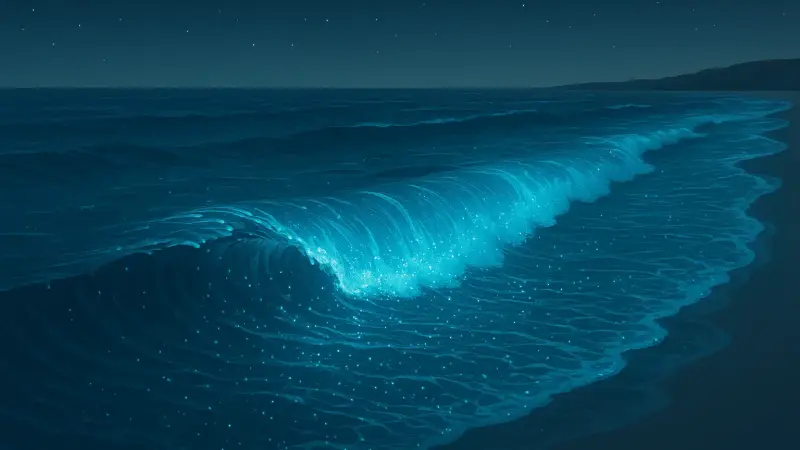
Why the water can flash blue at all
If you’ve ever seen video of a beach where every step lights up, it can look staged. It isn’t one single place or one single event. It shows up in different coastlines when conditions line up, including Southern California, the Maldives, and Puerto Rico’s Mosquito Bay. The core mechanism is simple: tiny plankton make light inside their cells, and they trigger it when the water around them is disturbed. A breaking wave is basically a long moving disturbance, so the glow can spread across a whole shoreline in seconds.
Most of the time the main culprits are bioluminescent dinoflagellates, not jellyfish or fish. They’re single-celled, and the “spark” is a chemical reaction. One molecule (luciferin) gets oxidized with help from an enzyme (luciferase), producing light. That light is usually blue-green because those wavelengths travel farthest through seawater.
The glow is usually a defense response
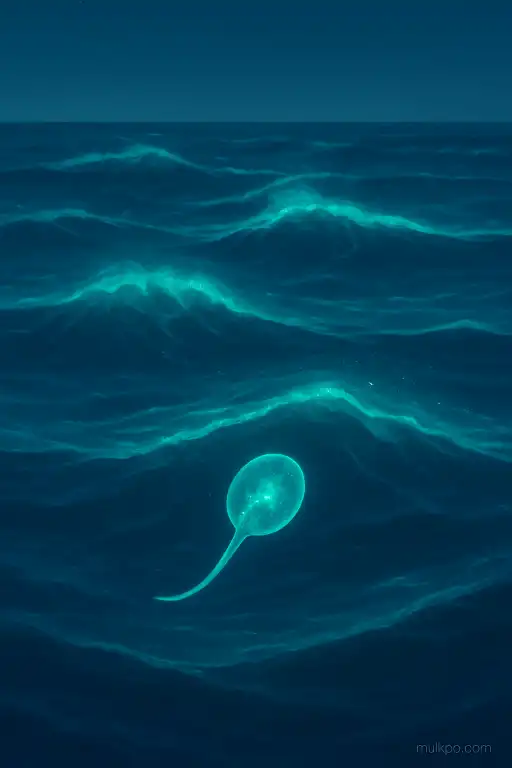
The flashing isn’t meant for humans watching the surf. For many dinoflagellates, it’s closer to a burglar alarm. When a predator bumps or grazes them, the sudden light may startle the predator or draw attention to it. That “attention” idea sounds abstract until you remember that larger hunters can see the flash too. A tiny grazer that triggers light can become more visible to something bigger nearby.
The overlooked detail is timing. Individual cells often flash for a fraction of a second. The reason waves can look continuously lit is that millions of separate flashes are being triggered one after another as turbulence moves through the water. The wave isn’t glowing as one object. It’s sweeping through a dense field of light-capable cells and setting them off like a chain of tiny camera flashes.
How a wave turns scattered flashes into a bright line
A wave face has zones of shear and turbulence, especially as it steepens and starts to break. That mechanical stress is the trigger. The cells don’t need to be crushed. They just need a sudden change in flow around them. Nearshore, the most intense triggering happens in the foamy, churning part of a breaker, which is why the glow often outlines the crest and the collapsing whitewater.
Brightness depends a lot on concentration. When dinoflagellates are sparse, you might only see a few sparks around your ankles. When they’re packed in, a whole wave can trace itself in light. This is also why the same beach can look dull one night and electric the next. The waves may be similar, but the number of light-producing cells in that patch of water can swing dramatically.
Why it happens on some nights and not others
Glowing surf is often linked to blooms, when dinoflagellate populations build up quickly. Blooms can be driven by nutrients, water temperature, and how the water column mixes or stratifies, and the exact mix varies by region and year. On the U.S. West Coast, for example, upwelling can bring nutrients to the surface and support bursts of plankton growth. In tropical lagoons, calmer, protected water can help high concentrations persist.
Moonlight matters more than people expect. The bioluminescence doesn’t necessarily get stronger on darker nights, but the contrast does. A bright moon, nearby city lights, or even the reflective wash of breaking surf can make a real glow look faint. That’s why footage can be confusing: cameras can amplify low light, while the human eye at the same spot might see only a thin rim of blue.
What you’re seeing in famous glowing-water spots
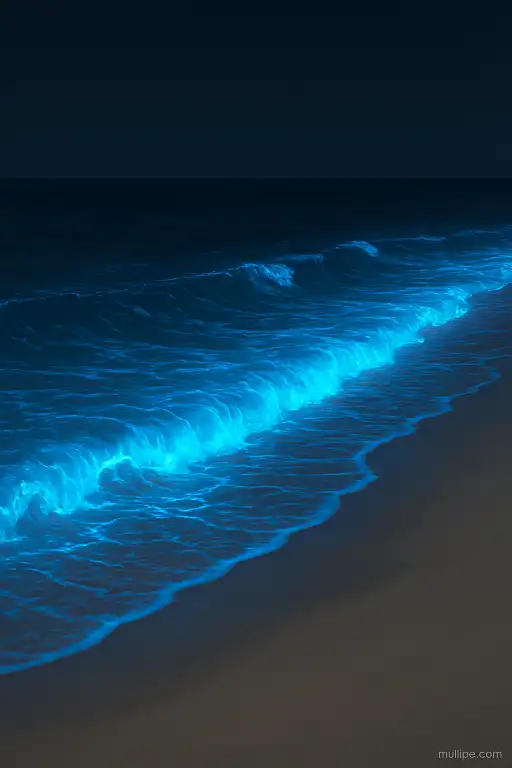
Some well-known locations are bays or lagoons rather than open surf, and the experience looks different. Puerto Rico’s Mosquito Bay is famous for glowing trails behind paddles and boat wakes, because the water is sheltered and the disturbance is localized. In open-ocean surf zones, like parts of Southern California during certain dinoflagellate blooms, the motion is constant and large, so the glow tends to appear as moving bands on wave faces and bursts in the foam.
Not every glow in the sea is dinoflagellates. Some bioluminescence comes from different plankton, and even from larger organisms. But when the light seems to “ignite” exactly where the water is being churned—footsteps, a hand swirl, a breaking crest—that pattern is a strong clue you’re watching mechanically triggered flashes from huge numbers of microscopic cells, all responding to the same physics at the water’s surface.
Related reads
- A park bench packed with thousands of folded notes left by strangers
- How pitcher plants use slippery surfaces and fluid flow to drown prey
- How misheard lyrics rewrite whole songs in your head
- The Victorian engineer who patented safety coffins and set London’s burial panic in motion
- The phantom buzz: why phones feel like they’re vibrating when they’re not
- Why we rehearse arguments long after they’re over