

If you ever shuffled across carpet and sparked a doorknob, you probably noticed something odd: the spark hurts, but you don’t “electrocute yourself” just by carrying charge around. Electric eels are that contradiction, scaled up. They can release hundreds of volts—some reports put big adults near 600 volts—yet they keep swimming afterward. This isn’t one single famous event in one place. It’s a repeating natural trick seen in the Amazon Basin and Orinoco Basin, and in lab tanks at research institutions that study fish physiology. The core reason is simple: their organs and skin route current outward, while their own vital tissues stay off the main path.
Voltage is not the same as current through the body
“Thousands of volts” gets said a lot about electric animals, but voltage is only the push. The danger is how much current actually passes through sensitive tissues and for how long. An eel can generate a high voltage across its electric organ, but it is not automatically forcing that same current through its brain and heart. Most of the current takes an easier route: out through the skin into the surrounding water, then into whatever completes the circuit.
Water matters because it provides a broad return path. In air, a high voltage has to jump a gap as a spark. In water, the field can spread out and the eel can “aim” where the strongest gradient is. That means the eel isn’t bathing itself in equal intensity everywhere. The strongest part of the discharge is concentrated near the head and near the target, not uniformly through the eel’s own core.
The electric organ is built like a battery stack, pointed outward
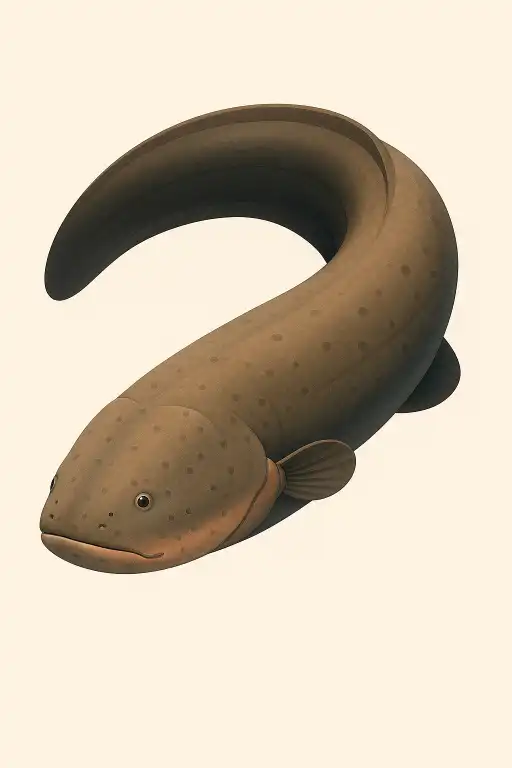
The main power source is the electric organ, made from thousands of modified cells called electrocytes. Each electrocyte produces only a small voltage. They are arranged in series, like battery cells stacked end-to-end, so the voltages add up. The eel’s nervous system triggers them to fire in a coordinated pulse, turning a lot of tiny pushes into one big one.
What people usually overlook is orientation. The stack is arranged so the highest potential difference is along the length of the eel, with one end effectively “more negative” and the other “more positive” during a discharge. That geometry makes it easier to send current out of the body at the ends, through the water, and into a target nearby. It’s not random electricity leaking from every square inch the same way.
Insulation and tissue layout keep vital organs off the main circuit
Electric eels are fish, so their skin is wet, but that doesn’t mean it conducts like bare wire. Their outer tissues present resistance, and the internal layout matters even more. The electric organ sits as large slabs of tissue along much of the body, separated from other organs by connective tissue layers and fluids with different conductivities. Current follows the path of least resistance, and the eel’s body offers it a deliberately “good” path that does not run through the brain or heart.
There is also a timing advantage. The high-voltage pulses are brief. Short pulses can disrupt a prey fish’s nerves and muscles without requiring a long, sustained flow that would heat and damage the eel’s own tissues. So the eel’s physiology is not only about insulation. It’s also about delivering energy in quick bursts that do a job outside the body before it spreads inward.
They control where the field is strongest by how they position their body
A concrete example is the “curl” behavior observed when an eel wraps its body around prey. By bending so the head and tail come closer, the eel changes the shape of the electric field. This can raise the field strength through the prey because the prey sits between two poles that are now nearer and better aligned. The eel is effectively tightening the circuit around the target while still keeping its own most sensitive tissues out of the center of the path.
This is also why distance and angle matter. A prey fish a few centimeters from the head experiences a much steeper voltage gradient than something farther away. In open water, the field spreads and weakens quickly. So an eel can be generating a strong discharge but only strongly “hitting” what is close and positioned in the right place.
Self-shock isn’t impossible—it’s managed and limited
They are not magically immune to electricity. The eel’s own muscles and nerves are active during discharges, and there are tradeoffs in how much it can fire and how often. The system is built so that the worst of the current goes outward, but some internal exposure is unavoidable. The difference is that their anatomy and pulse pattern keep it below the level that would disrupt their own control systems.
One more overlooked detail is that the eel’s discharge is not a single, steady “beam.” It is a patterned burst of pulses whose frequency and timing vary with context—navigation, threat displays, or attacks. That pulse control lets the eel deliver enough current to interfere with another animal’s nerves while keeping its own electrical and muscular systems running normally in the middle of the event.
Related reads
- The bacterium in subway tiles that glows under blue light
- How electric fish create private radio channels underwater
- The ant species that farms aphid livestock across fields
- Why alpine plants curl their leaves at night
- Why bioluminescent plankton pulse when ships pass
- Why Martian dust devils can fling pebbles across plains