
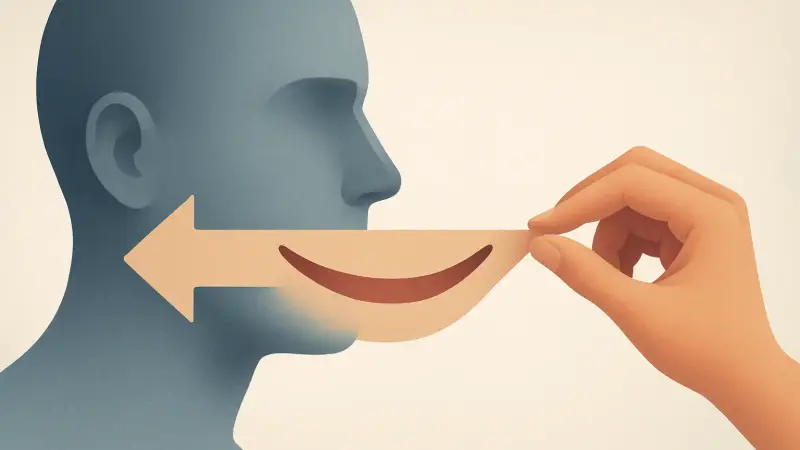
A weird thing you notice in real life
This isn’t one single story with a single place attached to it. It shows up everywhere. In a Tokyo subway car where everyone is exhausted. In a London service counter where the “customer smile” appears on cue. In a U.S. call center where your voice is monitored and a smile is basically part of the script. The odd part is that the face can lead the feeling, at least a little. A grin that starts as pure performance can nudge the body toward “things are okay” signals. Sometimes that shift lands in minutes. Sometimes it doesn’t. The effect isn’t magic, but the mechanism is surprisingly physical.
The face and the brain keep checking each other

One reason a forced smile can change mood is simple feedback. The brain doesn’t only generate expressions. It also reads them. When the muscles around the mouth and cheeks contract, sensory nerves send information back up. The brain uses that input as one more clue about what state the body is in. That clue can slightly shift arousal, attention, and even how threatening the room feels.
A detail people often overlook is that “a smile” isn’t one muscle. A broad grin uses different facial muscles than a tight, polite mouth shape. The eyes matter too. When the muscles around the eyes don’t join in, the brain may read the expression as effortful or fake, which can change what the feedback does. That’s part of why some people feel a quick lift and others feel irritated by the same act.
Breathing and posture quietly change at the same time
Facial expression rarely happens alone. Even a small smile often changes the jaw position, the throat, and the way air moves through the nose and mouth. That can alter breathing rhythm without anyone noticing. Breath is tied to the autonomic nervous system, so small changes can push the body toward slightly calmer patterns. It’s not guaranteed, but it’s a plausible reason the shift can feel quick.
Posture can ride along too. A forced smile often comes with a tiny lift in the cheeks and head position. That can reduce the “closed in” shape people take when stressed. It’s subtle. But the body is sensitive to subtle. When the body loosens a notch, the mind sometimes follows, because the brain constantly updates emotion based on physical state, not just thoughts.
It can change what you notice and how you interpret it
Mood isn’t only chemistry. It’s also attention. When the face signals friendliness, people tend to scan the environment differently. Small neutral cues can be read as less hostile. A coworker’s blank expression can seem less like disapproval. A short email can feel less like a jab. This isn’t a conscious decision. It’s a bias shift in how ambiguous information gets categorized.
A concrete example is the “camera-ready” moment. Someone is tired, then a photo is taken, and the smile comes out automatically. Right after, the room can feel a bit lighter, even if nothing else changed. Part of that is social feedback—other people smile back. Part of it is internal—once the brain tags the moment as safe or playful, it can temporarily reduce defensive processing.
Why it helps sometimes and backfires other times
The effect varies because context matters. If the smile is chosen freely, the brain can treat it as a self-generated signal and integrate it smoothly. If the smile is demanded—by a boss, a customer, or a social rule—it can come with stress. That stress can cancel out any positive feedback from the muscles. This is one reason “emotional labor” jobs can feel draining even when they require constant friendliness.
It also depends on what’s happening in the body already. If someone is deeply anxious or grieving, the nervous system may be too activated for facial feedback to make a noticeable dent. And if the person is tracking the mismatch—“I’m smiling but I don’t feel it”—that monitoring can add tension. In those moments, the forced expression can feel like pressure rather than a reset, even though the same movement in a different setting might have felt like a small relief.
Related reads
- The tiny mental skip that makes a face feel strangely familiar
- That strange moment when your hand feels like it’s not yours
- Why we say sorry for things that don’t need apologizing
- Why video calls make us miss tiny facial cues
- Why bread yeast bubbles leave honeycomb holes in dough
- How glowworms choreograph light to catch flying insects