
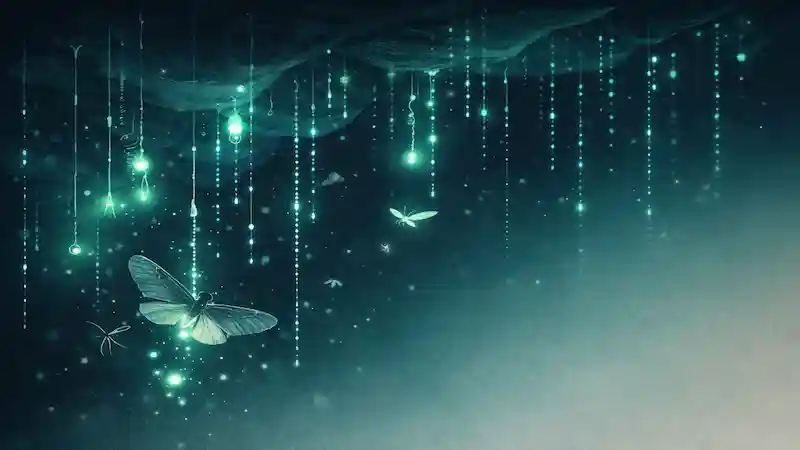
Light that acts like a trap
If you walk into a damp cave or a shaded creek bank at night, you can sometimes see a line of tiny blue-green points hovering in the dark. This isn’t one single “glowworm” story. It varies by species and place, from the Arachnocampa glowworms in New Zealand caves like Waitomo to gnat-like glowworms along streams in parts of Europe. The basic trick is the same: a larva makes light and uses it to pull flying insects toward a sticky, hanging snare. The “choreography” isn’t dancing. It’s timing, brightness, and placement, tuned to what flies past and how easy it is to catch.
Who is making the light, and where it comes from

In famous cave displays, the lights are usually not adult insects at all. They’re larvae. Arachnocampa larvae live on cave ceilings or overhangs and build a little mucus “nest,” then suspend multiple silk lines coated in sticky droplets. The light is produced in a specialized organ near the tail end. It uses the same general chemistry as fireflies: luciferin reacts with oxygen in the presence of the enzyme luciferase, and the energy comes out as visible light instead of heat.
One detail people often overlook is that the glow isn’t just decoration on the ceiling. It’s spatially aligned with the fishing gear. The brightest point is positioned so insects fly toward the light source and end up in the curtain of hanging lines below it. The larva does not need to move much. It needs the “bait” and the “net” to line up in the dark.
How they tune brightness to the night
Glowworms don’t simply glow at one fixed level. Brightness tends to rise when conditions make insect capture more likely. In Arachnocampa, hunger increases light output. That makes sense, because the light is energetically costly and also risky. A brighter point is easier for prey to see, but it can also be easier for predators to spot.
They also respond to ambient light. When moonlight or artificial light makes the background brighter, the lure becomes less effective, and some species reduce output. In a dark cave, the same larva can look intensely bright because the contrast is extreme. That contrast matters more than absolute brightness. The insect’s eyes are making a quick decision while flying, and the glowworm is working with that moment.
Choreography as spacing and timing, not synchrony
People sometimes imagine a coordinated, synchronized light show. What you usually see is something subtler. Each larva adjusts its own glow based on its state and its micro-spot on the ceiling. When many larvae share a surface, the result can look organized because the environment is organized. The best sites have steady humidity, airflow, and the right traffic of insects. Larvae occupying those “good seats” can sustain brighter lures and more snare lines.
Spacing matters because the trap is physical. If two larvae are too close, their sticky lines can tangle, and an insect pulled toward one light might hit the other’s lines. That sets up a kind of informal spacing rule over time. The “pattern” people see is often the long-term outcome of individuals settling, competing, and surviving in the spots where the lure and the fishing lines work cleanly.
What an insect experiences in the last second
A flying insect in a dark corridor tends to steer toward the brightest point in its field of view. In places like Waitomo, the ceiling lights become the dominant reference, and a gnat or moth can drift upward toward them. The glowworm doesn’t need to “aim” at a specific victim. It needs to bias flight paths so random traffic intersects the sticky curtain below.
The overlooked part is what happens after contact. The hanging lines have spaced droplets, not one continuous glue smear. That droplet spacing changes how an insect struggles. Each movement can snag a new droplet, increasing adhesion like adding extra anchor points. Then the larva reels the line in, not quickly, but steadily, using the silk as a winch cable until the prey reaches the mouthparts.
Why the cave “sky” looks so even
In a good glowworm cave, the scene can look uncannily uniform. Part of that is human perception. Your eyes and camera adapt to darkness and compress differences, so lots of slightly different brightness levels read as “the same.” Part of it is the habitat. Cave ceilings can provide consistent moisture that keeps the sticky droplets from drying out, and stable airflow that carries insects through predictable routes.
And some of it is simply turnover. Larvae that can’t catch enough food don’t stay bright forever. They dim, grow slowly, or die, and the remaining lights belong to individuals that are well fed, well placed, and actively maintaining their lines. So the “choreography” you see on a given night is partly biology and partly selection playing out on a ceiling, one insect at a time.

Related reads
- The rock in a backyard that turned out to be a meteorite and what it revealed
- How touch-me-not plants fling seeds with a springy snap
- How gut microbes change after a course of antibiotics
- The bacteria discovered chewing plastic in ocean gyres
- How hummingbirds hover by twisting their wings
- Why weeds often sprout between sidewalk cracks