
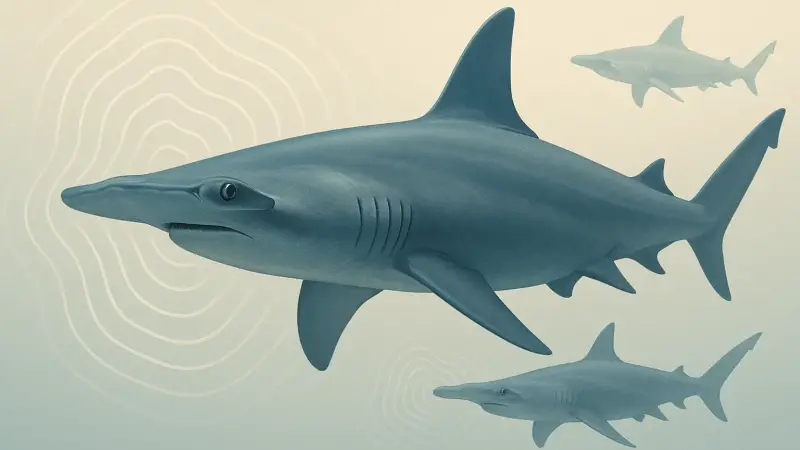
People usually imagine sharks hunting with smell or sight. But a hammerhead can still “find” a fish that’s buried in sand and not moving much. This isn’t one single famous event in one place. It’s a built-in sense seen in hammerheads around places like Florida, the Galápagos, and Australia. The core mechanism is electrical. Living animals leak tiny electric fields as nerves fire and muscles contract. Hammerheads detect those weak signals with special pores on their skin. Then the wide, flattened head helps the shark compare the signal from one side to the other and steer in.
The electric sense comes from pores, not “extra eyes”
Hammerheads use structures called the ampullae of Lorenzini. They look like little dots on the snout and underside of the head. Each dot is a pore that opens into a jelly-filled canal. The canal ends at a sensory bulb packed with nerve endings. That jelly conducts electricity well, so a tiny voltage difference between the pore and the inside of the shark can be turned into a nerve signal.
These organs don’t “see” shapes. They detect changes in voltage across the skin. The fields are extremely weak. They’re closer to background static than to a clear signal. That’s why the system is built for sensitivity, not detail, and why the shark’s nervous system has to do a lot of filtering.
What creates the electric fields in the first place
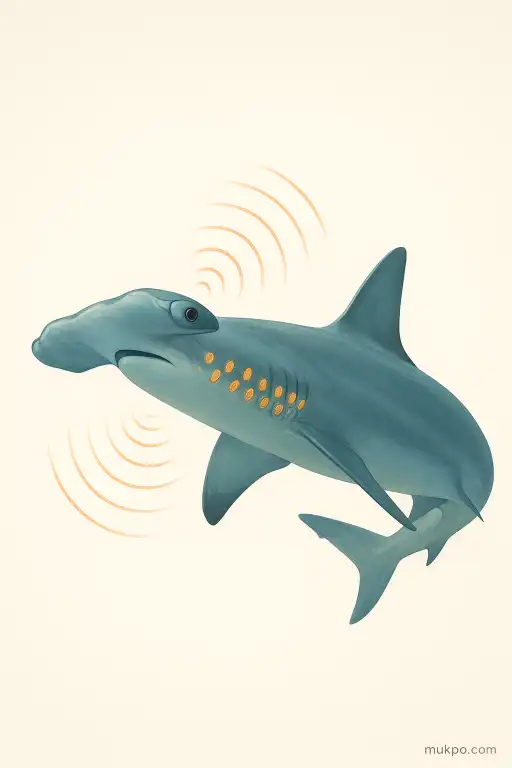
Any animal with nerves and muscles produces small electrical currents. A fish’s gill muscles, a ray’s fin muscles, and the rhythmic firing that controls swimming all leak a faint field into the surrounding seawater. Even an animal that is “still” is usually still breathing, holding posture, and firing sensory nerves. Those processes keep a detectable field present.
A detail people overlook is that seawater matters here. Salt water conducts electricity far better than fresh water, and that changes how these fields spread. The signal drops off fast with distance, and it’s easily distorted by turbulence, temperature layers, and the animal’s orientation. So the shark is typically using this sense at close range, when other senses have already narrowed down the search.
Why a hammer-shaped head helps with direction
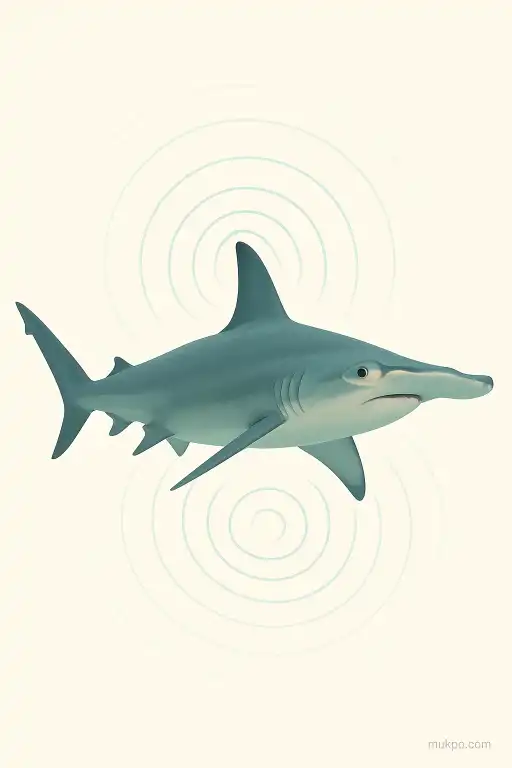
The wide head is not just a weird silhouette. It spreads the sensors apart. When the shark approaches a source, the pores on the left and right sides experience slightly different voltages. That difference gives the brain directional information. It’s similar in concept to how two ears help an animal localize sound, except the cue is electrical rather than acoustic.
This spacing also helps when the shark is sweeping its head while searching. Small head movements change the pattern of input across the pores. The brain can use those changes to correct course. The effect depends on the species and head shape. A scalloped hammerhead and a great hammerhead do not have identical head widths, so the “baseline” spacing and the strength of left-right comparisons likely varies.
A concrete example: finding a hidden stingray
A common situational example happens on sandy flats where stingrays bury themselves. A ray can cover its body with sand so only the eyes and spiracles are exposed, and sometimes even those are hard to spot. A hammerhead cruising low over the bottom can still detect the ray’s bioelectric field through the sand-water boundary, because the field is not “light” that gets blocked the same way vision does.
At that point, the shark tends to dip and angle its head, as if sampling. The goal is to pinpoint the highest gradient, not to “sense the whole ray.” If the shark gets very close, the signal becomes stronger and more reliable than smell in turbulent shallows. That’s one reason this sense is often described as a final targeting tool, used when the prey is nearby and hiding.
What can confuse the signal, and how sharks cope
Electrical sensing has to compete with a noisy ocean. Moving water can change ion concentrations around the skin. Waves and shifting sand can generate small electrical effects. And the shark itself produces electrical activity. So the brain has to separate “self” from “other” and ignore slow drifts while staying alert to sharp, localized changes.
There’s also another electrical source in seawater: the interaction of Earth’s magnetic field with moving conductive water and with the shark’s own movement. Many sharks appear to use magnetic cues for navigation, and the ampullae are often discussed as part of that story. The exact balance between magnetic sensing and prey-detection depends on context and is not perfectly settled for every hammerhead species, but the same hardware can support both jobs.
Related reads
- How three lighthouse keepers vanished from a Scottish isle in 1900
- The 17th-century Ottoman court that negotiated with a nonexistent envoy
- An apartment block where every mirror vanished overnight
- The bat tongue that scoops nectar with brushlike hairs
- How brief mirror practice changes the way you move
- The statue whose bronze weeps salty streaks after foggy nights