
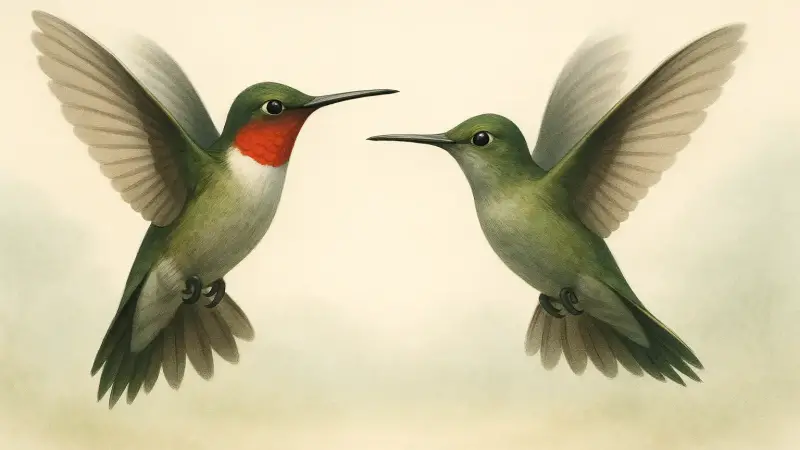
Seeing a bird stop in midair
At a backyard feeder in places like Arizona or Southern California, a hummingbird can look like it hits pause. Its body stays almost still. The head makes tiny adjustments. The tail flicks. The hover isn’t magic, and it isn’t just “fast flapping.” It works because the wings don’t simply move up and down like most birds. They twist as they sweep, so each stroke can keep producing lift even when the wing is moving “backward.” That twist is the key mechanism, and it happens over and over, dozens of times per second, while the bird keeps its body steady.
The shoulder joint does most of the work

In most birds, the wing beats like a lever: strong downstroke, weaker upstroke. Hummingbirds are built differently. Their shoulder joint allows the wing to rotate through a wide arc, closer to a figure-eight pattern than a simple flap. The upper arm stays relatively fixed compared with the dramatic motion you see in the hand portion of the wing. That anatomy is what makes twisting possible without the whole body rocking back and forth.
The twist is partly passive and partly controlled. The bird’s muscles drive the stroke, and the wing’s structure and airflow help it “flip” at the ends of each sweep. You can sometimes catch this on high-speed video: the wing turns edge-on briefly, then presents its surface again. That rapid rotation is where a lot of the hover control comes from.
Lift on both strokes, not just one
When a hummingbird sweeps its wing forward, the wing is angled to push air down and back, creating lift. Then, on the return sweep, the wing twists so it can again push air down, even though it’s traveling in the opposite direction. That’s the big difference from a typical songbird, where the upstroke is often more of a recovery motion. With hummingbirds, both halves of the cycle can contribute meaningful lift.
A detail people often overlook is how short the “flip” phase is. The wing doesn’t spend much time turning around compared with the time it spends sweeping. That matters because hovering needs near-continuous support. Any long pause between lift-producing strokes would show up as a bobbing body. The quick twist reduces that gap.
Air tricks at the wing’s front edge
Twisting the wing also sets up the airflow the bird needs. At the right angle, the leading edge of the wing can maintain a stable, swirling pocket of air over the surface for a moment. This helps the wing keep generating lift at angles that would stall a rigid, fixed wing. The effect depends on speed, wing shape, and exactly how the twist is timed, so the details can vary by species and by what the bird is doing.
This is one reason hovering looks smooth even though the wings are beating so fast. The force isn’t delivered in one big shove and then nothing. It’s moderated by how the wing meets the air through the whole sweep. If you watch closely, you can see the body stay level while the wings blur, because the bird is managing airflow rather than brute-forcing it.
Staying in place is constant correction
A hover is never perfectly still. Hummingbirds are always correcting. Tiny changes in wing twist can shift force forward, backward, left, or right. That lets the bird hold position in front of a flower or a feeder port even when the air is moving. The tail and body angle help too, but the wing twist is the fast control surface. It’s the part that can be adjusted within a single beat.
You can see this in a concrete way at a feeder when another bird approaches. The hummingbird doesn’t need a running start. It can slide sideways, rise a few centimeters, or back out from the feeder while still hovering. Those little translations come from slight asymmetries—one wing twisting a bit differently than the other for a moment—so the net force tilts without the bird having to swing its whole body around.

Related reads
- Why weeds often sprout between sidewalk cracks
- How pitcher plants dissolve insects with acid and enzymes
- Why comet tails always point away from the Sun
- How coral reefs time mass spawning with the moon
- Why pumice rafts let plants and insects colonize distant islands
- Why raindrops make different sounds on metal and wood