

A simple question people rarely ask
How would you even use a catapult against sickness? The story people repeat is blunt: during the 1346 siege of Caffa (today Feodosiya in Crimea), Mongol forces under Jani Beg allegedly flung plague-infected corpses over the walls. The mechanism is straightforward. A besieged city is crowded, stressed, and short on clean space. If bodies land inside, they force handling, burial, and contact with fluids and filth. Whether that reliably “starts” plague is less clear. But the idea of turning death into a delivery system is easy to picture, which is why the episode keeps resurfacing.
What the sources actually say
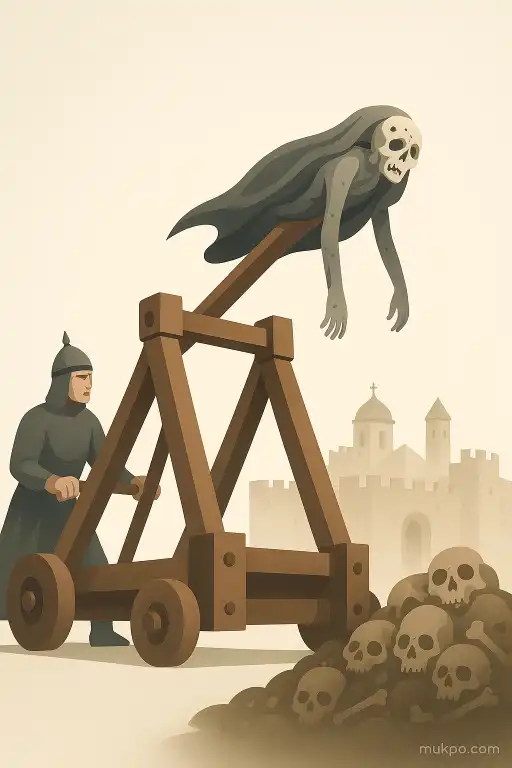
The most cited account comes from the Italian notary Gabriele de’ Mussi, who wrote that the besiegers, struck by a deadly disease, hurled corpses into the city to spread it. De’ Mussi was not known to have been at Caffa himself. That matters because siege stories travel fast and get cleaned up into a single dramatic act. Other contemporary or near-contemporary references to Caffa focus more on panic, flight, and the movement of ships than on a detailed “plague catapult” scene. So the claim is not made up out of thin air, but it rests heavily on one narrative that may be secondhand.
A detail people usually overlook is that this story does not need to be perfectly accurate to describe something real. Medieval armies did sometimes throw dead animals, human remains, or waste into fortified places to foul wells and make defenders miserable. That older practice existed even when nobody knew what bacteria were. The Caffa version adds plague to a tactic that already fit the logic of siege warfare: make the inside of the walls unlivable.
How a corpse could make people sick (and how it might not)
Plague is usually associated with fleas on rodents, and that can make the “corpse projectile” idea sound wrong at first glance. But a siege compresses risks. People have to pick up what lands, drag it away, and dispose of it. They may do it barehanded, or with minimal protection. If the dead were recently ill, there could be infected fleas in clothing or bedding, and there could be exposure to body fluids in the frantic cleanup. Even without plague, decaying bodies raise the chance of other infections and dysentery when sanitation collapses.
There are also reasons the effect could be limited. Fleas do not automatically stay on a cooling body forever, and launching a corpse is violent and unpredictable. Plague transmission depends on timing, temperature, vectors, and the presence of local rodents and fleas ready to carry the disease further. A city already suffering crowding and malnutrition might see outbreaks no matter what gets thrown in. That makes it hard to separate “catapulted bodies caused plague” from “plague arrived because the region was already saturated with it.”
Why siege conditions make disease feel like a weapon
Even if nobody deliberately “engineered” an epidemic, a siege amplifies every small contamination event. Water sources get compromised. Garbage piles up. Rats and insects thrive in the cracks. People sleep packed together, and they stop moving around the city normally. The defenders’ usual routines for cleaning streets and isolating the sick break down first, because everyone is focused on the walls. A single shocking act—like a body landing in a courtyard—can also change behavior. People panic, crowd into churches or cellars, and share air and bedding more than they would otherwise.
There is also a psychological reason the story sticks. It turns an invisible threat into something you can point at. If plague is “thrown” over the walls, then the enemy is not just outside the city. The enemy is inside the courtyards and wells. That framing fits how people described disease before germ theory: as corruption, taint, and poisonous air, not as a microbe hopping across a chain of hosts.
What the Caffa story gets used for
Modern retellings often treat Caffa as the first clear case of biological warfare. That’s an appealing label, but it can flatten the messiness. Medieval commanders did not need a laboratory to see that rot and stench weaken a city. They also did not need to understand plague’s ecology to try desperate measures when their own camp was dying. If a besieging army is losing men, flinging bodies could be a way to dispose of them quickly while also pressuring the defenders.
The other common use of the story is as an origin point for the Black Death entering Europe, via fleeing merchants from Caffa. Movement by ship from the Black Sea to the Mediterranean did happen, and plague did spread along trade routes. But tying an enormous pandemic to one dramatic tactic is much shakier. It’s more accurate to say the siege sits inside a larger web: warfare, commerce, and constant travel across the Mongol-linked routes of Eurasia. The catapult detail may be true, partly true, or a sharpened rumor that survived because it explains fear in one brutal image.
Related reads
- A garage sale that turned up a trunk of handwritten novels no one claimed
- The colonial standoff over the Ashanti Golden Stool and the symbol no one would hand over
- When Ottoman succession customs let new sultans quietly eliminate brothers to secure the throne
- Why you keep rehearsing conversations you never have
- The commuter train that adopted a stray cat as its official conductor
- The winter night of 1916 when conspirators tried to poison, shoot and drown Rasputin in a St. Petersburg house