

Not one sidewalk, but a pattern you can spot
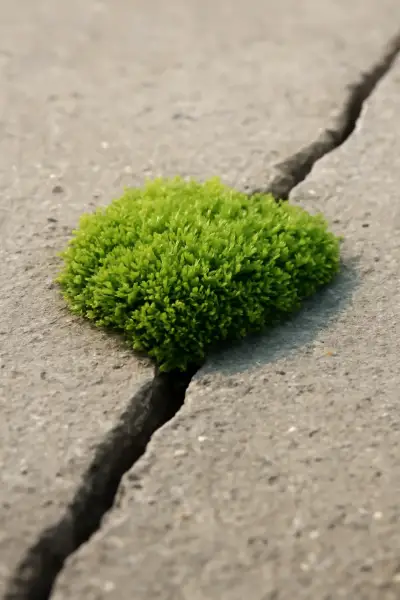
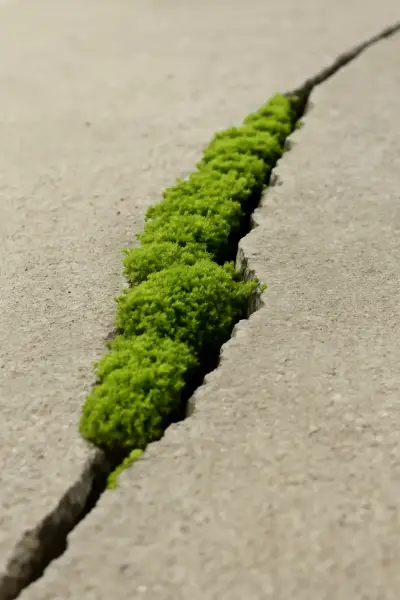
You see it in a lot of places, not just one famous street: along Seattle sidewalks after a long wet season, in Edinburgh closes where stone stays damp, and in Tokyo alleyways where shade lingers between buildings. A thin green patch appears in one crack and not the next. That “choice” isn’t a decision so much as a filter. A crack becomes a good home when it stays wet long enough, gets enough light to photosynthesize, and offers a surface that spores can stick to without being scraped off right away. A few small differences at the scale of millimeters decide which crack gets colonized first.
Moisture lasts longer in some cracks than others
The biggest factor is how long a crack holds water after rain or watering. Depth matters, but shape matters more than people think. A narrow crack can act like a tiny capillary tube, pulling water down and holding it there even when the pavement looks dry. A wider gap may drain fast and dry out, especially if wind can move through it.
Orientation changes everything. A crack that runs slightly downhill will wick and collect runoff from a larger area. One that crosses the slope can shed water. Even the presence of a curb or a small lip of concrete can create a little “backwater” spot where dampness lingers for hours longer than the open slab beside it.
Light is a gate, not a bonus
Moss needs light, but not the kind of full-sun exposure that cooks a thin film of water off the surface. The best cracks often sit in bright shade: next to a wall, under a fence line, or at the edge of a shrub where the sun is blocked for part of the day. Two cracks a foot apart can have totally different daily light cycles if one falls under a railing’s shadow.
A specific detail people usually overlook is the glare and heat from the pavement itself. Dark asphalt and some concrete mixes heat up and radiate warmth into the crack. That can turn a “good” damp crack into a dry one by mid-afternoon. A crack beside a lighter surface, or beside stone that stays cooler, may keep the thin moisture layer moss relies on.
Spores land everywhere, but only some can stay put
Moss spreads by spores that are small enough to ride wind and splash. They land on most sidewalks sooner or later. The limiting step is sticking. A smooth, recently poured slab gives little for a spore to cling to. A crack with rough, sand-grain texture, tiny pits, or flaking aggregate gives more grip and more sheltered micro-spaces where a spore isn’t immediately knocked away.
Then there’s disturbance. Sidewalk cracks get scuffed by shoes, bicycle tires, brooms, and the thin scrape of grit being pushed around by rain. A spore that lands on an exposed edge can be removed in a day. One that lands a few millimeters deeper is protected. That difference is so small you wouldn’t notice it without getting down close, but it changes whether moss can get past the vulnerable first stage.
The first green film changes the crack’s chemistry
Once a little moss (or sometimes algae first) establishes, it alters the crack. It traps dust and fine soil, which holds water longer. It also slows evaporation by breaking up airflow right at the surface. That makes the spot more stable for the next wave of growth, even if the original conditions were only barely good enough.
The surface chemistry can matter too, and it varies. Fresh concrete tends to be more alkaline, which some mosses tolerate better than others. Over time, weathering and grime shift that. Add in tiny nutrient inputs—leaf litter, dog urine, a bit of fertilizer washing off a nearby lawn—and the crack becomes less like bare mineral and more like a miniature soil bed. You can sometimes see this progression in one place: an almost invisible green haze deep in the crack, then a thicker mat where dust has collected at a joint, then little tufts where the crack meets a low spot that stays damp.
Related reads
If you liked this, you might also enjoy: