
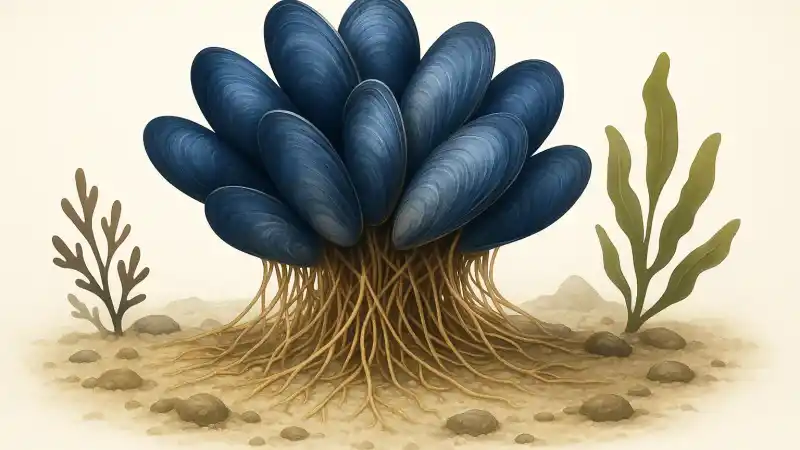
At low tide, a mussel bed can look like a pile of loose shells that should slide off the rock. But in places like the Pacific Northwest, the coast of Maine, and Scotland’s rocky shores, those clusters stay put through surf that can knock a person over. The hold comes from byssal threads: tough filaments a mussel makes and sticks to stone, other shells, or even seaweed. Each thread is a tiny anchor line with glue at the end. Together they turn individual animals into a single, grippy surface that other intertidal life can build around.
What a byssal thread is, up close
A mussel makes byssal threads with a muscular “foot” it extends out of the shell. The foot presses onto a surface and releases proteins that cure in seawater into an adhesive plaque. Then the mussel pulls back, leaving behind a taut thread connected to that plaque. It repeats this many times. The result is a bundle of threads that can be replaced, tightened, or added to as conditions change.
One overlooked detail is that the glue doesn’t just stick like tape. It has to work while wet, on surfaces that may be slimy, gritty, or coated in biofilm. That’s part of why mussels can attach to wave-washed rock where many other organisms struggle to get a clean grip.
From individual anchors to a living net
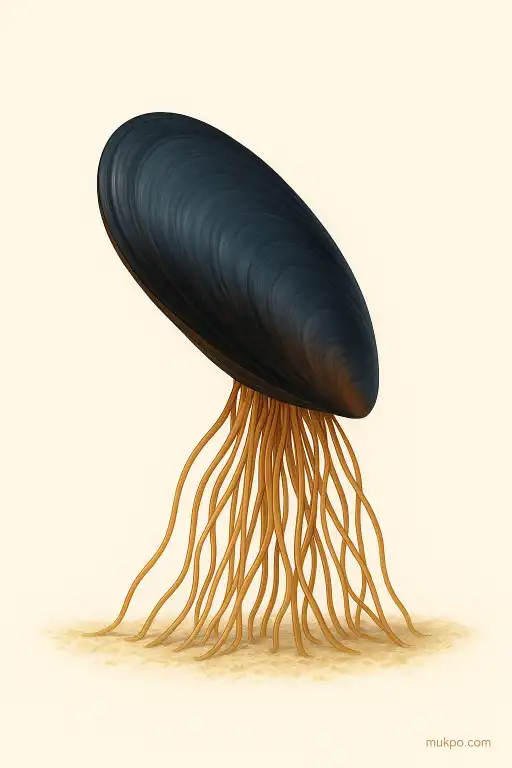
A single mussel can anchor itself, but a bed acts differently. Threads tangle and cross-link between neighbors, so the attachment isn’t just mussel-to-rock. It becomes mussel-to-mussel-to-rock. That matters when waves hit. Force gets spread across many bodies and many attachment points instead of snapping one animal loose.
This is why beds often have a distinct edge and a more stable interior. The outer rim takes more direct wave drag and gets peeled back more often. The middle is buffered. Inside, mussels can hold position long enough for smaller residents to settle and survive between shells and under the thread mat.
The bed becomes habitat, not just a pile of shells
Byssal threads create structure in a place that is otherwise hard and exposed. The gaps between mussels trap water as the tide drops, keeping humidity higher for longer. That tiny bit of retained moisture can be the difference between surviving and drying out for small invertebrates. The threads themselves add extra surfaces for larvae to snag on, and for detritus and microalgae to collect.
A concrete example shows up during a calm low tide: lift the edge of a mussel clump and there is often a damp, shaded layer underneath. Tiny crabs, juvenile snails, and worms can be there, along with bits of sand and broken shell held in place by the thread network. That sheltered underside is easy to miss because the bed looks solid from above.
Anchoring changes who can live on the rock
When mussels hold a patch of shoreline, they change the competitive game. Bare rock is a high-stress surface where only certain barnacles, algae, and hardy grazers can hold on and avoid drying. A mussel bed replaces that with a textured, cooler, wetter platform. That allows different species to persist, including animals that would be swept away or desiccated on open stone.
It also affects predators. Sea stars, for example, can pry and pull at mussels. But dense attachment and tight packing raise the effort needed to remove one shell. Predation still happens, and it varies by coastline and species, but the thread web and the crowding can slow the rate at which predators can open up space.
Threads are constantly adjusted as conditions shift
Byssal threads are not permanent bolts. Mussels can add new threads when the water gets rough, and old threads can wear out from abrasion on rock or from repeated stretching. Temperature, wave exposure, and even how much suspended grit is in the water can change how fast threads degrade. That means a bed’s “strength” is something the animals maintain, not something they achieve once.
That maintenance is one reason mussel beds can expand and shrink like living patches. After storms, edges may be stripped and the interior may remain. Then, as mussels reattach and recruit into gaps, the thread mat rebuilds. The community that depends on that structure rides along with those changes, shifting with the stability of the anchor network.
Related reads
- The bakery that times its loaves to the passing freight trains
- The coffeehouse pitch in 1719 that fanned the South Sea Bubble
- A hidden stash of decades old receipts that paid someone s rent
- Why waiting in line feels longer than the same wait at home
- How two Yorkshire cousins convinced Edwardian Britain that fairies danced in their garden
- How a bark beetle epidemic transformed 20th century North American forests