
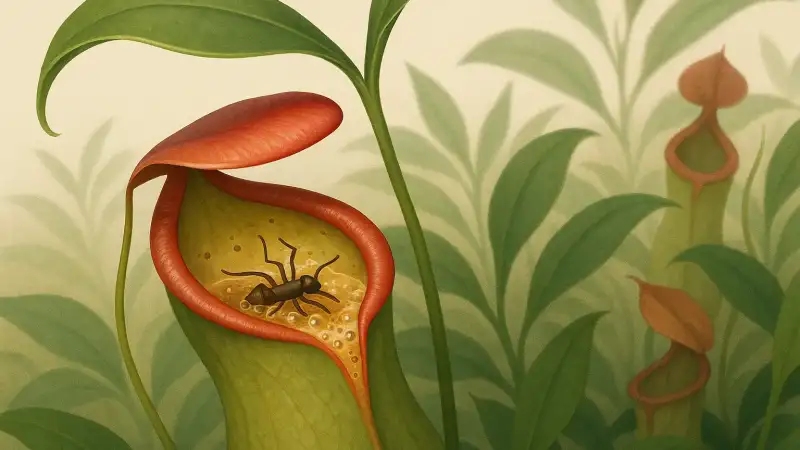
A leaf that acts like a stomach
If you walk through a bog in North Carolina’s Green Swamp, you can find plants that don’t just trap insects. They digest them. This isn’t one single “pitcher plant” story, either. It plays out in different ways in places like the southeastern United States (Sarracenia), Borneo (Nepenthes), and parts of Europe with related carnivorous plants nearby. The core mechanism is surprisingly straightforward. An insect slips into a tube-shaped leaf, ends up in a pool of digestive fluid, and that fluid breaks the body down using acid and enzymes, then the plant absorbs the released nutrients.
Getting the insect into the liquid

The “pitcher” is a modified leaf shaped into a deep cup or tube. Nectar and scent cues can bring insects to the rim. The surface near the opening is often the real trick. It can be slick when wet, or coated with waxy crystals that crumble under a foot. Some pitchers also have downward-pointing hairs that make climbing out harder than falling in.
A detail people tend to overlook is that the lip and upper wall can change behavior with humidity. A rim that seems grippy in dry air can turn into a skating rink after a light rain or morning dew. That means the “trap strength” isn’t constant. It depends on conditions right at the mouth, where the insect is making tiny traction decisions.
What the digestive fluid is like
Once the prey hits the fluid, the environment shifts from “pond water” to something more like a controlled chemical bath. The acidity varies by genus and species, and even by how full the pitcher is, so it’s not one fixed number. Some Nepenthes species maintain notably acidic fluid, while others rely more on enzymes and microbial partners. Either way, low pH helps in two ways: it stresses or kills the insect faster, and it makes proteins easier to unfold so enzymes can attack them.
The fluid is not just acid. It is also a mix that can include surfactants, which reduce surface tension. That matters because an insect that might otherwise float can sink and stay submerged. In some pitchers, the liquid can look calm but behaves “wetter” than water, so struggling doesn’t buy much time.
The enzymes that do the dissolving
Enzymes are the workhorses. Proteases break down proteins into smaller peptides and amino acids. Chitinases help attack chitin, a major component of insect exoskeletons. Phosphatases can liberate phosphate from organic molecules. The exact enzyme lineup varies, and it is not always clear how much is made by the plant versus contributed by microbes living in the fluid. What’s consistent is the direction of travel: big, tough biological structures get chopped into soluble pieces.
This doesn’t happen instantly. Soft tissues can go first, while tougher parts like wings and heavily sclerotized body segments linger. Over time, even those get eroded as enzymes keep working and as bacteria and other organisms in the pitcher process what the plant can’t directly digest. In some systems, the pitcher acts less like a sterile test tube and more like a managed community where multiple players turn an insect into absorbable nutrients.
Absorbing nutrients without “eating” like an animal
The plant doesn’t swallow. It absorbs. The inner surface of many pitchers has specialized zones. Near the lower portion, cells can take up dissolved nitrogen and phosphorus compounds from the fluid. Transport proteins move these nutrients across cell membranes, then the plant routes them into growth and reproduction. This is one reason carnivory shows up in bogs and sandy wetlands: the soil can be acidic and nutrient-poor, even when there’s plenty of sunlight and water.
A concrete scene helps: a fly lands on a Sarracenia rim, drinks, slips after a rain, and drops into the tube. Within the pitcher, the chemistry and enzymes start dismantling it, but the plant also has to manage dilution. Heavy rainfall can water down the digestive pool, so some species have lids and shapes that reduce direct filling, while others tolerate dilution and lean more on enzyme production and the pitcher’s resident organisms to keep breakdown going.
Keeping the trap working over time
A pitcher is a temporary organ. It has to stay functional long enough to pay back its construction costs. That means preventing the fluid from turning into a useless rot bucket. Acid helps, enzymes help, and so does the plant’s control over what gets into the pitcher. Some pitchers can limit overflow or restrict large debris. Others “accept” a messy interior and still come out ahead because even partial digestion provides scarce nitrogen.
There’s also a timing element that varies. Some pitchers ramp up enzyme levels after prey arrives, rather than keeping the same concentration all the time. That saves energy but makes the first hours after a fall-in look deceptively quiet. From above, it can seem like nothing is happening. Down in the fluid, proteins are unfolding, bonds are being cut, and nutrients are already starting to move into the leaf wall.

Related reads
- Why comet tails always point away from the Sun
- How coral reefs time mass spawning with the moon
- Why pumice rafts let plants and insects colonize distant islands
- Why raindrops make different sounds on metal and wood
- The orchid that mimics a female moth down to the scent molecules
- How electric eels prevent self-shock while stacking thousands of volts