

That small “why is this so hard?” moment
It isn’t one single event or place. It shows up everywhere, from commuting in London to answering Slack messages in a U.S. office to cooking dinner in a small apartment. Someone is pouring coffee while reading a text, and the mug bumps the counter. Someone is driving and trying to follow spoken GPS while also thinking through a work call, and a simple lane change suddenly feels loaded. The core mechanism is plain: attention is limited, and splitting it forces the brain to keep switching which task gets the “front seat.” That switching has a cost, even when both tasks seem easy.
Attention doesn’t split cleanly, it switches
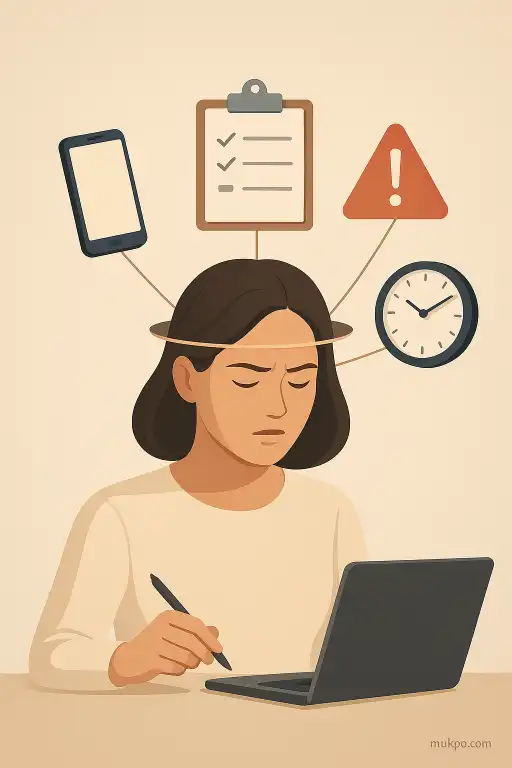
People often describe it as doing two things at once. For most ordinary tasks, it’s closer to rapid toggling. One stream gets processed, then the other, back and forth. Each toggle requires a tiny reset: reloading the goal, the next step, and where things were left. That reset time is small, but it repeats. It’s why a short interruption can make a short task feel longer than it “should.” The work includes getting back into the work.
This is also why the difficulty can feel strange. The tasks themselves haven’t changed. The brain is doing extra coordination in between them. That coordination is mostly invisible from the outside, so the only thing that stands out is the sense of friction.
Working memory gets crowded fast
Many everyday actions rely on a small mental scratchpad. It holds the phone number long enough to dial it, the next turn you’re waiting for, the pan you meant to check in two minutes, the sentence you’re halfway through. When attention gets split, that scratchpad fills with competing fragments. The brain then spends time refreshing what matters and discarding what doesn’t. That refreshing can feel like “blanking,” even when nothing is wrong with memory in general.
A detail people usually overlook is how often tasks contain hidden state. A spreadsheet isn’t just numbers; it’s which cell you were about to edit and why. Cooking isn’t just stirring; it’s how browned the onions looked ten seconds ago. When attention shifts, that state decays, and the brain has to reconstruct it from clues.
Ordinary tasks have fragile timing
Split attention doesn’t just slow thinking. It can disrupt timing. Many “simple” activities depend on micro-predictions: when to brake, when to lift the spoon, when to start the next sentence so a conversation flows. Switching attention adds jitter. It’s not always dramatic, but it’s enough to create near-misses, awkward pauses, or small spills. The task then feels harder because it demands more monitoring to stay on track.
A concrete example is trying to type a short email while also listening to a meeting. The email isn’t hard and the meeting isn’t hard, but both have timing demands. The moment the meeting mentions a key term, attention snaps to it. The sentence you were typing loses its thread. You return and reread the last line to rebuild what you meant. The rereading feels like extra work because it is extra work.
Effort rises before errors show up
One odd feature is that people can feel overloaded even when they’re still performing “fine.” The brain can compensate for a while by pushing harder: more checking, more self-monitoring, more slowing down. That effort can show up as irritation, mental fatigue, or the sense that the task is slippery. Errors often come later, after the compensating system gets tired or the environment demands a faster response.
That’s why the hardest part can be a stretch of time that looks calm from the outside. There may be no obvious mistake. It’s the constant rebuilding: reloading context, re-parsing what was just said, re-finding the place on the page, re-confirming what the hands are doing. When those resets stack up, even an ordinary errand can start to feel heavier than it has any right to feel.
Related reads
- How Victorian salons turned arsenic into beauty and scandal
- The museum plaque that rewrote itself every morning
- How a nine-day queen became a pawn in the Tudor succession crisis
- When a streetlight began syncing its blink to residents footsteps
- A supermarket that redirected abandoned carts into a hidden community garden
- The town that numbered its stray cats and issued them identity cards