
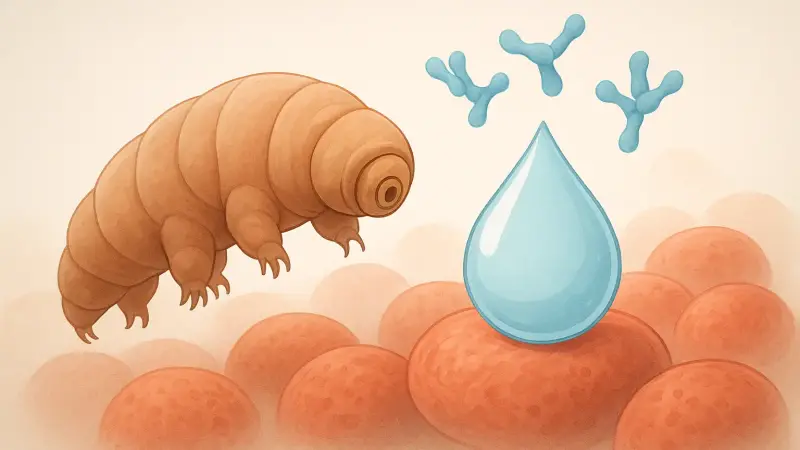
Drying out usually ruins cells
A grape can turn into a raisin and still be food. A cell can’t do that. When water leaves a cell too fast, the membranes wrinkle and crack. Proteins misfold. DNA gets stressed. It’s not one single place or event, so the best way to picture it is by where it’s been observed: tardigrades on roof moss in London, in Antarctic soil, and in Japanese hot springs (the exact species varies by site, and not all are equally tolerant). Some of them survive extreme drying by switching into a “tun” state. The key is that certain tardigrade proteins change how the inside of the cell behaves when water disappears.
The overlooked detail is the speed problem. Drying damage is not just “no water.” It’s the transition. As water leaves, salts concentrate and chemical reactions spike. Surfaces that were separated by a thin film of water suddenly touch and stick. That’s when structures collapse.
What tardigrade proteins do as water drops
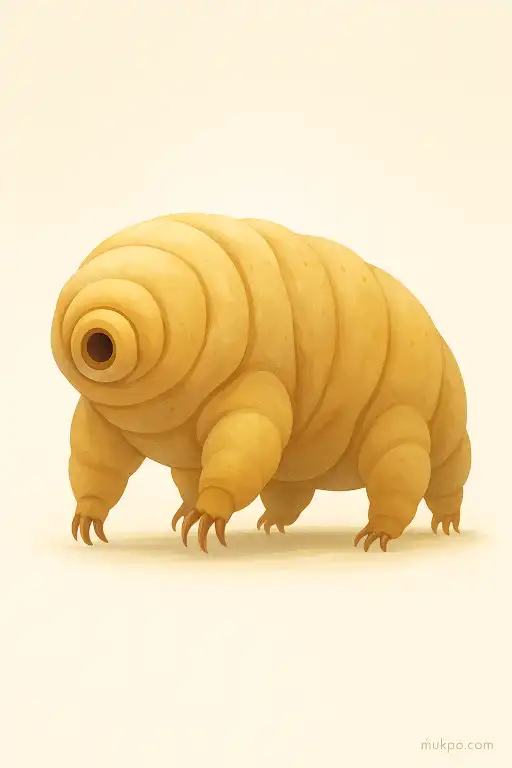
Tardigrades make unusual, highly flexible proteins that don’t settle into one fixed shape. Many are called intrinsically disordered proteins, including groups researchers often refer to as tardigrade-specific disordered proteins. In normal conditions they float around like loose strands. As water becomes scarce, they start interacting with each other and with other cell components. Instead of relying on a perfect folded shape, they work because they can rearrange quickly.
As dehydration continues, these proteins can form a protective matrix. Some lab studies describe this as vitrification: the cell interior becomes more glass-like and less fluid. That matters because it slows down the unwanted chemistry that accelerates during drying. It also helps hold membranes and protein complexes in place so they don’t collapse into damaging contacts.
A physical shield, not a chemical fix
A common assumption is that survival must come from “repairing” damage after the fact. With desiccation, much of the trick is preventing damage by changing the cell’s physical state before things fall apart. A more rigid, crowded interior limits diffusion. That reduces the chance that reactive molecules slam into vulnerable targets. It also reduces the tendency of proteins to unfold and then clump together, which is one of the most irreversible kinds of drying injury.
This is also why timing and location inside the cell matter. Some protective proteins concentrate near membranes or around sensitive complexes. Not every protective component has to be everywhere. A thin stabilizing layer in the right place can stop a cascade of failures that would otherwise spread.
How scientists know these proteins matter
The evidence mostly comes from controlled experiments rather than field observations. Researchers can put tardigrade genes into other cells, like yeast or cultured human cells, and then test survival after drying stress. When certain tardigrade proteins are expressed, the cells often tolerate dehydration better than controls. That doesn’t make those cells “tardigrade-like” in every way, but it isolates one part of the mechanism: the proteins themselves can provide protection even in a different biological context.
Scientists also test purified proteins outside of cells. If a protein solution forms a gel or becomes glassy as water is removed, that supports the idea that the proteins can physically stabilize structures. The exact behavior varies by protein family, by concentration, and by how quickly water is removed, which is one reason different labs sometimes report different strengths of effect.
Why this doesn’t work the same way for every organism
Plenty of organisms survive drying, but they do it with different toolkits. Some nematodes and brine shrimp lean heavily on sugars like trehalose. Many plants use their own protective proteins, including LEA proteins, which share some “disordered” behavior but are not the same as tardigrade-specific families. Tardigrades can use sugars too, depending on the species, but the standout feature is how much they can rely on protein-based stabilization.
In a real patch of moss, this can look surprisingly mundane. A tardigrade can dry down with the moss, sit inert through a dry spell, then rehydrate when rain returns. The cell interiors don’t “like” being dry. They’re being held in a constrained, paused state until water comes back and normal motion becomes safe again.
Related reads
- The bridge that plays a melody when cars drive over it
- The fungus that turns ants into trail-building automatons
- The parish that burned dozens in a single, frenzied 17th-century witch trial
- Why strangers sometimes seem familiar even when you haven’t met them
- The town that hires goats to mow its parks and roundabouts
- What organic molecules in a meteorite reveal about early solar chemistry