
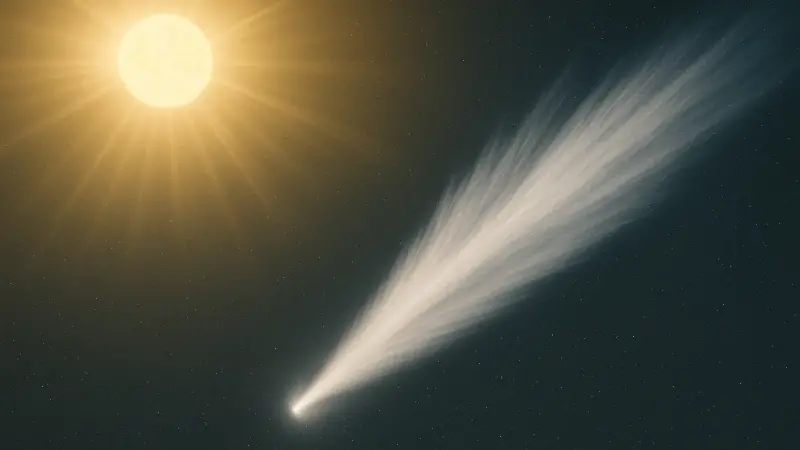
Why a comet’s tail doesn’t point “back”
Why does a comet’s tail sometimes seem to ignore the direction the comet is traveling? It isn’t one single place or event, and the details vary with each comet. But you can see the pattern in well-known cases like Comet Hale–Bopp, Comet NEOWISE, and 67P/Churyumov–Gerasimenko, the comet visited by ESA’s Rosetta mission. The bright, streaming plume is mostly a response to the Sun, not a record of the comet’s path. The key driver is a constant outflow from the Sun called the solar wind, plus sunlight itself.
That’s why comet tails can look “wrong” if you expect them to trail like smoke behind a moving car. A comet can be racing along one direction while its ion tail aims almost straight away from the Sun. It can even look like it swings quickly as the comet moves through changing solar wind conditions.
Two different tails, two different forces
Comets often grow two main tails, and they behave differently. The dust tail is made of tiny solid grains lifted off the nucleus as ice sublimates. Sunlight pushes on those grains through radiation pressure, and gravity bends their paths. That tail tends to look broader and slightly curved. It can lag behind the comet’s orbit in a gentle arc.
The straighter, sharper-looking tail is the ion (plasma) tail. It forms when gas from the comet is broken into charged particles by sunlight and interactions with the solar wind. Once those particles are ionized, the solar wind’s electromagnetic fields grab them. They get carried outward along the flow, which is why this tail often looks like a bright, narrow streamer pointing away from the Sun.
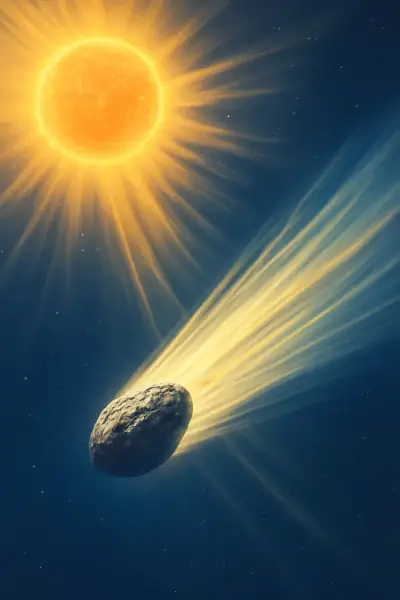
How the solar wind “grabs” a comet’s gas
The solar wind is a fast stream of charged particles, mostly protons and electrons, blowing out from the Sun. It carries the Sun’s magnetic field with it. That magnetic field is not static. It’s embedded in the moving plasma and shaped into a spiral structure across the solar system. When a comet releases neutral gas, some of it becomes ionized. Those new ions feel electromagnetic forces immediately, not just gravity and sunlight.
A specific detail people usually overlook is that the comet is not simply “blowing” a tail behind it. The solar wind can actually mass-load itself with cometary ions, slowing and diverting locally as it picks up that new material. A boundary region forms where the flow and fields reorganize. That’s part of what sculpts the ion tail into a coherent plume instead of a fuzzy cloud.
Why the tail can kink, snap, or change fast
The solar wind isn’t steady. It has gusts, shocks, and magnetic sector boundaries, and it changes with solar activity. When a comet passes through a sharp change in the interplanetary magnetic field, the ion tail can develop kinks or sudden bends. Sometimes it appears to break off and reform. These events are called disconnection events, and they’re linked to changes in the magnetic environment sweeping past the comet.
A concrete situational example shows how abrupt it can look: observers have watched ion tails change shape noticeably over a single night, while the dust tail stays comparatively smooth. The dust grains keep following their own orbits after being released, so their structure changes more slowly. The ion tail is tethered to whatever the solar wind and magnetic field are doing right then.
Brightness, streamers, and the role of the comet itself
Not every comet produces a dramatic, bright plume. The comet has to supply enough gas, and it has to be ionized efficiently. Activity depends on how close it is to the Sun, what ices it has, and how its surface is behaving. Some comets are dusty but gas-poor. Others produce strong jets from specific regions on the nucleus, feeding narrow structures that can map into filament-like streamers in the ion tail.
The viewing geometry matters too. If the ion tail is aligned partly along the line of sight, streamers can look denser and brighter than they really are. If it’s angled away, the same tail can look faint or thin. That’s one reason two comets with similar activity can look very different from Earth, even when the underlying solar wind physics is similar.
Related reads
- The smell-triggered time machine: how odors unlock buried memories
- Why some rivers form tidal bores that rush upriver as walls of water
- How microbes dissolve concrete to access buried minerals
- Why volcanic ash plumes often produce spectacular lightning bolts
- How your brain filters out half of a crowded conversation
- When Victorian Parliament fled as the Thames reeked across London
If you liked this, you might also enjoy: