

How it starts: one tiny thing, then your brain keeps paying rent
It’s not one single event or place. It happens in open-plan offices in London, on packed subway platforms in New York, and in a quiet kitchen when a phone keeps lighting up. A small irritation lands—an email subject line that feels sharp, a chair that squeaks, a neighbor’s bass that hits every few seconds. Nothing here is “big.” But your attention begins to orbit it. The mechanism is simple: the mind treats unresolved friction as unfinished business, so it keeps checking it, even when you’re trying to do something else.
The brain flags annoyance as a possible problem
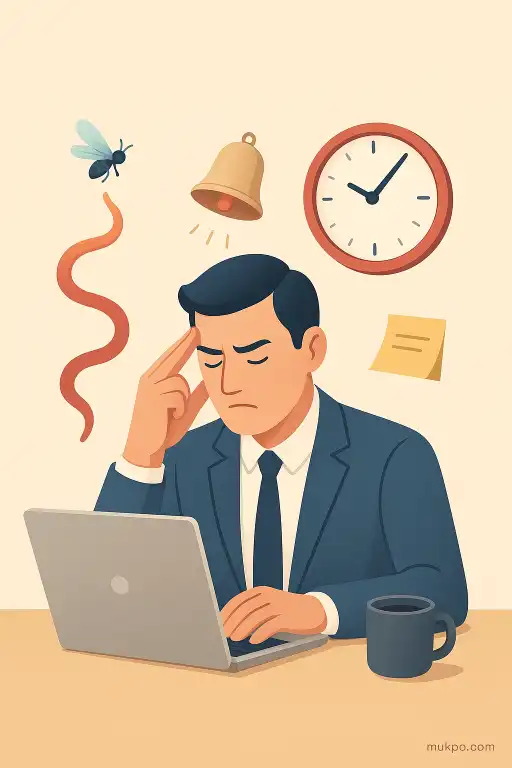
Tiny annoyances are good at grabbing attention because they look like small threats or errors. Not danger in a dramatic sense. More like “something is off and might need fixing.” That’s why an uneven table leg can steal focus more reliably than a neutral background noise. It’s also why a passive-aggressive message can replay in your head hours later. The content is small, but the uncertainty isn’t. Your brain keeps a tab open because it can’t tell whether the issue is finished.
One detail people overlook is how often these irritations are intermittent. A constant hum fades into the background faster than a sound that comes and goes. A notification that appears at random intervals is harder to ignore than one that arrives on a schedule. The same is true for a coworker who sighs “sometimes,” or a glitchy app that fails only every third time. Unpredictability keeps the system scanning.
Focus doesn’t just switch; it drags
After an annoyance pulls attention away, the return isn’t clean. There’s a lag. You might look back at the document, but part of your mind is still holding the thread of the irritation, checking whether it’s happening again, or running a quick story about what it “means.” That drag shows up as slower reading, more re-checking, and tiny mistakes that feel out of character. It’s not that you can’t concentrate. It’s that concentration is now sharing space with monitoring.
This is why “small” distractions can lead to a day that feels oddly thin. The cost isn’t just the moment you looked away. It’s the repeated re-entry. Each re-entry needs context rebuilding—where you were, what mattered, what was next. A squeaky chair doesn’t take an hour. The repeated rebuilding can.
Annoyance recruits memory and imagination
Once an irritation is tagged as relevant, it gets extra processing. Memory gets involved (“they always do this”), and imagination fills gaps (“they’re ignoring me on purpose”). This can happen even when you know, logically, that the cause is mundane. A delayed reply might be a meeting. A weird look might be nothing. But annoyance pushes for an explanation, and explanations are sticky. They keep attention returning, because the brain prefers a finished story over an open loop.
That stickiness is also why a small social slight can outweigh bigger tasks. Social information is high priority for most people. If someone in a group chat reacts to everyone else and skips your message, it can sit in the mind longer than it “should.” The reaction isn’t proof of anything. It’s the uncertainty and the social relevance that make it hard to drop.
Why it can last all day without feeling intense
The strange part is how mild it can feel in the moment. You’re not necessarily angry. You might not even notice you’re tense. But the body often does a small activation anyway—slightly higher arousal, a bit more scanning, a bit less patience. That state makes the next annoyance easier to catch. The day becomes a chain of micro-interruptions that don’t look connected, but they share the same lowered threshold.
It also changes what gets remembered. A day with many tiny frictions can feel “busy” without clear accomplishments because attention spent so much time on management: checking, adjusting, re-orienting, recovering. The tasks are still there, but the mental energy has been siphoned into keeping things from slipping further, like rereading the same paragraph because a small sound in the room keeps resetting your place.
Related reads
- A cliff that resonates a clear low note only at sunrise
- A roadside diner where the jukebox plays songs recorded by customers the same day
- An abandoned phone booth that still connects callers to a single mysterious number
- The office elevator that always opens to the floor the last person thought of
- A statue that oozes coffee instead of rain after storms
- Why imagined arguments seem more satisfying than real ones