
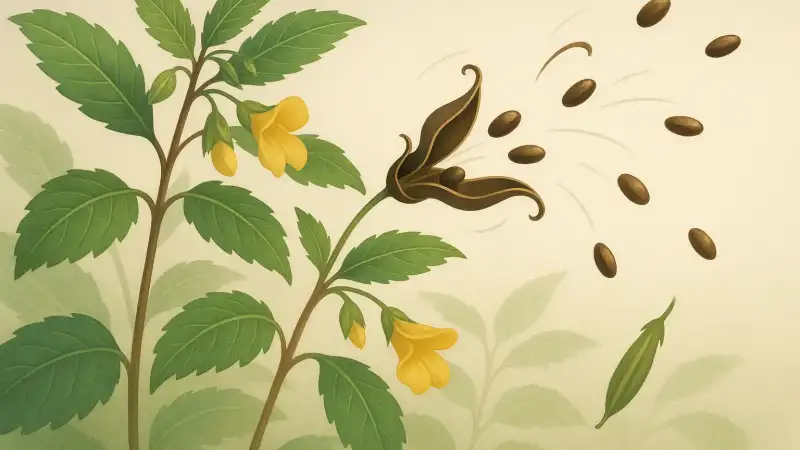
That snap isn’t the leaves
If you’ve ever brushed past a sensitive plant and heard a faint pop, it’s easy to assume the leaf movement is the whole trick. But there’s a separate little catapult hiding in the fruit. This isn’t one single place-specific phenomenon. You can see it in Mimosa pudica in India and parts of Southeast Asia, in tropical gardens in Brazil, and in Florida where it’s grown as an ornamental and also turns up as a weed. The seed flinging happens when the mature pod dries and tensions build in the pod wall. A slight touch, a gust, or just the right level of dryness can set it off.
What the pod is built like

After flowering, the plant makes flat pods with several seeds arranged like beads. Each seed sits in its own little compartment. The pod wall is not uniform. It’s made of layers that shrink differently as they lose water. Plant tissues are full of stiff cellulose fibers embedded in softer material, and those fibers can be oriented in different directions from layer to layer. When drying makes one layer want to shorten more than another, the pod can’t shrink evenly. The mismatch stores mechanical stress, like a bent strip that’s being held in place.
One detail people often overlook is that the pod can “pre-load” that stress without visibly changing much at first. It can sit there looking normal while the tissues keep drying and the internal strain quietly increases. The snap is not the pod suddenly drying. It’s the pod suddenly releasing strain it already had.
How drying turns into a spring
As the pod reaches the right dryness, parts of the wall are effectively acting like a spring held by a latch. In many legumes, the “seam” lines are designed to split. Once a small crack starts along a seam, the balance changes fast. The wall can curl or twist because the fiber-reinforced layers are no longer constrained. That curling motion can be rapid enough to kick seeds out of their compartments. You’ll often see the empty pod segments coiled or warped after the event, which is a clue that the pod itself did most of the moving.
The trigger varies. A bump from an animal, a finger, raindrops, or shifting humidity can be enough. There isn’t a single universal threshold, because humidity, pod age, and even how shaded the plant is can change how much tension builds and how brittle the seams become.
Where the seed gets its shove
When the seam gives way, the pod wall changes shape quickly. That motion transfers momentum to the seeds. It’s not an explosion and it isn’t air pressure doing most of the work. It’s mechanical contact: the curling wall pushes and flicks. The seeds are hard and smooth, so they don’t absorb much energy. They slip free and travel away from the parent plant, sometimes landing a short distance away, sometimes farther depending on how high the pod is and whether wind catches them.
A concrete scene: along a warm walkway edge in a garden bed, a mature Mimosa pudica plant can hold pods at ankle height. When a passerby brushes the stems, the leaves fold first, but a pod that’s already primed can crack and flick seeds into the surrounding mulch. You might not notice unless you’re looking down, because the sound is small and the seeds are tiny.
Why this doesn’t need the “touch” response
The famous touch response in sensitive plants is driven by changes in water pressure in special joints, and it happens in seconds. Seed flinging is different. It’s powered by drying and stored strain in dead or stiffening pod tissues, and it can happen even if the plant isn’t actively moving anything. That’s why you can find a dried pod that still snaps when disturbed, even if the leaves nearby are already wilted or unresponsive.
This separation matters because it explains the timing. The leaves fold when the plant is alive and hydrated enough to move fluid around. The pod waits for the opposite condition: dry enough to act like a loaded spring. Both are “fast,” but they’re fast for different reasons, and they don’t have to happen together.

Related reads
- How gut microbes change after a course of antibiotics
- The bacteria discovered chewing plastic in ocean gyres
- How hummingbirds hover by twisting their wings
- Why weeds often sprout between sidewalk cracks
- How pitcher plants dissolve insects with acid and enzymes
- Why comet tails always point away from the Sun