
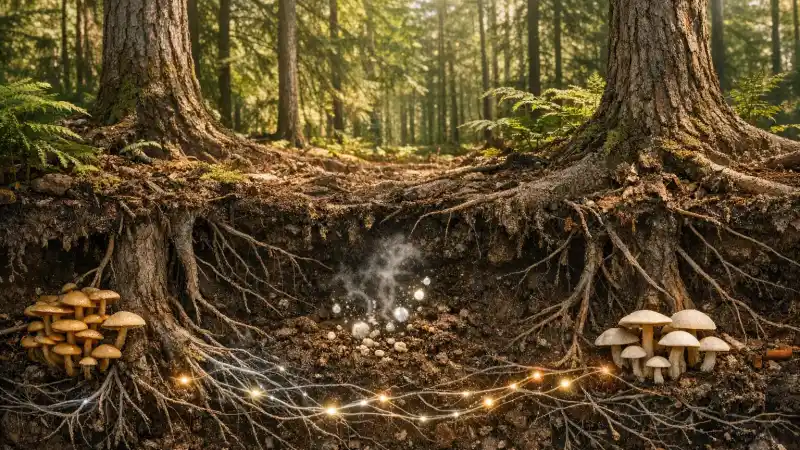
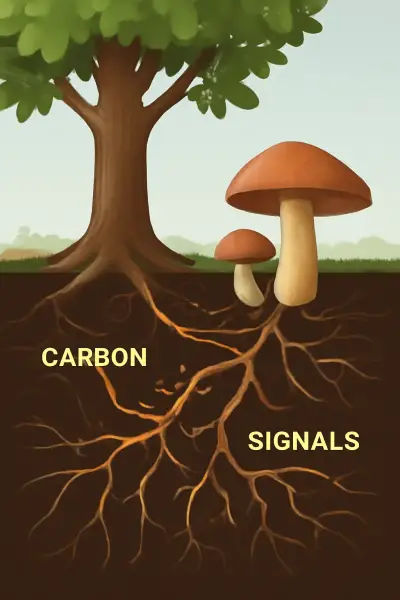
Walk through a forest and it’s easy to think every tree is on its own. But below the leaf litter, roots are often connected to fungi that act like living cables. This isn’t one single “network” in one place. Versions of it show up in Douglas-fir forests in British Columbia, beech woods in Europe, and boreal stands in Scandinavia. The basic mechanism is fairly direct: a fungus wraps or enters fine roots, trades minerals and water for carbon compounds from photosynthesis, and can move those compounds along its own filaments. At the same time, chemical signals can travel through the same shared fungal links, sometimes changing how neighboring plants behave.
How the partnership is built
The main players are tree roots and mycorrhizal fungi. In ectomycorrhizae (common with pines, oaks, birches, and many conifers), fungal threads sheath the root tips and slip between root cells. In arbuscular mycorrhizae (common across grasses and many broadleaf plants), the fungus actually forms tiny tree-like structures inside root cells where exchange happens. Either way, the plant supplies the fungus with sugars and fats it made from CO₂ and sunlight. The fungus supplies hard-to-reach nutrients, especially phosphorus and nitrogen, plus water in dry periods.
A detail people overlook is scale. The “fine roots” doing most of this work are often hair-thin and short-lived. Trees constantly grow and shed them. That means the exchange interface is being rebuilt all the time, and the fungal partner has to keep finding and colonizing new tips. The visible tree looks stable. The trading surface underground is in constant turnover.
How carbon can move between trees
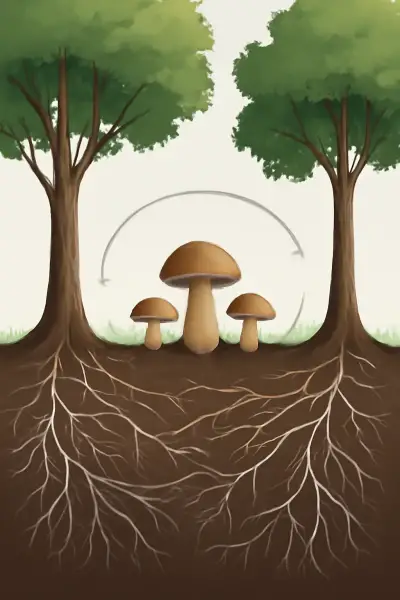
Carbon movement is usually discussed in two steps: first from tree to fungus, then potentially from that fungus into another plant’s root. Researchers have tested this with carbon isotopes, including labeling one plant with a distinctive form of carbon and checking nearby plants later. Movement has been observed in some setups, but the amount and direction can vary by species, season, light conditions, and which fungus is involved. It’s also not always clear how much of what’s detected is direct transfer through shared fungal tissue versus carbon leaking into soil and being reabsorbed later.
One concrete situation where exchange tends to be studied is a shaded seedling near a larger tree. A seedling in deep shade produces less sugar. It can still maintain mycorrhizal connections, and labeled-carbon experiments sometimes find carbon from a well-lit neighbor appearing in the shaded plant. That doesn’t mean forests run on charity. It means the fungal network can act as a shared pathway when concentration gradients and biological “rules” line up.
What signals can travel underground
Nutrients and carbon are not the only things that move. Plants and fungi release signaling chemicals that can change gene expression, root growth, and defense responses. When one plant is attacked by an insect or pathogen, nearby plants sometimes “prime” their defenses faster than expected. The signal might move through the air as plant odors, through soil water as dissolved compounds, through root-to-root contact, or through fungal links. Experiments that physically block hyphae while keeping other routes open suggest fungal connections can contribute in some cases, but the exact molecules and routes are still an active area of research.
Fungi also send their own signals. A fungus encountering a nutrient-rich patch can shift its growth pattern and resource allocation. That change can alter how much nitrogen or phosphorus it supplies to different hosts. In practice, “communication” often looks like a cascade of chemical adjustments, not a single message traveling cleanly from Tree A to Tree B.
Why fungi don’t behave like neutral pipes
A common misunderstanding is that the fungus is just infrastructure. It’s an organism with its own incentives. It can connect to multiple plants, but it doesn’t have to treat them equally. Many mycorrhizal fungi appear to allocate more nutrients to plants that provide more carbon, and reduce support to weaker payers. That can look like “favoritism,” but it’s closer to resource budgeting. The fungus is constantly balancing growth, storage, and survival, and it can change partners over time.
This is one reason network effects vary so much. Two trees can be close and still not share the same fungal partners. Or they might share a partner, but only briefly. Soil type, moisture, temperature, and the local fungal community all shape who connects to whom. Even within a single forest stand, the underground wiring diagram can shift from year to year.
What this looks like in a real forest floor
In a conifer forest with ectomycorrhizal fungi, the most active exchange tends to happen right at the root tips in the topsoil, often within the upper few inches where organic matter and fungal activity are highest. That’s also where disturbances matter. A heavy footpath, a dry spell, or a change in leaf litter can alter moisture and oxygen and disrupt those fine roots and hyphae. Above ground, nothing dramatic has to happen for the network to change.
If you crouch and sift through duff, you might see thin white threads or fuzzy coatings on tiny rootlets. That is the interface where the swapping happens. It’s easy to focus on big roots and miss it. Most of the “network” is made of structures you can’t see without a microscope, and it’s doing its work at the scale of millimeters while the trees overhead look motionless.
Related reads
- When soldiers and farmers clashed with emus in 1932 Western Australia and the birds won
- Why hearing your name in a crowd grabs your attention
- How a small change in posture instantly shifts confidence
- The shiver from a song: what causes musical goosebumps
- When a group all remembers the same detail that never happened
- Why your handwriting tightens when stress creeps in