
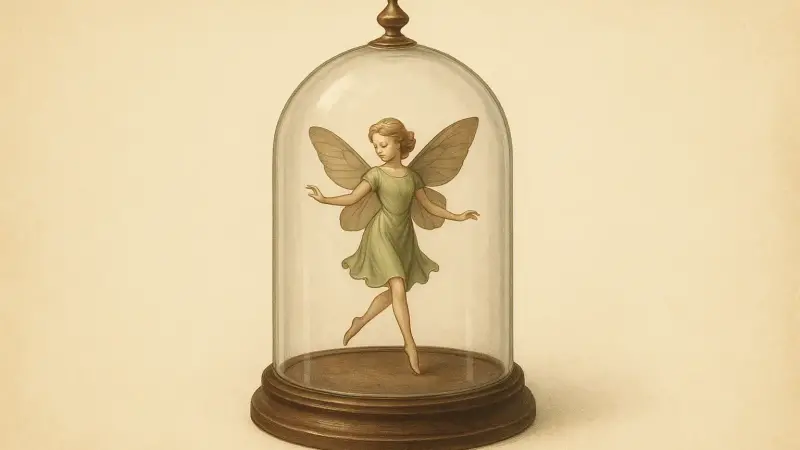
People often treat old photographs as if the camera can’t lie. In 1917, two cousins in Cottingley, near Bradford in Yorkshire, leaned on that assumption and got surprising mileage out of it. Elsie Wright and Frances Griffiths produced a handful of pictures that seemed to show small winged figures posing and dancing in their garden. The core mechanism was simple: a camera plus a convincing print can travel farther than the day it was taken. Once those prints reached the right adults—especially writer Arthur Conan Doyle—Edwardian Britain supplied the rest: hunger for wonder, trust in new tech, and the feeling that modern life had stripped the world of small enchantments.
Two girls, a beck, and a borrowed camera
The story starts in a place that doesn’t sound dramatic. Cottingley Beck was just a stream behind the Wright family home. Frances, visiting from South Africa, played there with Elsie, who was older and liked drawing. When Frances came home with wet clothes, the adults assumed she’d been messing about in the water again. Frances said the fairies had been there. It’s the kind of claim that usually dies in the kitchen. Instead, it turned into a dare: prove it.
Elsie’s father, Arthur Wright, had a camera and a darkroom interest. The cousins used his quarter-plate camera and produced a print of Frances apparently interacting with a fairy. The overlooked detail is how physical this kind of trick had to be in 1917. If you want something to appear in-frame, you have to put it there at the moment of exposure. There’s no quick retouching step that a bored teenager can do casually. The “fairies” were presented as solid, in the light, with the same focus rules applying to everything else.
How the pictures were made to look convincing

The cousins didn’t need complicated fakery. Cut-out figures, likely traced from contemporary illustrations, could be pinned into the ground with hatpins. A flat drawing can look surprisingly “present” in a photo if the lighting is even and the camera isn’t close enough to show thickness. The poses mattered, too. The figures weren’t just floating. They were positioned as if they had weight and intention, as if they were aware of the girl in the frame.
Photography at the time also helped them. Exposure times and lens sharpness made it easier for edges to soften. A faint blur reads like motion, not like paper. And the prints weren’t viewed like a modern high-resolution scan. They were handled, passed around, and judged by eye under household lighting. Small cues—like whether shadows fall the way you expect—can vanish in that setting, while the big cue (a clear “figure”) stays.
Why adults wanted to believe it
The pictures landed in a country that had reasons to reach for comforting stories. World War I had just chewed through families. Spiritualism was popular. People attended séances and read accounts of unseen worlds as if they were reports. Fairy belief wasn’t fringe in the way it sounds now. It sat alongside folk memory, children’s stories, and a growing “psychical research” culture that tried to treat strange experiences as data.
There was also a social bias at work. Children were often imagined as closer to innocence and therefore closer to truth. Two girls making up a sustained hoax didn’t fit the sentimental picture adults held of them. When the cousins were calm and consistent, that steadiness got misread as purity rather than practice. The adults involved argued about cameras and negatives, but many of them were actually reasoning about character.
How it spread from a local curiosity to a national sensation
The route from garden stream to national conversation ran through organisations and reputations. The photographs circulated in Theosophical circles first, where belief in unseen beings already had a home. Then they reached Arthur Conan Doyle, who had become an outspoken Spiritualist. Doyle had authority with the public, and he treated the images as supportive evidence for a worldview he already defended. When he wrote about them, he didn’t present them as a playful oddity. He framed them as a serious, hopeful sign.
That framing changed the stakes. Once a famous author is involved, disagreement starts to look like an attack on a person, not an argument about paper cut-outs. Newspapers and magazines picked up the story because it had everything: children, pictures, a famous believer, and an argument people could have at the breakfast table. The images were also just legible enough to invite debate. If they had looked obviously fake, they would have been discarded. If they had been too perfect, they would have looked like studio work.
What finally cracked the spell
Sceptics pointed out problems early, including the illustration-like style of the fairies and the way they faced the camera like performers. But the story stayed alive for decades because the cousins didn’t fully withdraw it. When people asked later in life, they tended to hedge or shift. It was easier to let the myth continue than to disappoint believers, especially believers with status. It also meant the photographs were rarely treated as a finished case. They became a lingering argument that could be reopened whenever someone wanted proof that the world still had surprises.
Eventually, the admissions came. Elsie and Frances acknowledged that the photographs had been staged, using cut-outs. Even then, there was a last twist: one of them maintained for a time that at least one image might have captured something real. It’s an oddly human detail. A hoax can start as a prank and still end with someone wanting part of it to be true, especially after years of being told—by strangers, editors, and famous writers—that you’ve touched something sacred.

Related reads
- How a bark beetle epidemic transformed 20th century North American forests
- What aurora colors reveal about collisions in Earth’s upper atmosphere
- The fish with transparent teeth that glow under red light
- The pause when two people start talking at once and who yields
- The town that held an election where a dog outpolled a human candidate
- The French adventurer who declared himself king of Araucania and Patagonia in the 1860s