
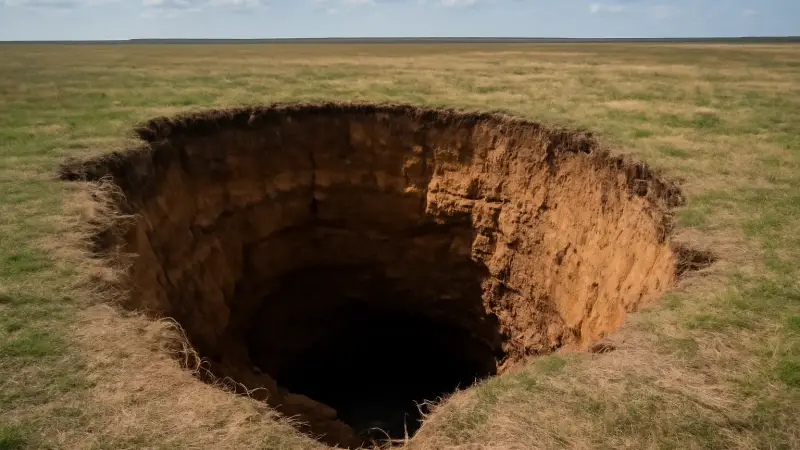
When flat ground suddenly drops
A sinkhole feels like something that belongs in steep, rocky country. Then it opens in a place that looks perfectly level. That has happened in Florida, across parts of the Yucatán Peninsula in Mexico, and in the chalk country around Diss, England. It isn’t one single “sinkhole town” story. It’s a repeatable setup: water moving underground makes empty space, and the roof over that space eventually can’t hold. The ground surface can stay calm for years because the failure happens below, out of sight, while the surface keeps getting subtly supported by whatever thin layer is left.
Why underground rivers form under plains
“Underground river” can mean different things. Sometimes it’s a real, channel-like flow you could kayak in if you could reach it. More often it’s fast groundwater moving through networks of cracks, joints, and dissolved pathways. Flat landscapes can sit on rock that dissolves easily, like limestone, gypsum, salt, or chalk. Rainwater absorbs carbon dioxide from soil and air and becomes slightly acidic. Over long periods, that weak acid is enough to widen fractures into conduits.
Plains also tend to hide the drainage pattern. Surface streams may be rare or intermittent, because water can disappear into swallow holes and fractures. Underground, flow concentrates along a few preferred routes because water keeps taking the easiest path. Once a conduit exists, it attracts more water, which enlarges it further. That feedback can create sizable voids even where the surface looks uniform.
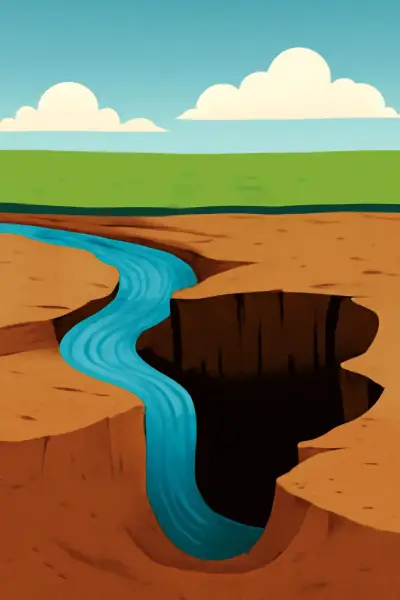
How moving water creates a cavity
There are two main ways a cavity grows. One is chemical removal: the rock itself dissolves and the space expands. The other is mechanical removal: the water flow carries sediment away, grain by grain, from the overlying soil or from weak rock. This second process is easy to miss because the void may be in the soil layer, not a big cave in bedrock. Engineers often call that “piping,” and it can hollow the ground from below without much warning at the surface.
A specific detail people overlook is how much the soil’s grain size and layering matters. A sandy layer over a tighter clay layer can act like a trap. Water moves along the boundary and steals sand into a crack or conduit. The surface may still look fine because the clay layer can bridge across a growing gap for a while. When it finally breaks, it breaks quickly.
What makes the collapse sudden
The collapse is a roof problem. As the void grows, the overburden above it becomes a thinner and weaker “beam” of soil or rock. The surface doesn’t sag much until a threshold is crossed. That threshold depends on material strength, moisture, and how the load is distributed. If the roof is cohesive clay, it can span space like a stiff sheet and then fail abruptly. If it’s loose sand, the surface may settle and form a shallow depression first, but it can still drop suddenly if the sand is being pulled into a small opening below.
Water level changes can push the system over the edge. When groundwater is high, it partly supports the roof and reduces effective stress. When levels drop, that buoyant support disappears. Flow can also speed up during storms, flushing more sediment and enlarging openings. The timing is not consistent from one place to another, which is why sinkholes are hard to predict from the surface alone.
Why flat places can be the most deceptive
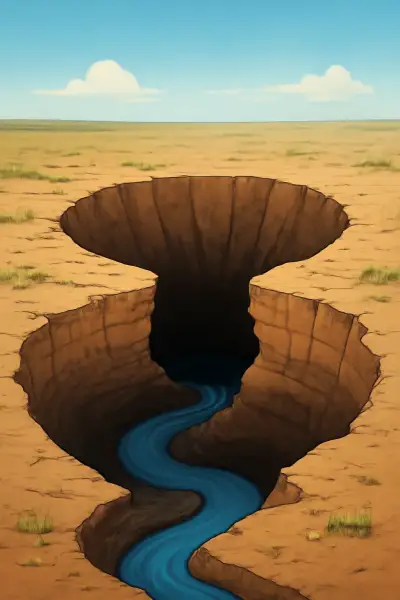
In hilly terrain, water has obvious routes. In plains, the routes are often underground, and the “valleys” are invisible. That makes it easy for people to assume the ground is uniformly supported. But subsurface flow is usually uneven. One conduit can be doing most of the drainage for a wide area, especially where the geology funnels water into a narrow band of fractured rock.
That uneven drainage is why sinkholes can cluster in surprising patterns: aligned along buried joints, near old sinkholes that were filled, or along the edge of a plain where water enters the ground. A field can look identical from one end to the other, yet only one strip sits above a fast-moving underground pathway that has been quietly stealing support from below.
Related reads
- The algae that turns shorelines bright pink and how its bloom works
- When people reportedly burst into flame with no visible fire
- Why mornings can leave you foggy for minutes after waking
- A corpse, a forged identity and the ruse that duped WWII intelligence
- A time capsule hidden in a wall that revealed a vanished life
- The city that once outlawed chewing gum
If you liked this, you might also enjoy: