
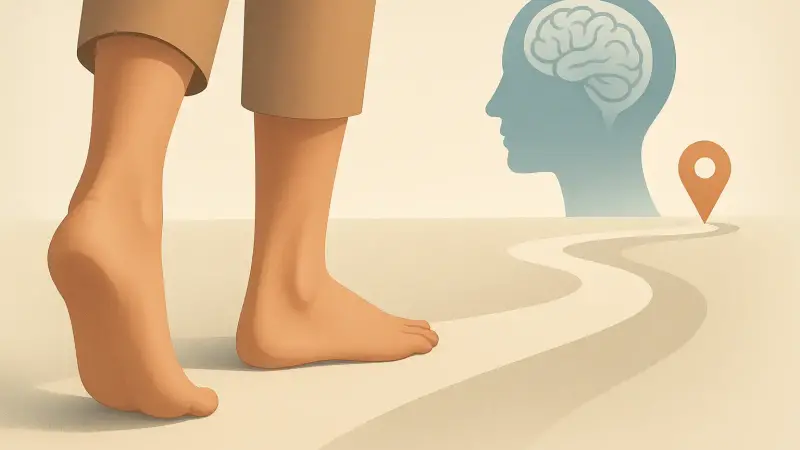
You’re already choosing a route before you notice
Watch people pour out of a train in Tokyo Station or Grand Central Terminal in New York. They fan out, dodge each other, and somehow end up in the right corridor with almost no visible deliberation. This isn’t one single place or one famous event. It’s a general thing humans do anywhere there’s a path, a doorway, or a crowd. The core mechanism is that walking is run by layered control systems. Some parts plan, but a lot happens below awareness. Your eyes and inner balance feed fast predictions about where you’ll be a second from now, and your feet follow those predictions unless something forces an update.
The fast route is often a “good enough” one
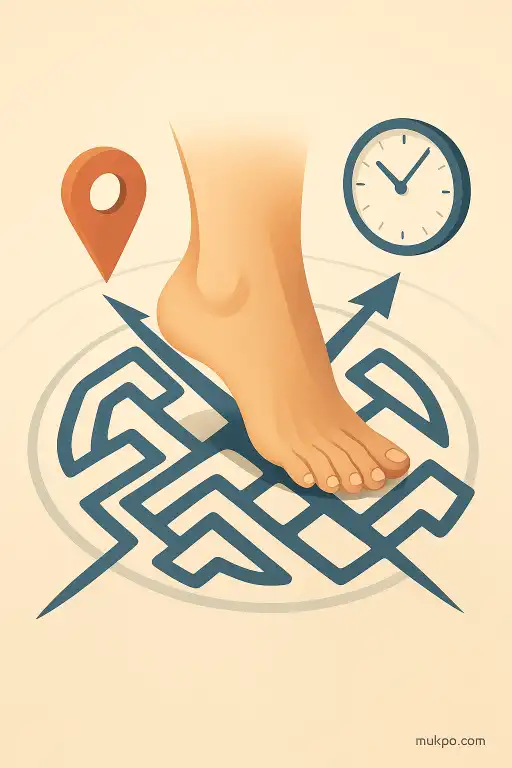
When people say “fastest route,” they usually mean least time and least effort combined, not a perfect geometric shortest line. The brain tends to pick an option that feels low-risk and low-cost right now. A slightly longer arc that avoids a dense cluster of bodies can beat a straight line that requires braking or shoulder-checking. That’s why a hallway can develop “lanes” even without signs. Each person is tracking tiny delays and choosing the flow that reduces them, and it happens too quickly to feel like a decision.
There’s a specific overlooked detail here: walking speed isn’t just forward speed. Micro-stops matter more than people think. A single half-second hesitation, repeated a few times, can erase the advantage of a shorter route. So the “fast” choice often favors smoothness. Feet and hips settle into a rhythm, and the nervous system protects that rhythm because breaking it costs energy and time.
Local steering runs on prediction, not reaction
Dodging isn’t mostly reflex. It’s prediction. The visual system reads others’ headings, speed, and body orientation and projects where they’ll be soon. Your next few steps are adjusted to avoid future collisions, not current ones. That’s why you can thread through a crowd without feeling constant panic. The adjustments are small and early: a slight toe-out, a small shift in where the foot lands, a tiny change in cadence.
The “without conscious thought” part comes from which circuits are doing the work. Balance and locomotion lean on spinal pattern generators, the cerebellum, and fast sensorimotor loops that don’t need language or explicit planning. Conscious attention can step in, but it’s slow. Most of the time it only notices the outcome, like realizing you drifted toward the wider staircase before you could have explained why.
Memory and maps kick in when the scene is stable
When the environment is familiar, route choice can be driven by stored spatial memory. In a workplace, a school, or a neighborhood, people often start turning before the destination is visible. That’s not magic. It’s a learned sequence: this doorway, then that corner, then the brighter corridor. The brain treats it like a chunked routine. It frees attention for other things while the body runs the script.
But that memory system is sensitive to context. Small changes can flip the “fastest” choice. A wet floor sign, a closed gate, a new line of strollers, or a loud construction barrier can push the system back toward moment-to-moment steering. The route that used to be automatic becomes uncertain, and you see it in the gait first: shorter steps, more foot placement checking, a slight head turn to sample options.
Why it feels like your feet decided
There’s a timing gap between action and awareness. By the time you “notice” you’re veering left, the shift probably started a step or two earlier. The brain often explains actions after they’re underway, using whatever story fits: the left side looked clearer, the sign was there, the crowd pulled you. Those can be true. The point is that the selecting happened in systems that don’t wait for a verbal, conscious go-ahead.
It’s also social. Humans implicitly coordinate. People tend to avoid head-on conflicts by reading subtle cues like shoulder angle and gaze, and they accept tiny detours to keep interactions smooth. So the “fastest route” isn’t only about space. It’s about avoiding the kinds of close calls that force both walkers to slow down. When that coordination works, it feels effortless, and the body keeps moving as if it already knew the answer.
Related reads
- How the Amber Room vanished from a royal palace and became WWII’s enduring mystery
- The Kentucky hamlet that keeps electing a dog as mayor
- Century old jam on a supermarket shelf that still passed safety tests
- Why doodling can help you pay attention during long talks
- The 1976 Korean DMZ tree-cutting standoff that escalated into a military spectacle
- Why your pulse jumps for a heartbeat after an unexpected sound