
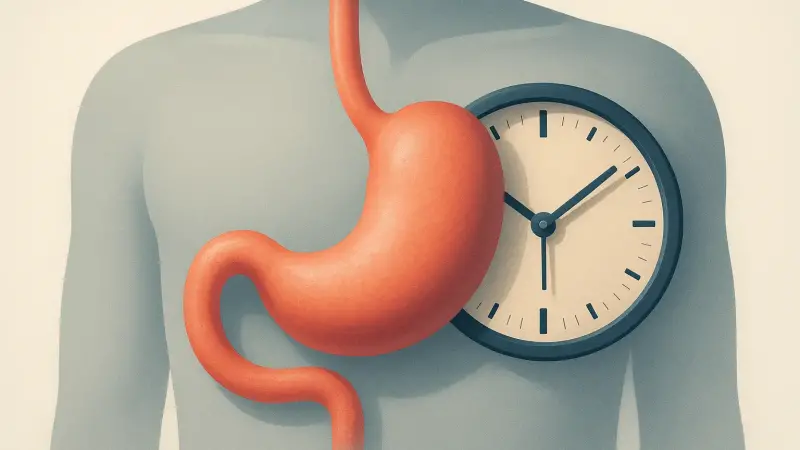
That “right on time” stomach feeling
People notice it in ordinary places because it’s so predictable. A rumble that shows up a little before lunch. A sudden hollow feeling right when a meeting ends. This isn’t one single local custom or one famous event. It’s reported everywhere, from the U.S. to Japan to Italy, and it can show up even when meal times change. The core mechanism is not a tiny clock sitting in the gut. It’s a pattern-maker: nerves, hormones, and muscle rhythms that learn when food usually arrives and start preparing the digestive system ahead of time. The timing can vary a lot across people, and even across different weeks for the same person.
The stomach and intestines run their own rhythm
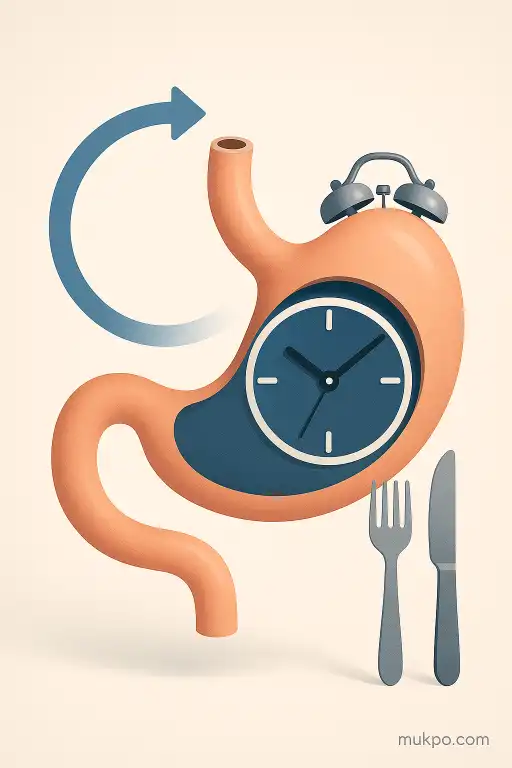
Even between meals, the stomach and small intestine don’t stay still. They cycle through a repeating “housekeeping” pattern of contractions that sweeps leftover material and bacteria downstream. Researchers call this the migrating motor complex. It tends to become more noticeable when the stomach is empty, which is one reason hunger can feel like waves rather than a steady line. It’s not perfectly timed like a stopwatch, and it can be disrupted by snacks, sleep, stress, and illness, but the body does run this background rhythm without asking the brain for permission.
The overlooked detail is that these contractions are happening whether a person is thinking about food or not. People often assume hunger is only “low fuel.” But a lot of the sensation is mechanical and sensory: stretching, squeezing, and how the gut lining signals those movements upward through nerves.
Hormones that rise before food arrives
Timing also comes from chemistry. Ghrelin, a hormone made largely in the stomach, often rises before a habitual meal time and drops after eating. It’s one of the clearer “anticipation” signals in hunger research. Insulin and other signals can also shift in expectation of food, because the body does better when it prepares early. This is part of a broader set of learned, anticipatory responses called cephalic phase responses, where the digestive system starts to gear up before nutrients actually hit the bloodstream.
A concrete example shows how specific this can get. Someone who reliably eats around noon may notice hunger at 11:30 even on days when breakfast was bigger than usual. That timing isn’t proof the body “needs” calories at 11:30. It’s proof the body is good at predicting patterns and prefers not to be surprised.
The gut has its own nervous system, and it learns
The digestive tract is wired with the enteric nervous system, a large network of neurons embedded in the gut wall. It coordinates motion, secretion, and sensitivity locally. It also talks to the brain through the vagus nerve and through spinal pathways. That two-way connection is why hunger can be influenced by cues that aren’t strictly “stomach empty,” like smell, routine, or even a familiar cafeteria line.
Learning matters here. If food often shows up after a particular cue—finishing a commute, a certain break time, a daily workout—the body can start shifting gut activity and hormone patterns toward that window. This is not magic and it’s not always stable. Travel, shift work, or changing schedules can scramble it. Some people adjust quickly; others don’t, and it isn’t always clear why.
How “body time” and meal time get linked
There’s also a bigger timing system in the background: circadian rhythms. The master clock in the brain is set mainly by light, but many organs—including parts of the digestive system—show daily rhythms too. Some of these peripheral clocks can be influenced by feeding patterns. That’s one reason appetite can feel different at the same clock hour depending on sleep timing, night shifts, or jet lag. The gut is not just reacting to an empty tank. It’s tracking time-of-day physiology as well.
One detail people overlook is thirst and hydration. A dry mouth, mild dehydration, or caffeine can change gut sensations and the way hunger feels, because the gut is sensitive to volume, acid, and motility signals, not just calories. So the “stomach keeps time” effect can be real, but the feeling that announces it can be shaped by small, easy-to-miss changes in the body’s internal state.
Related reads
- A parking meter that once spooled out free bakery coupons during a heatwave
- Why a single compliment can change the way you walk
- An unused stairwell that opens into a hidden rooftop garden full of mailboxes
- What your blink rate reveals about attention and stress
- Why your taste changes with your mood
- Why we unconsciously copy another person’s posture