

Why plastic sticks to underwater grass
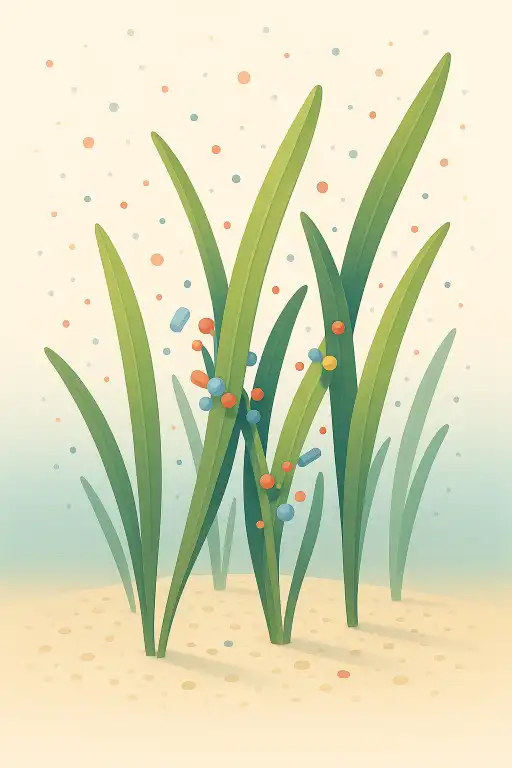
Stand at the shore and look into clear water, and it’s easy to assume the mess floats somewhere else. But this isn’t one single place or incident. It shows up in seagrass beds from the Mediterranean to Australia, and in places like Florida Bay in the U.S. Seagrass meadows sit right where waves slow down. Their blades act like a physical filter. Tiny plastic pieces moving with the current bump into leaves, snag on rough surfaces, and get held there long enough to drop into the sediment.
The overlooked detail is the coating. Seagrass blades aren’t smooth. They’re often covered in biofilms and hitchhiking organisms. That slimy layer can make microplastics stick more easily than they would on bare sand, especially when the particles carry their own weathered, sticky surface from time in the ocean.
How the meadow turns moving particles into settled ones

Water slows down inside a dense bed. That changes what happens to anything suspended in it, including microplastics. When flow drops, heavier particles settle. Lighter pieces don’t always float away either, because turbulence is lower and collisions with blades are more frequent. Some plastics get trapped directly on leaves. Others settle as part of mixed clumps that include silt, decaying plant bits, and microbial goo.
Not all microplastics behave the same. Fibers from synthetic clothing tend to tangle and snag. Hard fragments are more likely to bounce unless there’s a sticky film. Beads and pellets can settle if they’ve picked up enough biofouling to become denser than seawater. The balance depends on the species of seagrass, blade density, season, and local currents, so measured capture rates vary a lot by site.
What happens after plastics reach the sediment
Once particles are in the sediment, the chemistry story starts. Seagrass meadows are major “blue carbon” systems because they bury organic matter and slow erosion. That same trapping effect can bury microplastics too. Sediment becomes a layered mix of sand, plant detritus, microbes, and now plastic pieces that don’t readily break down. That can shift how water and gases move through the seabed because plastic can change porosity and the pathways that oxygen uses to diffuse.
Oxygen is the switch that controls a lot of sediment chemistry. Seagrass roots leak oxygen into the sediment during daylight. Microbes quickly use it up, especially where there’s plenty of organic matter. If microplastics alter the tiny channels in the sediment, oxygen penetration can become patchier. That affects whether microbes use oxygen, nitrate, iron and manganese oxides, or sulfate as they break down organic material, and those different pathways produce different chemical byproducts.
Changed chemistry means different nutrients and different gases
In low-oxygen zones, sulfate reduction becomes more important, and that can generate sulfide. Seagrasses are sensitive to sulfide around their roots. Meadows already manage this with oxygen leakage and sediment mixing by animals, but conditions can tip. Microplastics can also carry additives or sorbed pollutants, but how much they matter compared with other sources is still unclear and depends on the local contamination picture.
Nitrogen chemistry can shift too. The sediment hosts microbes that turn nitrate into nitrogen gas, and others that convert ammonium into nitrate. Those processes depend on oxygen gradients and the availability of organic carbon. If plastics change where oxygen sits in the sediment, the zones where these microbes thrive can move. That can subtly alter how much usable nitrogen stays in the system versus leaving it as gas, which matters because seagrasses are often limited by nutrient supply but also harmed by nutrient overload.
What researchers look for in real meadows
Field studies don’t just count plastics in the water. They sample blades, sediments, and sometimes the little animals living among the roots. A common situational pattern is a gradient: more microplastics inside the seagrass bed than on nearby bare sand, with the highest concentrations where the meadow is densest and current speeds are lowest. Some studies also look at what size and shape dominates, because fibers tell a different story than fragments about where they likely came from.
They also measure the chemistry right where it changes, not just in bulk sediment scoops. Microelectrodes can map oxygen millimeter by millimeter. Porewater samples can show sulfide, ammonium, and phosphate levels. Those details matter because the biggest shifts can happen in thin layers around roots and decaying leaves. That’s the same narrow zone where trapped microplastics often accumulate, mixed into the fine, dark sediment that builds up under a long-lived bed.
Related reads
- How dust grains stick together to build planets around young stars
- A microbe in Antarctic ice that eats methane without sunlight
- How cactus spines harvest fog into tiny water droplets
- How abandoned boats and tires turn into accidental reefs
- What causes red sprites to flash above thunderstorms
- The jellyfish that can reverse its life cycle