
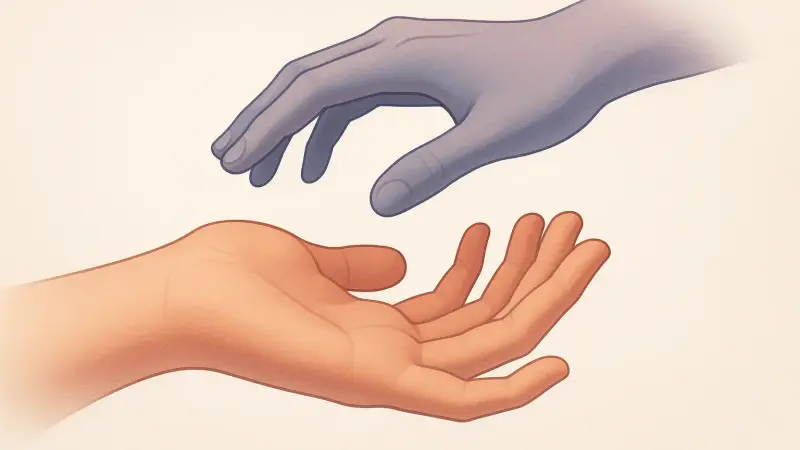
When the hand stops feeling like it belongs
Sometimes it happens in the middle of nothing. You’re scrolling, washing a mug, or reaching for keys, and your hand suddenly feels slightly “off.” Not numb, not weak. Just unfamiliar, like it’s being moved by the wrong set of instructions. This isn’t one single event tied to one place or year. People describe it across everyday settings, from a commuter train in London to a late-night desk in Seoul to a kitchen in Chicago. The core mechanism usually comes down to how the brain keeps a running model of “me” using touch, vision, and body-position signals—and how easy it is for those signals to fall out of sync for a moment.
The brain’s ownership test runs on prediction

Most of the time, the brain predicts what your hand will feel like before it actually feels it. When you decide to move, the motor system sends commands and also sends a copy of that command to sensory areas. That copy is a kind of heads-up: expect the fingers to flex, expect skin to stretch, expect contact if the hand is about to land on a surface. When the incoming sensation matches the prediction, the movement gets tagged as self-made and familiar. When there’s a mismatch, ownership can wobble. The hand can still work normally, but the feeling of “mine” doesn’t lock in the same way.
One overlooked detail is timing. The brain cares about delays on the scale of tens to a couple hundred milliseconds. A tiny lag between what you see your hand doing and what you feel it doing can matter, especially if attention is split. That’s part of why this can show up while looking at a phone while moving, or when a light source flickers, or when the hand is partly out of view. Nothing dramatic has to happen. Slight desynchrony is enough to make the hand feel strangely detached.
How vision can overrule touch
Ownership isn’t decided by touch alone. Vision has a heavy vote, which is why illusions like the rubber hand illusion work so reliably in lab demonstrations. If someone sees a fake hand being stroked in the same rhythm as their hidden real hand, many people start to feel the touch as if it belongs to the fake hand. The point isn’t that vision “wins” every time. It’s that the brain is constantly solving a practical problem: which signals belong together? When the matching rules get fooled, the feeling of ownership can slide to the side for a moment.
A concrete everyday version can happen at a sink. A person scrubs a plate while looking slightly away, and their fingers are in a repetitive motion under running water. The water makes touch information noisy, and the repetitive movement makes the predicted sensations bland and easy to ignore. If the hand is mostly seen in peripheral vision, the brain has less precise visual confirmation. Put those together and the hand can feel like it’s on “autopilot,” even though the person is fully awake and coordinated.
Body maps can drift without injury
The brain also keeps a live “map” of where each part of the body is, built from proprioception (signals from muscles and joints), touch, and vision. That map isn’t a static diagram. It’s updated constantly and it can drift. If a hand has been held still for a while, or pressed against an armrest, or cramped in an awkward angle while typing, proprioceptive signals can get less informative. Pressure on skin can also change the way boundaries feel. The result can be a vague sense that the hand is positioned somewhere different than it really is, which makes it feel unfamiliar when it moves again.
This is part of why the experience can show up after long periods of repetitive work. It isn’t always about fatigue in the muscles. It can be about a sensory map that has been running with low-quality updates. When movement restarts, the brain has to reconcile the new input quickly. During that reconciliation, the hand can briefly feel like an object being moved rather than a body part being moved.
When it’s linked to specific neurological patterns
There are also more specific clinical patterns that resemble the everyday version but are sharper and more persistent. In neurology, people have described “alien hand syndrome,” often after certain kinds of brain injury or disconnection, where one hand performs actions the person doesn’t intend. That’s not the same thing as a fleeting “not mine” feeling while washing dishes. But it shows the same general theme: agency and ownership are constructed experiences, not automatic facts. When the systems that normally integrate intention, sensation, and monitoring are disrupted, the hand can feel like it has its own agenda.
Other situations can tug at ownership without dramatic movement, like some focal seizures, migraine aura, or dissociative episodes, where perception of the body can change in odd, specific ways. The exact sensations vary and reports aren’t uniform. What stays consistent is that the hand isn’t being “recognized” by the brain’s usual integration process, even when the skin, muscles, and nerves are working fine. A person can look at perfectly normal fingers and still get that quick, unsettling sense of distance before it snaps back.

Related reads
- Why we say sorry for things that don’t need apologizing
- Why video calls make us miss tiny facial cues
- Why bread yeast bubbles leave honeycomb holes in dough
- How glowworms choreograph light to catch flying insects
- The rock in a backyard that turned out to be a meteorite and what it revealed
- How touch-me-not plants fling seeds with a springy snap