
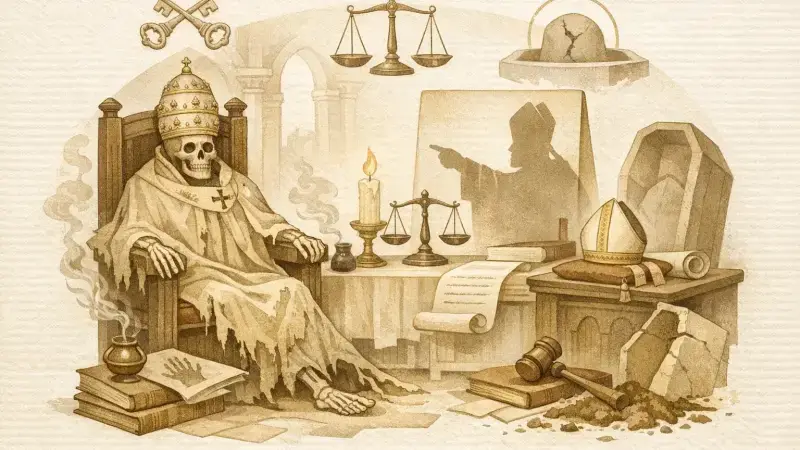
People assume a trial needs a living defendant. In Rome in 897, that assumption broke in a way that still sounds like a rumor. Pope Stephen VI had the body of his rival, Pope Formosus, dug up, dressed in papal robes, and set on a throne so charges could be read out loud. A deacon answered for the corpse. Witnesses were heard. A verdict was reached. The strange part isn’t only that a dead man was “tried.” It’s that the process was meant to do practical work in the present, by rewriting what counted as legitimate authority.
Rome, 897, and a courtroom with a body in it
The event is usually called the Cadaver Synod, or the “Synod of the Corpse.” It took place in the Lateran in Rome, during the short papacy of Stephen VI. Formosus had been pope from 891 to 896 and was already dead when the synod convened. His body was exhumed, reportedly put back into papal vestments, and placed where a living defendant would normally sit.
There was no expectation that the corpse could speak, so a cleric spoke on its behalf. That small procedural detail matters. The scene looks chaotic from the outside, but it still tried to mimic a recognizably legal church hearing: accusations, responses, judgment, and penalties. The theatrical part helped deliver the message that the institution—not the man—could keep talking after death.
Why dig up Formosus at all
Late 9th-century Rome was tied up with shifting alliances among powerful families and competing rulers in Italy. Popes were not only spiritual leaders. They were political actors who could endorse claimants, negotiate, and bless power. Formosus had been involved in high-stakes disputes before and during his papacy, and those choices left enemies behind once he died.
Stephen VI’s decision to prosecute him worked like a retroactive veto. If Formosus could be declared illegitimate or guilty of serious violations, then actions linked to him could be attacked as tainted. That matters in a system where ordinations and appointments create real chains of authority. It’s not just personal revenge. It’s a way to fight over who gets to count as “properly” in office right now.

The charges and what they were meant to undo
Accounts vary in detail, but the core accusations centered on Formosus’s status and conduct as a churchman, including claims tied to church law about holding or moving between bishoprics. In that era, technical violations could be politically useful. If someone could be framed as having broken a rule about offices, it could delegitimize later decisions without needing to argue every case individually.
One overlooked point is how much of the argument was aimed at paperwork made flesh: ordinations, promotions, and the authority of bishops and priests associated with him. The trial wasn’t only about shaming a dead pope. It was about making a legal-sounding basis for saying, in effect, that certain acts never properly happened. That kind of claim spreads quickly through an institution because it threatens everyone whose status depends on that chain.
The verdict, the body, and the symbolism of the hand
Formosus was found guilty. The penalties were aimed at both reputation and function. Chroniclers describe the body being stripped of its vestments. A detail people often miss is the focus on the right hand. Reports say fingers used for blessings were cut off, a way of saying the gestures of authority associated with that person were now void. It’s a blunt, physical way to argue about invisible legitimacy.
After that, the corpse was disposed of in the Tiber. Later accounts differ on exactly what happened next and in what order, but the river detail keeps coming back because it was a public, Roman kind of erasure. Even that didn’t settle things. The body’s treatment became part of the fight, not the end of it.
Backlash, reversals, and why the episode wouldn’t stay closed
The Cadaver Synod didn’t produce a stable outcome. Stephen VI’s own position soon collapsed, and he did not remain in power for long afterward. In the years that followed, the church swung between condemning Formosus and rehabilitating him, depending on which faction was ascendant. That instability is part of why the story survives. It wasn’t a single shocking act that everyone accepted. It was a contested move inside a larger struggle.
For observers at the time, the deeper tension was practical. If a pope could be posthumously put on trial, then the reliability of the church’s own record keeping was at stake. Every reversal threatened to invalidate someone’s rank, someone’s appointment, someone’s sacramental authority. The corpse in the courtroom was grotesque, but the fear underneath it was bureaucratic and immediate.

Related reads
- Why the first second after you look feels frozen
- Why it was once illegal to die in Parliament
- The sponge that grows glass skeletons on the ocean floor
- Vending machines that sell live crabs
- How lead pipes changed ancient water chemistry—and modern corrosion science explains why
- The festival where people chase a rolling wheel of cheese
If you liked this, you might also enjoy: