

Seeing “livestock” on a plant
Watch a bean plant for a minute in a garden, a meadow edge, or an orchard, and you might notice ants moving with a strange purpose. They aren’t hunting. They’re patrolling the stems, tapping tiny soft-bodied insects, and then heading back to the nest with full abdomens. This isn’t one single famous location or one rare event. It happens across big regions, including European fields where Lasius niger is common, North American crops where Formica and Camponotus species do it, and forests where Dolichoderus ants tend aphids in tree canopies. The mechanism is simple: ants trade protection for sugar-rich honeydew, and the aphids become a managed resource.
Which ants do the farming
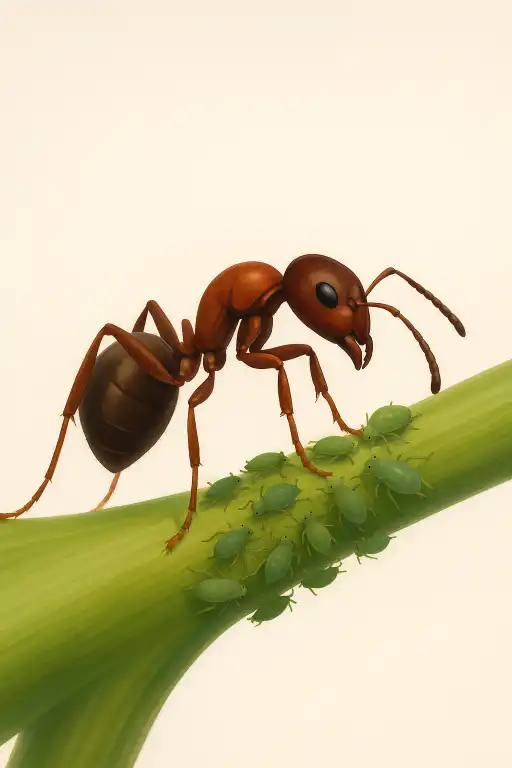
The “across fields” part fits especially well with soil-nesting ants that already forage over large areas. Species in Lasius are often cited because they are abundant in lawns, pastures, and crop edges, and they readily tend aphids on low plants. Some Formica species do it too, especially in cooler temperate zones, building big nests and running long foraging trails that pass through patches of aphid-host plants.
It varies by habitat and by the aphid species available. There isn’t one universal “aphid-farming ant.” Some ants specialize more than others, and some switch between hunting insects and tending aphids depending on season, weather, and what plants are flushing new growth.
How ants manage aphid “herds”
An ant approaches an aphid and strokes it with its antennae. That contact often triggers the aphid to release a droplet of honeydew. The ant drinks it on the spot or stores it in its crop to carry home and share. Then it goes back to checking nearby aphids, like it’s making rounds.
The overlooked detail is how physical this can get. Ants don’t just “guard.” They sometimes move aphids to better feeding sites, including fresh shoots with higher sap flow. In some systems, workers carry aphids in their mandibles to new stems or down into sheltered crevices when conditions turn bad. It’s not sentimental care. It’s inventory management around a food pipeline.
Protection, pressure, and plant damage
The trade is protection. Ants chase off or kill predators that would normally thin aphid numbers. Lady beetle larvae, lacewing larvae, hoverfly larvae, and tiny parasitic wasps all come into conflict with ants at an aphid colony. You can sometimes see a standoff: a predator tries to edge in, an ant rushes it, and the predator drops off the plant or retreats.
For the plant, this can make aphid outbreaks worse. Aphids remove sap and can distort new growth, and some species spread plant viruses as they feed. When ants are actively tending, the balance shifts. Natural enemies that would normally slow the colony get pushed away, and the aphid population can climb faster than you’d expect from the number of insects you first noticed.
Why fields are such good pasture
Fields and field edges keep producing the tender plant tissue aphids like best. New leaves and shoots have higher sap flow and different chemistry than older tissue, and aphids often do well there. That steady renewal can keep honeydew production reliable for ants, especially when other sugary sources are scarce. It’s also easy for an ant colony to maintain repeatable routes when plants are densely packed and the terrain is open.
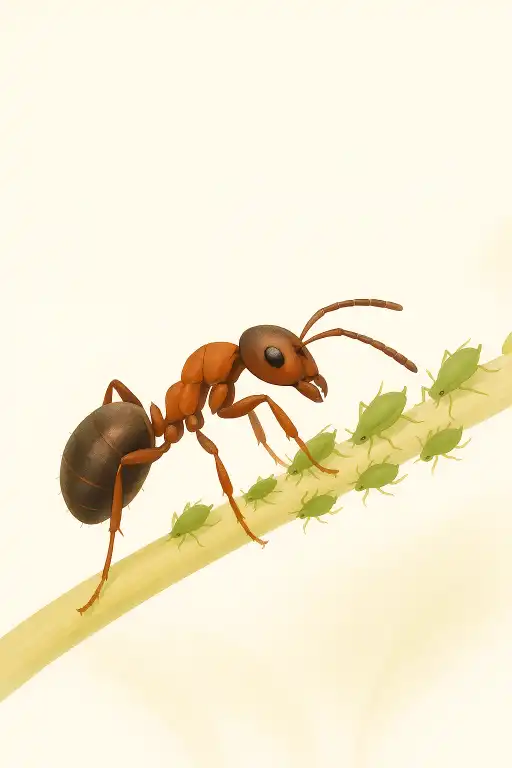
A concrete scene is a line of ants climbing the same few stems of a broad bean patch while other plants nearby are ignored. The ants aren’t randomly wandering. They’re working a small set of “productive” plants, returning to the nest on a narrow trail. On a warm afternoon, you can see workers pausing at the aphid cluster, taking honeydew, and immediately turning back, as if the shortest path matters more than exploring anything new.
Related reads
- Why alpine plants curl their leaves at night
- Why bioluminescent plankton pulse when ships pass
- Why Martian dust devils can fling pebbles across plains
- How mangrove roots enlist microbes to stitch new coastline
- A row of doors each fitted with a different custom keyhole
- A bench that refuses to warm for the same person twice