
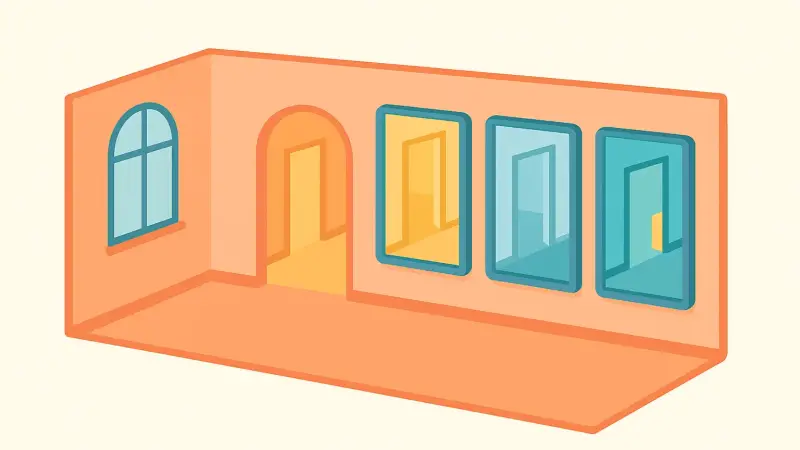
Seeing a hallway that isn’t there
People rarely notice how consistent their mirrors are until one breaks the rule. In this apartment, the mirror by the entry shows a hallway with a green runner. The bathroom mirror shows a narrower corridor with a different door at the end. The closet mirror shows a lit stairwell that the building doesn’t have. This isn’t one famous, documented address. It’s a type of story that shows up in different places, including old “strange house” threads on Reddit and the long-running “glitch” style posts people share on Tumblr. The core mechanism is simple: each reflective surface behaves like a window into a different version of the building’s common spaces.
How it behaves when someone moves through the rooms

The odd part is not just what the mirrors show. It’s how stable each view is. The entry mirror keeps “its” hallway even when the apartment lights change. The bathroom mirror keeps “its” hallway even with steam and condensation. People describe turning their head away and back and finding the scene unchanged, like a paused feed. But the moment they shift position, the perspective updates correctly, with proper parallax, as if the hallway has depth and the mirror is tracking the viewer’s angle.
One situational example that comes up a lot: standing in the kitchen late at night, the fridge hum is normal, the building is quiet, and the mirror on the pantry door shows a corridor with a wall sconce that flickers in a slow rhythm. The overlooked detail is the baseboard. In ordinary reflections, people can usually match scuffs, paint lines, and the seam where the baseboard meets the floor. In these accounts, the baseboard is clean and sharp, or it has a different profile entirely, like it belongs to a renovation that never happened.
Why mirrors can “agree” with you and still be wrong
A mirror is brutally literal about angles. If the apartment has a long line of sight—an open door, a glossy cabinet, a framed mirror slightly tilted—it can bounce a real hallway into a place you don’t expect. Two reflections can also stack. A mirror can show another reflective surface, which shows something else, and the result looks like a corridor that “should” be behind you. Add a cheap mirror with slight warping, and the geometry still tracks your movement while the space feels off. That’s enough to convince someone the hallway is new, not just rerouted by angles.
Building layouts help the illusion. In older apartments, especially pre-war buildings in New York City, service corridors and locked utility runs can sit close to living spaces. A mirror can catch a slice of a real, boring maintenance hallway through a half-open door across the way, then stretch it. People tend to overlook the height of the mirror, too. A mirror mounted a few inches higher than eye level changes what it can “see” down a corridor, including ceiling fixtures and transom windows that a person standing in the same spot wouldn’t notice directly.
What makes the “different hallway” version feel convincing
The stories that stick are the ones where the mirror shows information the apartment doesn’t seem to have. A different number of doors. A different paint color. A hallway that appears longer than the building footprint would allow. People also mention sound behaving oddly around it. The apartment stays quiet, but the mirror-view hallway “looks” like it should carry noise—an elevator clank, footsteps, a TV through drywall—and it doesn’t. That mismatch between expected sound and visible space makes the reflection feel less like a trick of angle and more like a separate place.
Time cues are another hook. The mirror-hallway might show daylight when it’s raining outside. Or show dim, sodium-colored light when the window view is bright. There’s no reliable pattern in the retellings, and it’s often unclear whether the teller checked other clocks or just went by mood and brightness. But the small specifics—like the color temperature of a hallway bulb or the direction of shadows along the floor—are the details that make readers pause, because they’re the sorts of things you don’t invent on purpose unless you’re trying to be precise.
What changes when someone tries to test it
When people try to “verify” the hallway, the behavior tends to shift. The mirror that looked deep and stable starts acting like a normal mirror when a phone camera points at it. Or the camera shows the regular apartment while the person’s eyes insist the corridor is there. Sometimes it’s the opposite: the camera captures a dim rectangle that shouldn’t exist, but the person sees nothing unusual in the moment. It varies, and the inconsistency matters. It means the story isn’t just about seeing an impossible space, but about disagreement between attention, expectation, and what a device records.
In the most grounded versions, the “different hallways” end up being real spaces seen indirectly: a neighbor’s open door at the end of the corridor, a mirror in the hall outside, a glass-covered picture frame acting like a faint reflector, a building renovation in progress that briefly exposed a passage. In the stranger versions, the reflections stay stubbornly specific even after furniture moves and doors close. Either way, the apartment becomes a place where the most ordinary object on the wall keeps offering a view that doesn’t match the body’s memory of the building.

Related reads
- Why you walk into a room and forget your purpose
- The elevator rule: why tiny strangers’ talk feels so awkward
- When it literally rained frogs and fish
- The town where the postman still delivers every letter by canoe
- Luggage that repeatedly showed up on flights to the wrong continent
- Microbes that breathe metals and reshape subterranean chemistry