

Why subway tiles can glow under blue light
Someone points a blue “blacklight” at a tiled wall in a subway station and a few spots flare up. It looks like a hidden paint job. It isn’t one single system or one single station, either. Similar blacklight photos show up from places like the New York City Subway, the London Underground, and subway systems in Seoul. The basic mechanism is simple: some compounds on the surface absorb blue or UV-ish light and re-emit it as visible light. In a station, those compounds can come from cleaners, skin oils, and sometimes living films of microbes that build up in grout lines and at tile edges.
What “a glowing bacterium” usually means in real life
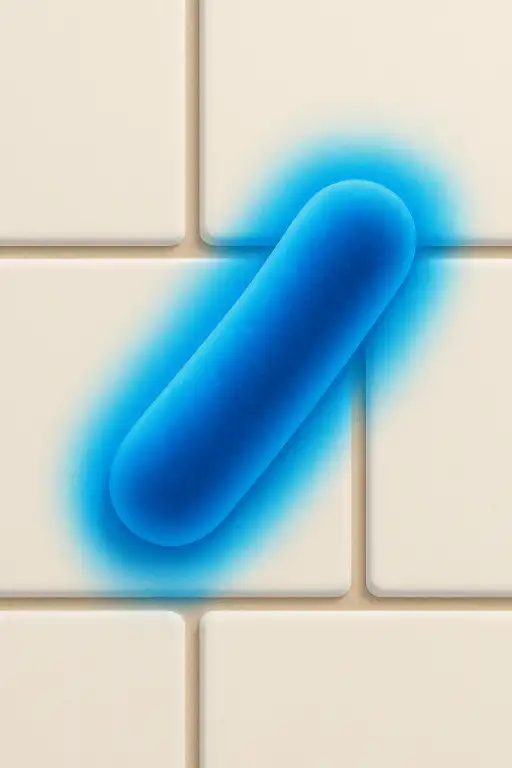
When people say a bacterium glows, they often mean fluorescence, not the bacterium generating light the way fireflies do. True bacterial bioluminescence exists (some marine species can do it), but that’s not the usual subway situation. On indoor surfaces, the glow under blue light is more often from fluorescent molecules that are either made by microbes, released when microbes break things down, or simply trapped in the slimy matrix of a biofilm.
A lot of bacteria also make pigments. Some pigments are strongly fluorescent under blue light. Microbes in the environment don’t need to be “rare” for that to happen. They just need the right conditions: moisture, a little organic residue, and time. The tiles are not the interesting part. The thin, sticky layer that forms on top of them is.
Biofilms love grout, edges, and tiny defects
Tiles look smooth, but the places around them are not. Grout is porous. The caulk line at the base of a wall can have micro-cracks. The edge where a tile meets a metal strip collects grit. Those spots stay damp longer after cleaning or after humid air condenses overnight. That extra “wet time” is a big deal for microbes, because it’s when they can feed and multiply instead of drying out.
A specific detail people usually overlook is that fluorescence often tracks the cleaning pattern. A mop head that always hits the same lower band of wall. A rag that wipes around a poster frame. Those repeated motions can leave a thin film of surfactant or disinfectant residue. Some residues fluoresce on their own. Others make it easier for a biofilm to hold on by changing the surface tension and trapping dust and skin flakes that become food.
Why blue light makes it obvious
Under normal station lighting, a biofilm can look like nothing. Under a blue light, fluorescence is suddenly high-contrast. The glow can be greenish, yellowish, or whitish depending on the molecules involved and on the filter used in the flashlight. That’s why two people can shine “blacklights” at the same wall and report different colors. The light source matters, and so does the camera. Phone cameras often exaggerate the effect because of automatic exposure and color processing.
It’s also why it’s hard to pin the glow on one organism from a photo alone. A glowing patch can be a mix: microbial pigments, detergent brighteners, lint fibers, and traces of bodily fluids. Without sampling and lab work, it’s usually unclear how much of the fluorescence is actually coming from bacterial products versus leftover chemistry from routine maintenance.
What scientists would need to identify the culprit
To say “this species did it,” researchers would swab a specific glowing area, culture organisms (if they grow), and run DNA-based identification. They would also test the surface chemistry, because fluorescence can persist after the microbes are dead. That distinction matters: a dead biofilm can still glow if the fluorescent molecules are still stuck in the matrix. A live biofilm might glow more after it’s disturbed, because pigments and metabolites get redistributed across the wet surface.
If it does turn out to be microbial, it’s rarely one bacterium acting alone. Biofilms in public spaces tend to be communities: bacteria, sometimes fungi, and whatever hitchhikes in on dust and shoes. The tiles are just the stage. The glow is the quick visual clue that something thin, chemical, and often biological has been quietly building up in the places nobody looks at unless the light changes.
Related reads
- How electric fish create private radio channels underwater
- The ant species that farms aphid livestock across fields
- Why alpine plants curl their leaves at night
- Why bioluminescent plankton pulse when ships pass
- Why Martian dust devils can fling pebbles across plains
- How mangrove roots enlist microbes to stitch new coastline