
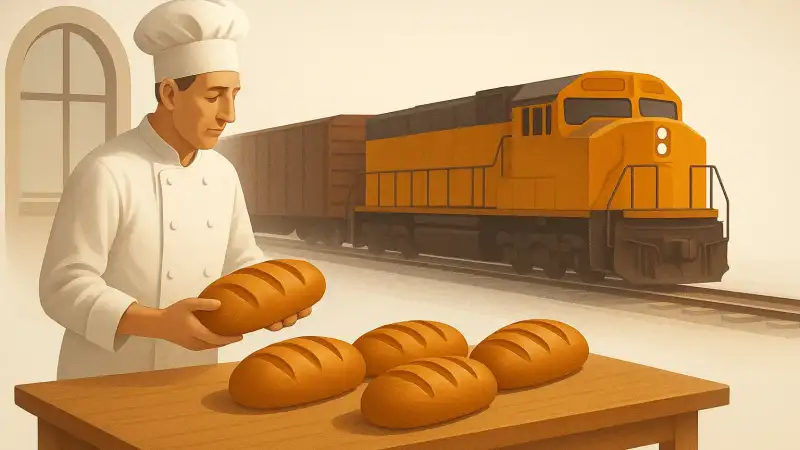
If you’ve ever waited at a grade crossing and watched a freight train crawl by, you’ve seen a kind of clock that doesn’t care about minutes. Some bakeries near active rail lines pay attention to that clock. There isn’t one famous shop that does this everywhere, and it isn’t a standardized practice, but the idea shows up wherever the tracks run close enough to be felt. Think of places like Chicago’s rail corridors, towns along BNSF and Union Pacific lines in the Midwest, or port rail approaches around Los Angeles and Long Beach. The core mechanism is simple: trains bring a predictable pattern of vibration, sound, airflow changes, and occasional brief power-quality hiccups, and a bakery can line up certain steps around those moments.
What a passing freight train changes inside a bakery
A long, heavy freight doesn’t just make noise. It sends low-frequency vibration through the ground and building frame. That can show up as a faint shiver in a proofing rack, a rattling of sheet pans, or a tremor in a worktable. If the bakery is close enough, you can also get pressure pulses: small shifts in air pressure as the train moves past, especially with long strings of intermodal containers or a fast-moving head end.
One overlooked detail is how uneven those effects are inside the same room. A mixer bolted to a slab might barely notice what a tall rack near a doorway does. A loaf pan on a flimsy speed rack can “walk” a few millimeters over a shift. People blame the wheels on the rack. The train can be the nudge that makes it happen on the same schedule every day.
Why timing matters for dough and ovens
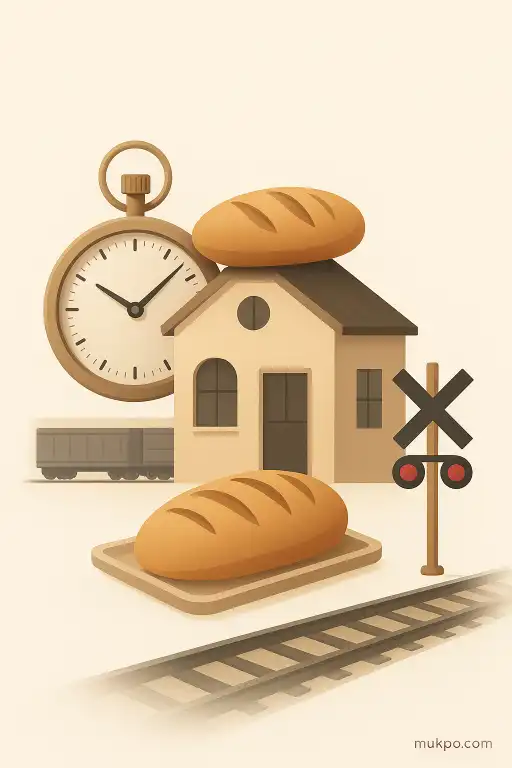
Most of bread baking is waiting, but not all waiting is equal. Proofing is sensitive to temperature swings and tiny disturbances. Shaped loaves can slump if they’re already at the edge of overproof. Scored dough can seal back up if it sits too long after the cut. Steam injection and oven loading are also timing-heavy, because the first few minutes of heat and humidity set the crust and how much the loaf expands.
So if a bakery has learned that a certain freight usually blocks the crossing and shakes the block around 6:30, they may prefer to have loaves already loaded, or still resting, rather than half on a peel with a hot deck oven waiting. The train isn’t “helping” the bread in any magical way. It’s a predictable disturbance. It’s easier to work around a disturbance you can anticipate than one that surprises you.
The schedule isn’t exact, but the patterns can be
Freight railroads don’t run like passenger timetables, and the exact minute varies. But patterns still emerge. Some lines have regular windows for intermodal traffic headed to terminals, or recurring locals that switch industries in daylight. A bakery on a busy corridor can learn the feel of it: the short, sharp rumble that’s likely an empty coal train versus the steadier, higher-pitched clatter of intermodal cars. Even without knowing what it is, the bakery learns how long it tends to last.
There’s also the human pattern around trains. Delivery drivers get delayed at crossings. Staff arrive late when gates are down. Customers change their morning routine if they get stuck once too often. That pulls the bake schedule indirectly. A shop might aim to have the first trays out before the usual blockage, not because the train changes the oven, but because the train changes who can reach the counter.
How the “train moment” turns into a kitchen routine
When someone says they “time the loaves to the trains,” it often means they’ve built small habits around a recurring interruption. Mixing might start right after the rumble, when the building settles. Loading might happen a few minutes before the expected vibration, so the oven door isn’t open during the loudest part and the baker isn’t trying to hear timers over the horn. If there’s a front-of-house rush that hits when the crossing clears, the back-of-house might push the most hands-on steps earlier.
Sometimes it’s about equipment behavior. Digital scales can flicker if a table is shaking. A dividing machine can drift if it isn’t level and the floor vibrates. Proofing cabinets can show tiny temperature dips if a door gets bumped open and shut during the commotion. None of these alone ruins bread, but the bakery notices which small failures cluster around the same minutes, and the routine evolves to keep the fragile steps away from those minutes.
The limits: when trains stop being a useful clock
This kind of timing only works when the train pattern is stable enough to be recognized. A corridor can change fast. A new terminal schedule, construction, or a traffic surge can shift trains to different hours. Weather can also change the whole feel. Cold air carries sound differently, and wet ground can transmit vibration in a way that makes a familiar pass feel bigger. If the bakery is right on the edge of noticing it, those conditions decide whether the train is “part of the day” or background.
And sometimes the “train timing” is less about physics and more about attention. When a loud, unavoidable thing happens regularly, people organize around it without meaning to. They glance at the clock. They pause a conversation. They wait to pull a tray until the shaking stops. Over months, that becomes the shop’s rhythm, even if nobody can say exactly which freight it was or why it came through at that hour.
Related reads
- The coffeehouse pitch in 1719 that fanned the South Sea Bubble
- A hidden stash of decades old receipts that paid someone s rent
- Why waiting in line feels longer than the same wait at home
- How two Yorkshire cousins convinced Edwardian Britain that fairies danced in their garden
- How a bark beetle epidemic transformed 20th century North American forests
- What aurora colors reveal about collisions in Earth’s upper atmosphere