
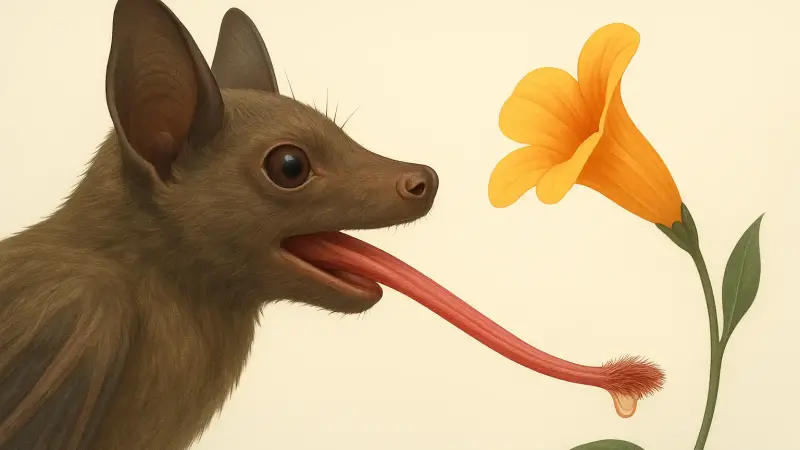
If you watch a nectar-feeding bat at a flower, it doesn’t sip the way most people imagine. It doesn’t form a neat straw with its tongue. In places like Costa Rica and southern Mexico, long-tongued bats visit night-blooming plants and make quick, repeated tongue flicks into the flower. The tongue tip spreads and changes shape. Tiny hairs along it stand up, and nectar clings to them. Then the tongue snaps back into the mouth before the bat is gone again. The whole trick is a tongue that acts less like a tube and more like a fast, wet brush that can load nectar in a fraction of a second.
Not one bat, but a whole set of nectar specialists
This isn’t a single species with a one-off odd tongue. Nectar-feeding bats show up in a few regions, and their details vary. In the Americas, many are leaf-nosed bats in groups often called “long-tongued” bats. In Africa and parts of Asia, fruit bats include nectar-feeders too. The exact tongue shape and hair arrangement differ, but the job is the same: take in sugary liquid from flowers that open at night, often while hovering or while clinging briefly to the plant.
The situation also changes by plant. Some bat-pollinated flowers hold nectar deep inside a tube. Others keep it in a wider cup. A tongue that can both reach and quickly collect helps across that range, especially when a bat is moving between flowers fast and doesn’t have time to settle in for a long drink.
How a “brush” tongue actually grabs nectar
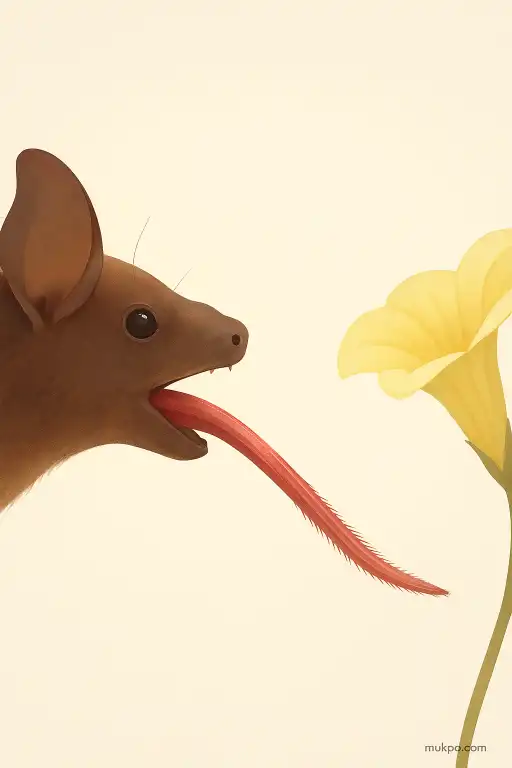
The brushlike hairs are real structures on the tongue surface, not a fuzzy coating. Near the tip, they can lie flatter or flare outward. When the tongue presses into nectar, those hairs spread, which increases surface area and creates many tiny spaces where liquid can hang on. When the tongue retracts, the hairs fold back down, which helps pull the nectar past the lips and teeth instead of leaving it behind at the flower.
People often overlook how fast this is. A bat can make multiple tongue insertions per second. That speed matters because nectar is usually a thin film or a small pool, not a big gulp. A fast repeating motion also helps when the bat is hovering and the flower is moving slightly under wing wash.
It’s not a straw, and that changes the physics
A straw-like tongue would rely mostly on suction and a sealed tube. A brush tongue relies more on adhesion and capillary effects across many small spaces. Nectar is sticky compared with water, so it clings well to surfaces. The tongue tip can “load” nectar without needing a perfect seal against the flower. That’s useful because flowers are irregular. Their openings can be wide, split, or crowded with stamens, and bats don’t land as carefully as an insect walking in.
The tongue itself is also doing mechanical work. Muscles and connective tissue let it extend far out of the mouth and then recoil quickly. Some nectar bats have tongues that can extend to a large fraction of their body length. It’s a lot of moving tissue to control, and it has to stay wet the whole time to keep nectar sticking efficiently.
What the bat has to solve inside its mouth
Collecting nectar is only half the problem. The bat still has to swallow it quickly and keep flying. Nectar is mostly sugar water, so it can be sloshed around and lost if it isn’t moved backward efficiently. The tongue retracts, and the bat’s mouth parts guide the liquid toward the throat while the tongue goes out again for the next flick. That back-and-forth can look chaotic in slow motion, but it has to be tightly timed to avoid choking or wasting nectar.
There’s also the messy reality of flowers. Pollen dust, bits of plant tissue, and even small insects can get stuck to a wet, hairy tongue. So the tongue is working as a collector for more than nectar. That can affect how much pollen ends up on the bat’s face and fur, which is part of why bats can be effective pollinators even when they only pause for an instant.
A concrete night scene: bat, flower, and split-second timing
Picture a night-blooming cactus flower in a dry region, or a large pale flower in a tropical forest understory. A bat approaches, flares its wings to hover, and pushes its face toward the opening. It doesn’t need to thread a narrow tube perfectly. The tongue shoots forward, the tip hairs flare in the nectar, and the tongue snaps back. That can happen several times in the time it takes to blink. The bat is already backing away as it finishes the last swallow.
The overlooked detail is that the tongue tip is not just “hairy.” The hairs change posture with each lick, switching between a spread-out collecting shape and a streamlined retracting shape. Without that active switching, a brush tongue would either fail to load enough nectar or would drag and drip on the way back into the mouth.

Related reads
- How brief mirror practice changes the way you move
- The statue whose bronze weeps salty streaks after foggy nights
- How mussel byssal threads anchor entire intertidal communities
- The bakery that times its loaves to the passing freight trains
- The coffeehouse pitch in 1719 that fanned the South Sea Bubble
- A hidden stash of decades old receipts that paid someone s rent