
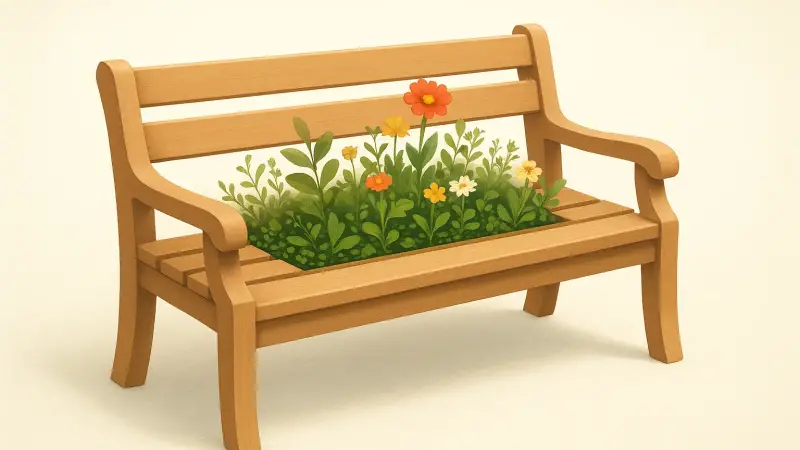
A bench that’s also a planter
You sit down on a bench and it feels normal. Slats. Screws. A little flex as you shift your weight. Then you notice a thin green line in the gaps, like something is quietly claiming the space between boards. There isn’t one single famous version of this idea. It shows up as different prototypes and local builds in places like London, New York City, and Melbourne. The basic mechanism is simple: the “seat” is built around a hidden planting channel. Soil sits inside a protected cavity, and plants emerge through narrow slots. From the sidewalk, it reads as street furniture. From a few steps closer, it’s a tiny garden working in plain sight.
How the slats can hide soil and still feel solid

The trick is that the visible slats aren’t carrying everything. Many designs use a rigid frame underneath—steel or thick timber—so the seating load goes into the frame, not into the planting box. The planting area is usually a long trough running the length of the bench, with a cap or lip that keeps soil from bulging out. The slats are spaced to leave planting openings, but the gaps are tight enough that most people won’t read them as “holes.”
One overlooked detail is how the trough is lined. If it isn’t isolated, constant moisture can rot wood and corrode metal fast. So you’ll often see (even if it’s not obvious) a waterproof liner, a root barrier, and a drainage layer. The drainage matters because a bench collects rain like a shallow roof. If water can’t escape, the soil turns swampy and the seat stays damp, which is when the whole thing stops feeling like a bench.
Water, drainage, and the problem of where it goes
A bench planter has to answer an awkward question: where does the runoff go when the soil is saturated? Some versions drain into a concealed pipe that exits under the bench onto the pavement or into a nearby drain. Others rely on a gravel layer and small weep holes so excess water drips out slowly. You can usually tell which approach is being used by looking under the seat after rain. If there’s a tidy drip line at the same points, it’s probably weep holes. If it stays dry underneath, it’s more likely piped away.
The other part people miss is the fill volume. A long thin trough can look generous but still be too shallow for roots. That’s why many installations stick to plants that tolerate tight spaces—some herbs, sedums, strawberries, or compact grasses—rather than anything that needs depth. When the planting is too ambitious, it’s not vandalism that kills it first. It’s heat. A narrow soil channel warms up quickly in summer and dries out faster than a normal bed.
How it turns into a community thing without anyone planning it
The social effect often comes from the fact that the “garden” is at sitting height. People see it up close. They can smell it. They can touch leaves without crouching. That changes who interacts with plants. It’s not just the people already inclined to kneel in dirt. It’s the person waiting for a bus, a kid swinging their legs, someone eating lunch. The bench still works as seating, so it keeps drawing bodies even when the planting is struggling.
Once people feel a little ownership, small caretaking behaviors tend to appear. Someone pinches off a dead stem. Someone pulls a wrapper out of the slats. Someone asks out loud what’s growing there. That last part is bigger than it sounds. A normal planter can be ignored. A bench forces a pause. The conversations are short, but they repeat, because the same people pass the same spot every day.
What usually goes wrong in public space
Public seating gets treated hard. Skateboard damage, spilled drinks, cigarettes, dog leashes, pressure washing. A planted bench adds a fragile zone right where all that happens. If the slat gaps are wide, litter drops into the soil channel and stays there. If they’re too narrow, seedlings can’t emerge well and maintenance becomes fiddly. There’s also the problem of soil loss. Repeated brushing, wind, and people tapping shoes can slowly eject the top layer through the openings.
Then there’s the unclear ownership. City crews might see a bench as something to repair, not something to water. Volunteer gardeners might see planting, not realize there’s a structural frame that can be damaged by digging too deep. When these things work, it’s often because somebody quietly set up a maintenance plan that fits both realities. When they fail, they don’t fail dramatically. The plants just thin out until it looks like a normal bench again, with a few stubborn sprigs still pushing up through the slats.

Related reads
- Why some river stones sing when water rushes over them
- The bakery that prints miniature maps on loaves pointing to secret recipes
- Why urban pigeons harbor unusual antibiotic resistant microbes
- How whale songs bend in deep ocean layers
- Why lightning sometimes strikes the same tree dozens of times
- The vending machine that dispenses live plants with tiny adoption cards