
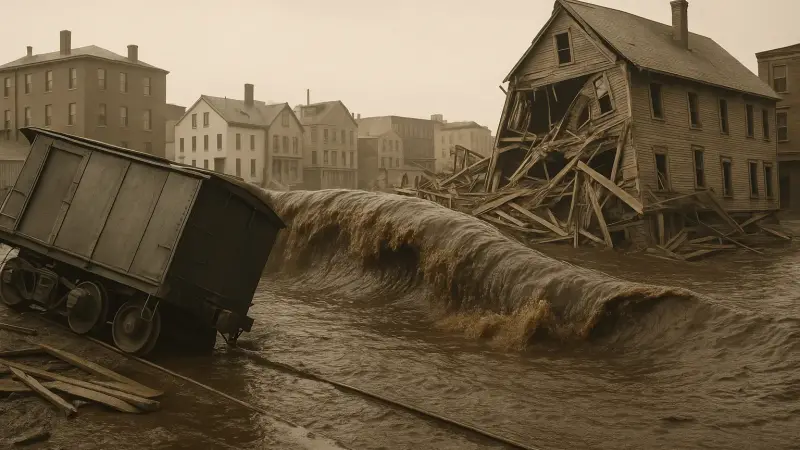
How molasses turns dangerous so fast
People think of molasses as slow. But if you put enough of it high up, behind steel walls, it behaves like any other stored liquid. On January 15, 1919, a huge storage tank owned by the Purity Distilling Company failed in Boston’s North End, near Commercial Street and the waterfront. Gravity did the rest. A dense syrup suddenly had a downhill path through narrow streets, and anything in the way became part of the flow.
The core mechanism wasn’t mysterious. It was a rapid release of pressure and weight from a container that had been holding millions of gallons. Once the tank opened, the leading edge of the surge pushed like a battering ram, even though the fluid itself was thick. The “slow” part comes later, when the mass spreads out and loses its initial force.
The tank, the neighborhood, and the moment it let go
The North End in 1919 was crowded and industrial. There were tenements, small shops, and rail lines close to the waterfront. The tank sat where delivery and shipping made sense, not where failure would be forgiving. When it burst, the molasses ran into buildings and around corners, and it didn’t drain away like water. It piled up, and the streets themselves became containers.
One detail people overlook is how much stored energy is involved before anything “moves.” A tall tank means a heavy column of liquid pressing outward and downward all the time. If the structure gives way suddenly, that pressure is released in a violent pulse. That first pulse is why people described it as a wave that could knock things down, including sections of the nearby elevated railway structure.

Why it could sweep trains and topple buildings
Molasses is thick, but it’s still a fluid. In a sudden release, the front of the flow can act like a moving wall because there’s so much mass behind it. The force comes from momentum: a heavy material moving at even modest speed hits with enormous impact. After impact, molasses doesn’t bounce off and run away. It clings, it fills basements, and it keeps pushing because more is still arriving from behind.
That stickiness mattered. People and animals could be trapped as the level rose, and rescues were slowed because movement through the muck was exhausting. Debris made it worse. Wood, metal, and broken parts of buildings turned into obstacles that redirected the flow and created pockets where it deepened. Water would have thinned and drained. Molasses stayed put, so damage kept accumulating even after the initial surge passed.
Cold weather, viscosity, and the cleanup problem
January in Boston is cold, and temperature changes viscosity a lot. Warmer molasses flows more easily. Colder molasses stiffens and resists movement. Accounts vary on the exact conditions and how much warming mattered that day, but the basic physics is steady: as the syrup cooled on streets and in shadowed alleys, it became harder to move and harder to remove. That meant the hazard didn’t end when the wave stopped.
Cleanup turned into a different kind of problem. Hosing with water spreads sugar and makes a wider sticky film before it finally dilutes enough to wash away. Molasses also worked its way into cracks, basement steps, and the texture of brick and cobblestone. That kind of surface detail is easy to ignore until you try to remove it. A smooth floor is one thing. A city block full of joints, seams, and grit is another.
Blame, lawsuits, and what the disaster changed
Afterward, the question wasn’t just how a tank could fail. It was who was responsible for making sure it wouldn’t. The disaster led to major legal action, and the investigations dug into construction, inspection, and whether warning signs were ignored. People nearby had reported concerns about leaks before the collapse, though accounts differ on how seriously they were taken and by whom in the moment.
The broader effect showed up in how cities treated big industrial structures sitting next to housing. A storage tank seems ordinary until it isn’t, and the Boston case became a reference point in arguments about oversight and engineering review. It also left behind a very specific memory in the North End: not just that it happened, but how long it took for the place to feel clean again.

Related reads
- How a Habsburg envoy went out a window and sparked Prague’s uprising
- How the solar wind sculpts comet tails into bright, streaming plumes
- The smell-triggered time machine: how odors unlock buried memories
- Why some rivers form tidal bores that rush upriver as walls of water
- How microbes dissolve concrete to access buried minerals
- Why volcanic ash plumes often produce spectacular lightning bolts
If you liked this, you might also enjoy: