

The moment it starts to feel different
There’s a point in a repetitive chore where the room seems to get quieter, even if nothing changed. Someone is washing dishes at a sink in a New York apartment. Someone is folding laundry in a flat in London. Someone is sweeping a corridor in a hospital in Tokyo. This isn’t one famous event or one place. It’s a pattern people report across settings. The core mechanism is simple: the task is predictable, the movements repeat, and the brain stops spending effort on deciding what happens next. Attention narrows. The outside world doesn’t disappear, but it gets less demanding for a while.
Predictability lowers the brain’s workload
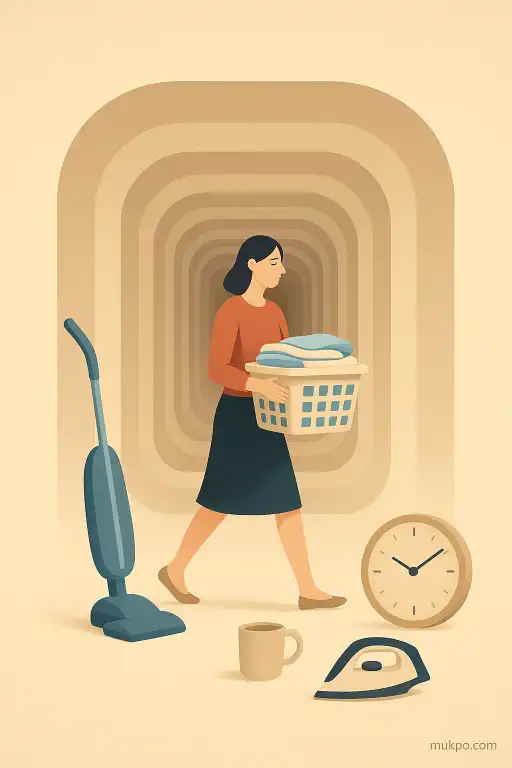
Repetitive chores reduce “choice points.” That’s the often-overlooked detail: the calming part is not only the motion. It’s how few decisions the task requires once it’s underway. Compare wiping a counter in steady strokes to cooking a new recipe. Cooking keeps asking questions: timing, heat, what’s next. Wiping mostly doesn’t. When the next step is obvious, working memory can unclench. People still notice things, but less of their attention is spent on planning, switching, and correcting.
This is also why the same chore can feel soothing one day and irritating the next. If the task has hidden uncertainty—running out of trash bags, a missing sock, a stain that won’t lift—the decision load comes back. The “tunnel” feeling tends to depend on how stable the sequence stays minute to minute.
Rhythm turns attention into something narrow
Repetition gives the nervous system a rhythm to lock onto. Scrub, rinse, rack. Vacuum line, turn, vacuum line. The body settles into a tempo, and attention often follows the tempo instead of bouncing around. This can resemble the mental narrowing people describe during long drives on familiar roads, except chores usually carry less risk, so the mind is less vigilant. Sounds that would be annoying in a “wide attention” state can fade into the background because they don’t demand a response.
A concrete example: someone mopping a kitchen floor may notice their gaze stops jumping. It sits on the edge where wet meets dry, tracking a simple boundary. That tiny visual rule—follow the line—can hold attention more firmly than people expect. It’s not deep focus on meaning. It’s focus on a repeating pattern that keeps renewing itself every few seconds.
Small sensory feedback makes it feel safe
Many chores provide immediate, low-stakes feedback. The plate looks clean. The pile gets smaller. The floor changes sheen. That feedback loop matters because it’s quick and unambiguous. The brain doesn’t have to wait hours or days to find out whether effort worked. For some people, that certainty is calming on its own, especially when other parts of life feel unresolved or abstract.
There’s also a sensory detail people overlook: the steady pressure on the hands and joints. Folding towels, squeezing a sponge, pushing a vacuum handle. Those repeated sensations can be grounding because they’re consistent and easy to interpret. Not everyone experiences it as pleasant, and it can vary with fatigue, pain, or noise, but the “safe” feeling often tracks with how stable and controllable the sensory input is.
Why it can flip from calming to agitating
The same tunnel effect can turn sour when the task stops matching the body’s expectations. If a vacuum keeps snagging, or the sink keeps refilling with dishes, repetition starts to feel like being stuck rather than moving forward. The nervous system reads that as error and unfinished business. Attention narrows, but now it narrows onto friction. That can feel tense instead of quiet.
Social context changes it too. Cleaning alone in a quiet home is different from cleaning while being watched, rushed, or interrupted. Interruptions force attention to widen and re-plan, which breaks the predictability that made the chore feel smooth. Sometimes the calm returns as soon as the sequence becomes uninterrupted again, and sometimes it doesn’t, depending on how much mental “reset” the interruption demanded.
Related reads
- Why a 20 minute nap can reset a bad mood
- A legionary’s bronze dodecahedron: the Roman-era object’s baffling purpose
- The antique camera that developed a decades old portrait on its own film
- How the brain invents reasons after we make a choice
- A library that stamps books with the weather they were read in
- How smiling can actually lower your stress levels