
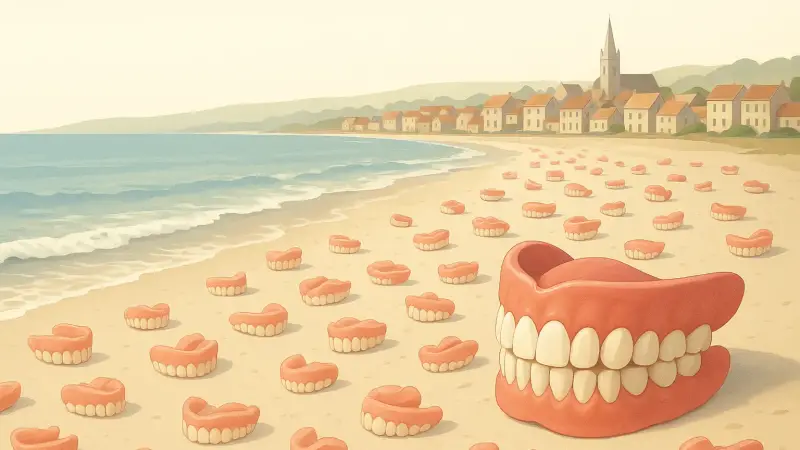
A strange kind of beachcombing
People notice the oddest things after a storm. Not just bottles or driftwood, but full dentures. The idea that one “coastal town” gets hundreds every year is the sort of claim that travels well online, but it usually isn’t tied to one verifiable place. Reports pop up in different regions instead, including the coasts of the UK and Japan, and in local stories along the US Pacific Northwest. The mechanism is simple and unglamorous: dentures are small, buoyant enough in the right conditions, and easy to lose in exactly the places that feed the sea with lost objects.
A concrete example shows how ordinary it can be. In 1992, tens of thousands of Nike shoes washed up on beaches from Oregon to British Columbia after a container spilled its cargo into the Pacific. No dentures were involved there, but it’s the same conveyor belt. The ocean doesn’t “find” anything. It sorts, carries, and returns what floats, and it does it in patterns people can sometimes predict.
How dentures get into the water in the first place

Dentures usually enter the sea the same way phones, sunglasses, and hats do: by accident. They can slip out while someone is swimming or surfing. They can fall from a pocket on a pier. They can be dropped from a boat during seasickness, when people lean over the rail and don’t think about what’s loose. They also leave through plumbing. A denture knocked off a sink ledge can be flushed in a panic, and from there it can reach waterways through sewer overflows or combined sewer systems during heavy rain.
Another route is less obvious. Care facilities and hospitals generate dental appliances that are damaged, replaced, or mislabeled. Most are handled correctly, but any waste stream that ends up in open dumpsters near wind and rain is a chance for lightweight plastic to travel. One overlooked detail is that some dentures include metal parts, but the pink acrylic base can still trap air and stay afloat for longer than people expect, especially if it’s attached to bits of foam, algae, or other debris.
Why they wash up together
When people imagine items washing ashore, they picture a straight line from loss to beach. Real drift is patchy. Floating objects collect in convergence zones where currents meet, then get released in pulses when wind changes or storms stir the surface layer. That’s why beachcombers often see “clusters” of similar stuff after certain weather, even if those objects were lost at different times and in different places.
Local geography makes the effect stronger. Long, gently curving bays, sand spits, and beaches down-current of a headland act like nets. So do places near river mouths, where freshwater outflow meets coastal swell and creates a busy mixing zone. Dentures aren’t special in that sense. They just stand out because they look personal, and because they land in the same strandline as seaweed, nurdles, and fragments of packaging that keep them from immediately sinking back.
The ocean’s lost-and-found has a schedule
Coasts don’t receive random samples every day. There’s seasonality. Winter storms tend to bring in more floating debris in many temperate regions, because rough seas shake loose shoreline trash and increase the distance that light items can travel. Spring can bring a different mix if river discharge rises with snowmelt. Some beaches get a brief “delivery window” when prevailing winds push surface water onshore for a week or two, then the same beach goes quiet again.
Small objects like dentures are also sensitive to the top few centimeters of water, where wind-driven drift matters more than deep currents. That layer can move at a different speed and even a different direction than the water below it. It’s a detail people overlook because it feels intuitive that “the current” is one thing. For floating plastic, it often isn’t.
Why the story persists, even when the details don’t
Dentures carry a human charge that a cracked buoy doesn’t. A single find prompts questions: Who lost them? Were they old? Did someone panic? That turns a piece of litter into a mini-drama, which helps local anecdotes stick. Numbers then inflate as stories get repeated, especially when “every year” replaces “after storms” or “over time.” It doesn’t help that beachcombing posts often lack context about how long an item has been in the water, or whether a photo shows one day’s finds or a whole season’s collection.
There are places where the beach is effectively a receipt printer for everything floating offshore, and unusual items show up often enough to feel routine. But pinning it to one definitive town with a reliable annual count is usually unclear. What can be said with confidence is narrower: dentures do wash ashore, they tend to appear in bursts, and the coastlines that collect them are the same ones that collect the rest of what people accidentally feed into the sea.

Related reads
- Why your face flushes before you realize you’re embarrassed
- The Georgian scandal where doctors believed a woman gave birth to rabbits
- Why elevator silence twists into awkwardness as a crowd grows
- The invisible muscle memory behind sloppy versus neat handwriting
- How tiny rituals like tapping or checking unlock a sense of control
- The town that paid families to move in and brought its main street back to life