
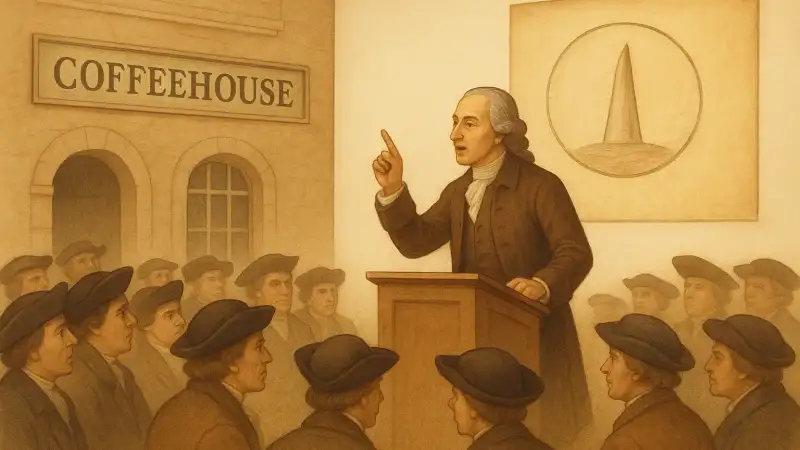
A coffeehouse is where the paperwork lived
People tend to picture stock bubbles as something that happens on an exchange floor. In London in 1719, a lot of the heat sat elsewhere. It sat in coffeehouses, where men read the latest pamphlets, swapped letters, and argued over prices they’d only half confirmed. The South Sea Company already existed, and its shares already traded, but the everyday mechanism that mattered was simpler: a story about future wealth moved faster than verifiable facts. A “pitch” didn’t need a stage. It needed a table, a newspaper, and someone confident enough to say they knew what Parliament might do next.
What the South Sea story sounded like in 1719

By 1719, the South Sea Company’s public identity leaned hard on overseas trade. The name itself did work. It suggested Spanish America, ships, and a stream of goods and silver. The awkward part was that the company’s big, reliable business was not a booming trade route. It was government finance. It held state debt and expected interest, and it tried to turn that into something that looked like a growth machine.
In coffeehouse talk, the trade angle could be repeated without anyone having to prove volumes, routes, or contracts. It was enough to point at geopolitics and hint that access could improve. Actual trade prospects were uncertain and constrained by treaties and rival empires, but uncertainty is not the same thing as silence. It gives promoters room to talk, and it gives listeners room to imagine.
The 1719 hinge: debt, Parliament, and a price that could move on rumor
The key ingredient in the lead-up was the idea that the company could take on more government debt and, in return, gain valuable terms from the state. That kind of plan is technical on paper, but it becomes simple when translated into coffeehouse language: the government needs help, this company is positioned to provide it, and the reward will push the shares higher. In that environment, “I heard a proposal is coming” could function like news even when the details were incomplete.
A usually overlooked detail is how naturally debt instruments and equity blurred in casual discussion. Many people didn’t treat them as separate worlds. Government annuities, lottery tickets tied to state payments, and company shares all sat in the same mental drawer: paper that produced money later. When a pitch framed South Sea shares as a smarter version of government income, it could feel less like speculation and more like an upgrade.
How a coffeehouse pitch actually spread
The pitch wasn’t just one person standing up and selling. It was a chain of small performances. Someone read a line from a newspaper. Someone else claimed to have seen a letter from a friend near the Court. A third person supplied a price from earlier that morning and treated it like a trend. Each link made the next one easier to believe, because it arrived wrapped in familiarity: a known coffeehouse, a known face, a known publication.
These rooms also had a built-in amplifier: they were repeatable. The same cluster could meet again the next day, and the story could gain polish. Unhelpful details would fall away. The most persuasive bits would survive. Even the act of people crowding around a table to hear the latest “word” created its own signal, because attention looks like confirmation when you can’t check the underlying facts.
Why 1719 mattered even before the famous 1720 surge
The year 1720 gets remembered because prices went wild and the crash became a warning story. But 1719 is where the social machinery warmed up. It’s when the company’s narrative, Parliament’s potential involvement, and the everyday market for rumors started to line up. A pitch in that year didn’t need to prove the whole future. It only needed to make the next step feel inevitable, so that buying now felt like arriving early rather than taking a leap.
That’s also when the boundary between “public talk” and “market action” became thin. In a coffeehouse, repeating a confident claim about what would happen could itself help make it happen, because prices responded to belief. Once a few people acted, the pitch gained a new talking point: movement. And movement, more than any pamphlet, is what kept the conversation going.

Related reads
- A hidden stash of decades old receipts that paid someone s rent
- Why waiting in line feels longer than the same wait at home
- How two Yorkshire cousins convinced Edwardian Britain that fairies danced in their garden
- How a bark beetle epidemic transformed 20th century North American forests
- What aurora colors reveal about collisions in Earth’s upper atmosphere
- The fish with transparent teeth that glow under red light