
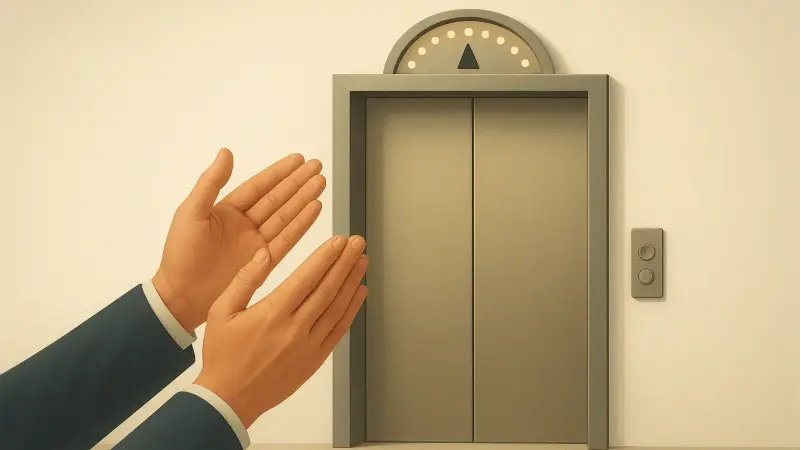
What people mean by an “applause” elevator
You step into an elevator, press the button, and nothing happens. Then someone claps, or a few people clap together, and the car finally starts to rise. There isn’t one single famous installation everyone agrees on, and the details vary depending on where you heard it. Versions get mentioned around show venues and tourist sites, like theaters in London’s West End, Broadway houses in New York, or big hotel atriums in Las Vegas, usually as a “quirky feature” someone swears they encountered. The core mechanism is always the same idea: the elevator is waiting for a sound cue, not a button press, or it’s waiting for a hidden condition that clapping happens to satisfy.
How an elevator could “listen” without magic
Elevators already use sensors constantly. Doors watch for obstructions. Motors watch load and speed. Some systems monitor vibration and noise for maintenance. Adding a microphone isn’t technically hard. If an installer wanted a novelty “sound trigger,” the control panel could take input from an audio sensor and treat it like a permission signal.
The overlooked detail is that most microphones in public spaces are not trying to recognize claps. They’re usually just measuring volume in a narrow band, over a short window, and above a threshold. A sharp burst of sound—clapping, a laugh, a dropped program, a palm smack on a wall—can all look identical to a simple detector. That’s why the story often includes people trying a second or third clap, then suddenly it works.
What’s more likely: a hidden condition people accidentally meet
A more common explanation is timing. Many elevators won’t move until the doors are fully closed and a series of interlocks read “safe.” If a door edge sensor is slightly misaligned, or a light curtain is finicky, the car can sit there while the system retries the close cycle. People get impatient. They clap, joke, or call out. A second later, the door finally seals and the elevator departs. The clap gets credited even though it wasn’t the cause.
Another hidden condition is the “nudging” mode some controllers use when doors have been blocked too long. The elevator may pause, beep, and then close with more force. In a crowded lobby after a show, the pause can feel like the elevator is waiting for permission. The moment the crowd settles—someone shifts a bag strap, a coat moves out of the light curtain—it starts up. The applause is just what was happening during that small fix.
Why clapping becomes the story people repeat
Clapping is socially “safe” in a group. If an elevator seems stuck, people don’t want to press random buttons or look panicked. A clap is a joke that invites others to join. If the car moves soon after, the group gets a tidy cause-and-effect that feels satisfying and easy to retell.
The setting matters. These stories cluster around places where applause is already normal—near theaters, event halls, awards dinners, and hotel ballrooms. People exit a show still keyed to clap. When an elevator hesitates, the default behavior is already in the room. The same delay in an office tower at 8:30 a.m. would probably turn into button-mashing, not a standing ovation.
When a “listening” elevator is real on purpose
Novelty systems do exist in buildings as interactive art or brand experiences, even if specific applause-elevator claims are hard to verify from public documentation. It’s plausible in a museum exhibit, a temporary installation, or a themed venue where the elevator ride is part of the attraction. In those cases, the “waiting” can be staged: a programmed delay, a light cue, a hidden operator trigger, or a simple sound threshold that makes any loud reaction feel like it worked.
What people usually overlook is that modern elevator controls log faults and states. If a building truly depended on clapping to function, it would be unreliable in a way that maintenance crews would notice immediately. That’s why the most believable versions are either deliberate one-off gimmicks, or ordinary elevators where a small pause lines up perfectly with a human impulse to clap.
Related reads
- Why walking often clears the fog and helps you solve problems
- How peregrine falcons harness mountain winds to reach dive speeds
- Why your handwriting shifts when you write in a hurry
- Why a sudden noise can still make your heart jump long after the danger is gone
- Why car tires squeal on hot asphalt from rubber chemistry
- How the Donner Party’s 1846 winter stranded a wagon train and forced unimaginable choices