
Seeing it happen up close
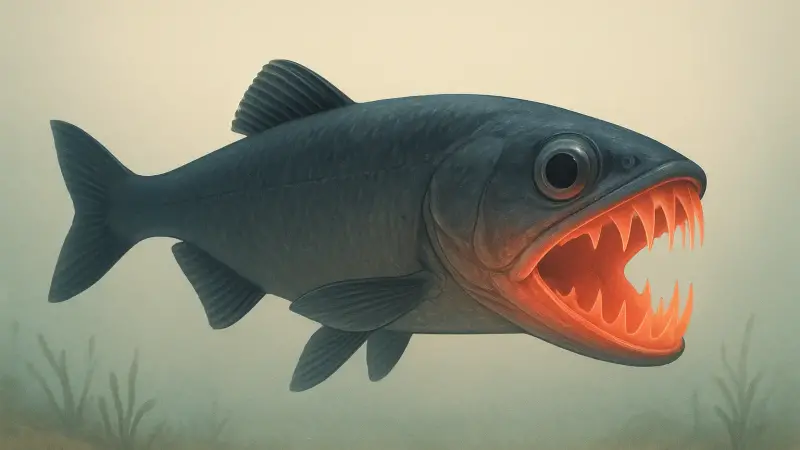
At a public aquarium, it’s normal to see a fish flare its jaws and catch a flash of light off a tooth. What’s less expected is a tooth that seems to disappear until the lighting changes. This isn’t one single “local legend” fish tied to one place. It’s a real trait that shows up in different marine animals in different regions, and it’s been described from places like the Red Sea and the western Pacific. The core mechanism is simple: some teeth are so low in pigment and so well matched to the refractive index of seawater that they look nearly transparent, and some of those teeth also fluoresce. Under red illumination, that fluorescence can show up as a glow, even when the tooth itself looks clear in normal light.
A concrete situation where people notice it is during night dives or in lab tanks that use narrow-band lights. A diver sweeps a beam across a reef fish’s open mouth, and the teeth don’t reflect like enamel “should.” Then, when a different wavelength is used, the edges light up. The overlooked detail is that the “red light” part can be confusing: many marine fluorescing materials are excited by blue or near‑UV light and then emit green, orange, or red. So the tooth can appear to “glow red” because it’s emitting red, or it can appear under red illumination because the rest of the scene goes dark and the tooth’s emission still reads as a bright signal. The exact effect depends on the light source and filters, and it varies.
What “transparent teeth” can mean in fish
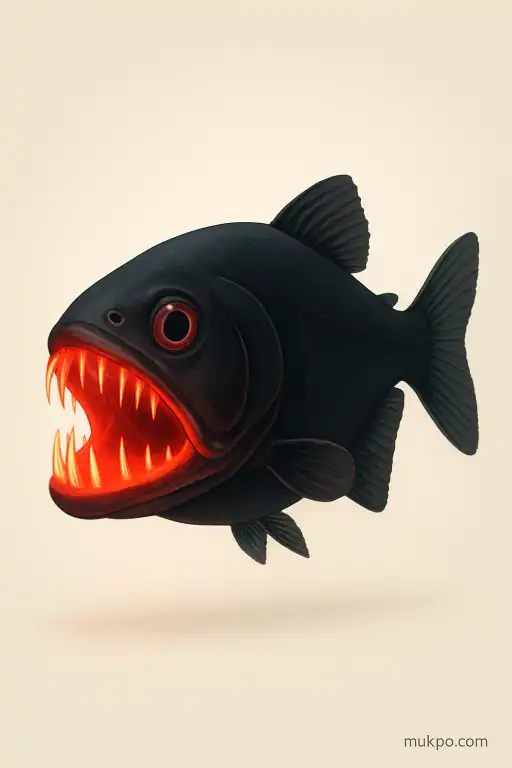
Fish teeth are not all built like mammal teeth. Many are more like small spikes or plates with thin mineral layers. If a tooth has very little pigmentation and its microstructure doesn’t scatter much light, it won’t look white. It can look glassy or faintly milky, and in water it can blend in even more. That’s partly optics. Light bends when it crosses from water into tooth material, and if the optical properties are close, there’s less contrast. Enamel-like tissues can also be thin or absent in some species, which changes how much light gets reflected back to the viewer.
There’s also a practical reason this can show up more in marine fish than people expect. Many reef fish feed in ways that don’t require thick, opaque, crushing teeth. Some scrape. Some nip. Some grab tiny prey. In those cases, the tooth doesn’t need to be a big, bright, highly reflective surface. It needs to be hard enough and shaped right. If the tooth is small and needle-like, “transparent” can simply mean “not obvious unless you catch it at the right angle.” In photographs, that can make the teeth look like they aren’t there at all, until the fish opens its mouth wide or the lighting changes.
Why anything would glow under red light
Glow is a slippery word. Sometimes people mean bioluminescence, where the animal produces light through chemistry. Teeth don’t do that. What’s reported for teeth is fluorescence: they absorb light at one wavelength and re-emit it at another. In water, this can be striking because ambient light is filtered by depth. Reds disappear quickly as you go down. Blues travel farther. That means a fluorescent material that emits at longer wavelengths can pop against a mostly blue background, especially if you add a specific light source and filter the camera or mask.
The phrase “under red light” can describe two different setups, and people often mix them. One is red excitation: you shine red light and the material emits a different red or near-red glow. That’s less common, because fluorescence usually needs higher-energy light (shorter wavelengths) to excite it. The other is red observation: you illuminate the scene with one wavelength (often blue) to excite fluorescence, and then you use filters so the reflected excitation light is blocked and only the emitted light is visible. Depending on the filters, what reaches your eye can look like a red glow in an otherwise dark scene. Without knowing the exact light and filter, it’s unclear which version someone is describing.
What teeth are made of, and where fluorescence can come from
Fish teeth are mainly mineral and collagen-like proteins, but the details vary by species. The mineral is often a form of calcium phosphate, similar to what’s found in other vertebrate hard tissues. Fluorescence can come from organic components, trace elements, or specific structural features that interact with light. In many vertebrates, dentin can fluoresce more than enamel because it contains more organic matrix. If a fish tooth is dentin-heavy or has a thin outer layer, you may see more fluorescence, especially along edges or at the base where the tissue transitions.
One specific detail people usually overlook is that the glow can come from the attachment and surrounding tissue, not just the tooth shaft. Fish teeth are often replaced continuously. The “tooth” you see can include a developing replacement tooth under the gumline and a functional tooth above it. Under certain lighting, the boundary between them can fluoresce differently. In a tank or on a dive, that can look like the tooth itself is glowing from within. But a microscope or a controlled photo setup can show that the brightest emission is sometimes at the base, where the tissue is younger and has a different composition.
What it might do for the fish in real situations
If a tooth is transparent in water, it can reduce visual cues for prey. A small fish or shrimp may react to a bright, high-contrast mouth. A mouth that reads as a dark opening with fewer visible hard points can be harder to interpret at close range. That doesn’t mean the tooth evolved “to be invisible,” because there are many constraints in tooth chemistry and shape. But in practice, low-contrast teeth can support ambush feeding, especially for species that strike fast and rely on getting close before the prey bolts.
The fluorescence angle is trickier. Fish can see different parts of the spectrum depending on species, and not all fish see red well. Some reef fish do have visual sensitivities that make fluorescence potentially meaningful at close distances. In that case, glowing tooth edges could act as a cue in social signaling or courtship, or as a way to line up bites when feeding in complex reef structure. But it’s also possible the glow is a byproduct. Hard tissues fluoresce for lots of reasons that aren’t “designed” for communication. A situational example helps: on a night dive with a blue excitation light and a filter, fluorescent patches on corals and fish can be obvious to the diver, while the fish themselves may not experience the same view at all. The glow can be real and still not be “for” anything in the way people assume.
Related reads
- The pause when two people start talking at once and who yields
- The town that held an election where a dog outpolled a human candidate
- The French adventurer who declared himself king of Araucania and Patagonia in the 1860s
- How prairie dogs shape rivers by digging
- The lichen that eats airborne metals in mining towns
- How mantis shrimp detect polarized light